


Elizabethan. Part 3
Description
This section is from the book "Style In Furniture", by R. Davis Benn. Also available from Amazon: Style In Furniture.
Elizabethan. Part 3
Figure 4 is of this type, and is interesting if only on that account; but it is interesting also in that it really marks the first stage in the development of the simple desk from its original form into that eminently sensible and useful piece of furniture the bureau, which came into such general use at the end of the seventeenth century. In the earliest stages, the lid was hinged at the upper edge, as in the ordinary desk; but it was not long before some inventive genius struck upon the idea of shifting the hinge to the lower edge, so that the inner side of the lid might be used as a writing surface, as in the bureaux of to-day.
The consideration of the supports of this old desk reminds me that a few words on the subject of turning must be said here.
The lathe, it may be noted, was used very extensively in the production of much, if not of most, of the English sixteenth-century furniture of the less expensive class. Take, for example, the three chairs that figure on this and the following page. The turning, however, was of a very simple, even primitive, character, revealing the presence of little or no fertility of ideas on the part of the designers and craftsmen who availed themselves so generously of its aid. Instead of a pleasing variety of different "members," such as is to be found in the turning of the best periods, delighting the eye by their graceful outline and ever-varying play of light and shade, we find the class of work illustrated in the sketches referred to. These pieces called for but limited skill to produce, and could therefore be turned out cheaply, which doubtless accounts for their having been in such common use. With the steady growth of the "Elizabethan," and with French and Italian models before him, the English turner, however, saw that he must attempt more ambitious flights; how he succeeded in them we shall presently discover.
"Elizabethan." V.Plate 5
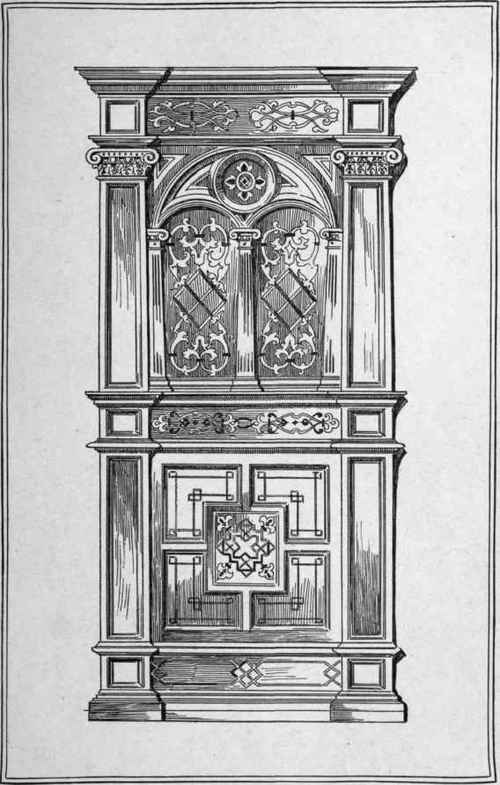
Inlaid Panelling From Sizergh Castle, Drawn To Larger Scale - Reference in Text. See page 35, and Plate 4

Sixteenth-Century English Chairs (Composed principally of turned work) (See above for reference)
As we still pursue our investigation of the cabinet work of this period, the article that calls for our attention next is well worthy of more than passing notice, for it must really be regarded as one of the earliest progenitors of the modern sideboard, though its many descendants, in the course of centuries, passed through numerous changes and assumed many forms before they eventually became the sideboards of to-day. It is the "Court Cupboard," then, that we will now discuss; and in Fig. 4, Plate II., and Fig. 4, Plate III., are represented two exceptionally fine old specimens of this particular piece of furniture.
The "Court Cupboard," both by its form and method of construction, clearly reveals its early origin. We can see at a glance that it was simply an elaboration of the ordinary, old side-table, with a cupboard, or chest, placed upon it. The cabinet maker had evidently considered that primitive arrangement carefully, and, having gleaned his idea from it, proceeded to elaborate. The form of the cupboard was altered somewhat, and it was made a fixture; an ornamental canopy or top was added, and was supported at both ends by the introduction of turned, or square, columns; as a result, yet another piece of furniture, of a type not previously known, took its place in the Elizabethan home.

Sixteenth-Century English Chair (Composed principally of turned work) (See page 29 for reference)
" Elizabethan." VI. Plate 6
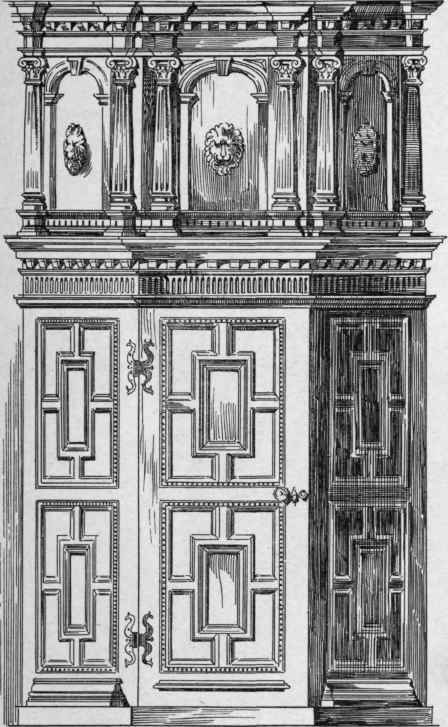
Inlaid Panelling From Sizergh Castle, Drawn To Larger Scale - Reference in Text. See page 35, and Plate 4
Both the examples illustrated, so far as I have been able to discover, are absolutely authentic in every particular. On the one that appears on Plate II., the date is carved to tell us the precise year of its manufacture; but the presence of a date, however deeply cut and antique-looking, must certainly not be accepted without question as a sure guide. This feature has been all too often relied upon by unscrupulous imitators - to employ no stronger term - to serve as "corroborative detail calculated to give artistic verisimilitude to otherwise bald and unconvincing" shams. When, however, it is accompanied, as in the case in point, by certain other unmistakable indications of true age, its presence is heartily to be welcomed.
The cupboard under notice is, of course, of oak, as was all the best furniture of the period; and depends chiefly for its enrichment upon carving and turning, though the two side panels of the upper cupboard and the centre panel of the lower part provide a variation by the introduction of simple inlay. Upon the employment of inlay at the time of which I am writing, I shall have more to say presently.
The pattern in these two panels, and the border - a "chequer" design - above and below, are in ebony or bog oak, which stands out black against the lighter wood of the "ground," while the tulip-like form, with its attendant stems and leaves, in the centre panel of the lower part, is of holly, and is, consequently, lighter than the oak into which it is sunk. The turning in this piece, I need hardly point out, shows that, at the time of its manufacture, a greater refinement and more variety in the shaping of members had come into play in this class of structural enrichment; and special note should be made of the spiral, or "twisted," character of that in the upper part. When once introduced, spiral turning, as it is technically termed, came rapidly into vogue, and was for many years very extensively employed, and with excellent effect, particularly in the manufacture of chairs, as we shall see in the next chapter.
Continue to:


My Books

