


Empire. Part 2
Description
This section is from the book "Style In Furniture", by R. Davis Benn. Also available from Amazon: Style In Furniture.
Empire. Part 2
Was the "Louis-Quinze" or the "Louis-Seize," with suggestions of pastoral pleasures and amorous delights, of any use here! No. Napoleon's views on the question of morality, it must be admitted, were far from narrow; but what he himself indulged in and what he desired others to do were vastly different matters. In his imperial surroundings at all events he would tolerate but little toying with love knots - except the historic one which was destined to be untied - nor would he countenance Cupid's bows; flowers were to be the wreath of the victor, and not to be garlanded about the lute, lyre, and pan-pipes; while as to the timorous Colin and the coy shepherdess, they could not look for a very cordial reception at court. There were some exceptions to this rule, but the rule obtained nevertheless. "Empire" must be writ large in everything, and the task was to find the men who could write it in bold enough characters. They were found of course; and the names of the chief among them were Charles Prrcier, Pierre-Francois-Leonard Fontaine, and Jacques-Louis David. The records of these men completely justified the choice under the special and unique conditions recorded. All three were deeply versed in the history of the old Roman Empire, the completion of a "second edition" of whose glories was ever present in the mind of Napoleon; all had become saturated with the traditions of Classic art in the lands of its birth; while one of them, at least, outvied, if possible, the Consul himself in his detestation of the Bourbons, and no doubt gloated with devilish delight over the day that saw the execution of the Due d'Enghien.
"Empire." I. Plate 82

Reference In Text
Page | ||||
Fig. | 1. | See | 273 | |
" | 2. | " | 274 | |
" | 3. | " | 270, | 276 |
Page | ||||
Fig. | 4. | See | 270, | 276 |
" | 5. | " | 273 | |
" | 6. | " | 275 | |
It is desirable to dwell for a brief space on the careers of these notabilities; for by so doing we shall be able later to account all the more readily for the character of the style which they created, and the study of which is the object we have at present in view.
Charles Percier, even during the reign of Louis the Sixteenth, had attained a fame so great as an architect, and particularly as an exponent of the principles of ancient Roman art, that when, in 1792, just a year prior to that during which the guillotine became the temporary ruler of France, he founded a school of architecture in Paris, students from all parts of the civilised world flocked to him for instruction, and received a training which, in after years, raised them in their turn to positions of eminence in their own lands. Perhaps the best known works of Percier himself are the completion of the Louvre, the Madeleine, and the Bourse, in Paris. This artist, it is interesting to note by the way, was on terms of the most intimate friendship with Canova and our own Flaxman.
Pierre-Francois-Leonard Fontaine (who worked largely in collaboration with Percier, and who became known as the "Father of the Modern French School"), in the year 1785, when quite a young man, in fact when only twenty-three years of age, won the French National Prize for architecture; went to study in Rome at the expense of the Academy; was accorded an extra prize of 3000 francs by the State for his drawings of "The Imperial City in the Time of the Caesars"; and, after his return to his own country, took first rank at the head of his profession, and terminated his career as Architect to King Louis the Eighteenth.
As for Jacques-Louis David, his life was indeed an eventful one. Born in 1748, while Louis the Fifteenth was yet on the throne, he early gave evidence of the possession of artistic talents; and, when he had attained the requisite age, became a pupil of Joseph-Marie Vien, Director of the French Academy at Rome, and afterwards Commander of the Legion of Honour when that order had been instituted by Napoleon. Having completed his studies in Italy, he returned to France, and, like Percier, opened a school, the fame of which attracted many students to its doors. He revisited Italy in 1784, and on his second return was hailed as "The Regenerator of French Art." His admission to the Academy followed, and apartments were accorded to him in the Louvre, together with the title "Painter to the King" (Louis the Sixteenth). When the people of France commenced to gorge themselves with blood, David displayed an insatiable appetite for it; forsook his "appartements" at the Louvre; forgot the favours that had been heaped upon him by royalty; became a member of the National Convention, joined hands with Robespierre, for whom he formed a great personal attachment; and, when the death of the king had been decided upon, was the loudest to clamour for the head of his sovereign, and the foremost to hurl the vilest insults at him upon whom he had previously fawned for favour. When he was deprived of the protection of Robespierre, and was himself brought face to face with "Mademoiselle de Paris," his head was left on his shoulders on account of his genius as an artist; so he hastily abandoned party politics and returned to art, in which he became "Dictator."
Such were the men to whom Napoleon looked for the creation of the art of the First Empire; men who laid the foundation of the "Empire" style, and, further, did much towards the completion of the edifice. Percier and Fontaine were set to work early to restore Malmaison and other palaces, as well as to complete the Louvre and the Tuileries; while, in the direction of the fine arts, the influence of David became supreme, and so far reaching in other paths that even the designing of the official dresses of the court was entrusted to him. Napoleon heaped favours upon his head, created him "Commander of the Legion of Honour," so that he took rank with his erstwhile master; and so inflated did he become with the greatness of his own importance that his conceit was almost intolerable, and fortunate were they deemed who could persuade him to execute commissions for them. A story is told to the effect that the Duke of Wellington visited David's studio on one occasion, and expressed a desire to be painted, but that the artist met the request by turning on his heel with the retort that he did not paint Englishmen! Whether this be true I am not in a position to affirm.
Empire." II. Plate 83
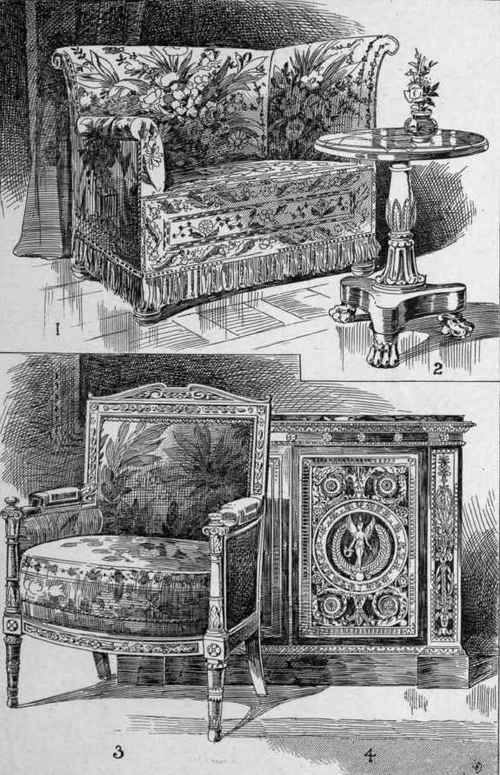
Reference In Text
Page | |||
Fig. | 1 | See | 272 |
" | 2. | " | 274 |
Page | |||
Fig. | 3. | See | 270 |
" | 4. | " | 275 |
The studies of these men had naturally made them masters of the best traditions of ancient Egyptian, Greek, and Roman art, and those traditions furnished exactly the inspiration which they required for the execution of the work they had in hand. Their imperial patron, moreover, had travelled much in the lands of the Caesars and the Pharaohs; had seen and admired many of the incomparable works of their times; and had found in them a material expression of the stupendous greatness of his own imaginings and plans. So there was an open field, a clearly defined programme, and unlimited opportunity for the achievement of great things; and certainly the chapter which was written at this time in the history of the art of the world moves with stately measure.
In considering individual examples of "Empire" furniture, we may note, in the first place, whether, notwithstanding the determination to banish all memories of the "Louis-Seize" and of the preceding styles, any traces of them lingered in the homes of Napoleon. It would indeed have been remarkable had absolutely none remained; some actually did, but they are very slight and few and far between. I will, however, point out one or two. If the general forms of Figs. 3 and 4, Plate I., Fig. 3, Plate II., and Fig. 6, Plate IV., be carefully studied, it will be apparent that, in planning them, the designer had not completely lost sight of the "Louis-Seize" chair, and was not able, try as he might, to keep clear of its lines, but there the resemblance ends. The proportions are different - much heavier generally; the detail is in no way related to that of the preceding style, so the whole structures are endowed with a character entirely different from that which charmed the refined tastes of Marie Antoinette. For an " Empire" chair, that illustrated in Fig. 3, Plate I., is exceptionally light and graceful, and the shaping of the back is somewhat suggestive of the " Greek" curwe so popular amongst French designers of the period; but the massive arm-chair on the same plate (Fig. 4) is dignified enough to support the shade, or the body were it available, of Junius Brutus himself, passing sentence of death on his son Titus - an incident so beloved of Jacques Louis David. Here we have a strong reflection of the ancient Roman splendour, with its overpowering heaviness and confusing wealth of redundant detail. A careful observation of the arms will reveal the presence of the Imperial Eagle - in an embryonic state it is true. The front legs of the chair, I need not say, are "Louis-Seize" clothed in "Empire."
Continue to:


My Books

