


Empire. Part 3
Description
This section is from the book "Style In Furniture", by R. Davis Benn. Also available from Amazon: Style In Furniture.
Empire. Part 3
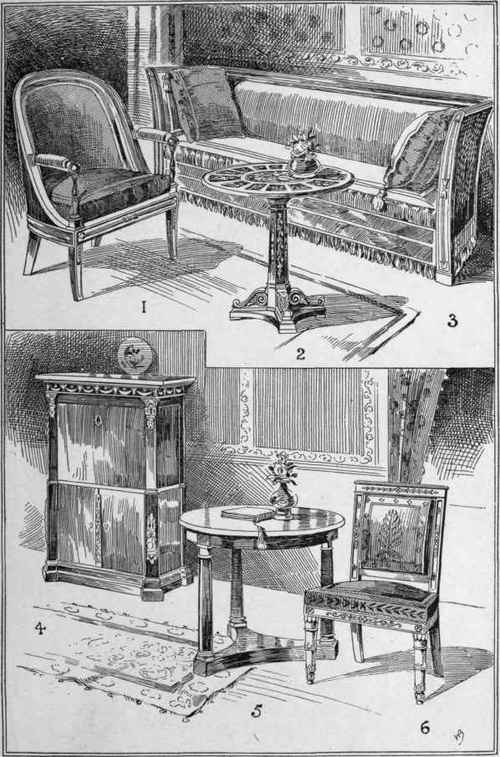
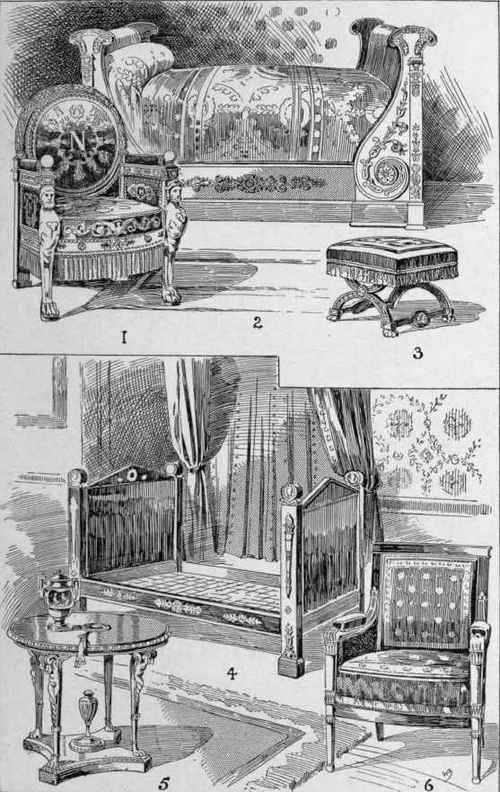
Figure 3, Plate II., as I have already suggested, illustrates another "Louis Seize" frame upon which the "Empire" mantle has fallen; in place of the dainty enrichment of the earlier style, we find the heavier "Roman" acanthus leaf, the "Classic" capital to the front legs, the bay, and the severe "Greek " scrolls surmounting the back. Fig. 6, Plate III., gives a very simple study in "Empire," and is most restrained so far as ornamentation goes, clearly revealing the "Greek" influence. Fig. 6, Plate IV., brings us nearer to the "Louis-Seize," though the turning of the front legs, instead of being diversified by members, presents one unbroken line, and the legs themselves, by their form and treatment, almost convey the idea of flaming torches, irresistibly recalling Nero and the traditional setting for the most famous of his musical performances.
"Empire." III. Plate 84
Reference In Text
Page | |||
Fig. | 1. | See | 273 |
" | 2. | " | 274 |
" | 3. | " | - |
Page | ||||
Fig. | 4. | See | 275 | |
" | 5. | " | 274 | |
" | 6. | " | 270, | 276 |
I have reserved three seats for special consideration. The first of these is portrayed in Fig. 1, Plate IV. Comparatively insignificant as this example of the chair maker's art is in point of size, I employ no figure of speech in saying that it is instinct with stately dignity in every item of form and detail. It well need be, indeed, for such was the sacred throne of the great emperor himself. When in the throne room, this chair was, of course, mounted on a dais, and shadowed by rich and heavy draperies, relieved by martial emblems; but, even when divorced from those stage accessories, it is every inch a seat for a king. The frame, with its chimerical "trusses" or supports, wreath of bay leaves entwined with ribands, and rosettes, or patera, is richly gilt, while the spheres terminating the arms, which were grasped by the hands of the emperor when seated in state, are of the purest crystal, studded with stars. Did not the imperial hand, holding the star-studded sphere, symbolise the insatiable aspirations of the man? Had he conquered this earth itself, would he have been satisfied, or might he not, in very truth, have chafed at the defiance of the terrestrial bodies, the symbols of which were beneath his fingers? Who will venture to say?
But to complete my description of this treasure. The covering is of deep green velvet, if I remember aright - it is many years since I saw it - richly embroidered with gold, the whole of the design of the embroidery being planned so as to frame in the royal initial "N." In front of the seat cushion the Imperial Eagle is "supported" by "Roman" foliated scrolls.
I have remarked upon the comparatively insignificant proportions of this throne; but is it not quite possible that this very insignificance, so far as size is concerned, may be most significant in other respects. It is not at all unreasonable to presume that, being notably small of stature, Napoleon dictated that his throne should be planned in proportion to his own frame; not being himself prepared to submit to even apparent subordination to wood and upholstery, even though that wood might be gilded with refined gold and the upholstery covered in the costliest products of the loom. Small as he was, he preferred to tower above his surroundings rather than to be lost amidst them.
Some writers would have us believe that Napoleon was never known to "take things easily"; but I am in a position to present conclusive proof to the contrary. Endowed with almost superhuman energy, displaying a terrible capacity for work, turning night into day, and all but killing those who served under him by his constant demands upon their physical endurance, there came periods when even he could support the strain no longer, and had to seek bodily repose, though whether his mind ever enjoyed immunity from activity is open to question. But his attitude even when temporarily resting was characteristic of the really restless disposition of the man; when settled down in either chair or sofa, or any other form of seat furnished with arms, over one or the other of those arms one of the imperial legs would be thrown sooner or later, if it was in any way possible to get it there. So strong was this idiosyncrasy with him that a special seat was made - it is said from his own design - to enable him to indulge it to the full, and with the maximum degree of comfort. Whether the story respecting the authorship of the design be founded upon fact or not must be left open to question; but that the seat itself really was used by Napoleon seems to be beyond dispute, and it now occupies a place of honour in the Palace of Fontainebleau, where I made the sketch for the drawing which appears in Fig. 1, Plate II. It is exceptionally sensible and comfortable, providing a model from which the modern upholsterer would do well to take a hint more often when furnishing the club, smoke-room, or "den."
" Empire." IV. Plate 85
Reference In Text
Page | ||||
Fig. | 1. | See | 271, | 276 |
" | 2. | " | 273. | 276 |
" | 3. | " | 273 | |
Page | ||||
Fig. | 4. | See | 273 | |
" | 5. | " | 274 | |
" | 6. | " | 270, | 276 |
Figure 1, Plate III., illustrates another "Empire" type of chair. The origin of its form, though that form is vastly different from the others shown here, is clearly "Classic," for it may be traced without difficulty to the old Roman chariots of the simpler description. Substitute two wheels for the legs and take away the arms, and there is the chariot ready for the horses and the arena.
In Fig. 3, Plate IV., we have a "Roman" form again, based on the ancient curule chairs, upon which the emperors used to take their ease when not reclining, and in which they were sometimes carried abroad. This particular seat is from the Throne Room at Fontainebleau, and its dimensions seem to suggest that, on State occasions at least, all present who were privileged to sit, had to be content with occupying a lower place in every sense of the word than that of the central and predominant figure.
Continue to:


My Books

