


Heppelwhite. Part 5
Description
This section is from the book "Style In Furniture", by R. Davis Benn. Also available from Amazon: Style In Furniture.
Heppelwhite. Part 5
The "pole" fire-screen, now but rarely seen, was just becoming popular at this period, and two examples of Heppelwhite's treatment of it are given in Figs, 1 and 5, Plate III. Screens of this type, says this designer, "may be ornamented variously with maps, Chinese figures, needlework, etc.," and, with regard to their construction, he continues: "The screen is suspended on the pole by means of a spring in the eye through which the pole goes." (We shall see in the next chapter how Sheraton, with his love for mechanics, improved upon this arrangement; as he did upon many of a similar nature.) "The feet of the screen are loaded with lead to secure immunity from sudden upsets."
The wood employed in their manufacture was often mahogany, but generally they were of some softer and less expensive wood, japanned. The "horse" screen, of the type shown in Fig. 11, was also a common accompaniment of the cosy fireside; the framework was invariably of mahogany, the panels being filled with rich silk, needlework, and the like. As to the working of the "horse" screen, the centre part slid in grooves made in the inner sides of the supporting uprights, being suspended by weights attached to it by a line which passed over a pulley in the top of the frame. Figs. 7 and 9 are candle-stands, which, according to this authority, "are very useful in large suites of apartments, as the light may be placed in any part at pleasure - in drawing-rooms, in halls; and on larger staircases. . . ." Their place, I need hardly point out, has now been taken by the metal, telescopic, standard floor lamp, with its tortuosities, spirals, leafage, and rosettes in wrought iron, brass, and copper. The modern article, it must be admitted, serves the purposes for which it is intended satisfactorily enough, and is not infrequently an attractive demonstration of the metal-workers' skill; but, at the best, it is not, in my opinion, so truly decorative nor "home-like" as its wooden ancestor of Heppelwhite's days. But that is a matter of taste, so I need say no more upon the subject. I may, however, remind the reader that it is not uncommon nowadays to find the pillars of old "four-posters" cut-down to serve the purpose at present in view, and admirably they serve it.
"Heppelwhite." I.Plate 43
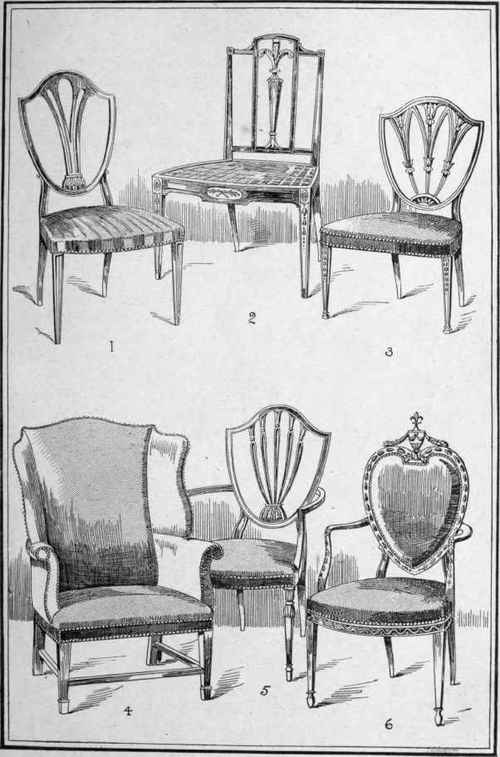
Reference In Text
Page | |||
Fig. | 1. | See | 138 |
" | 2. | " | 140 |
" | 3. | " | 133 |
Page | ||||
Fig. | 4. | See | - | |
" | 5. | " | 138, | 261 |
" | 6. | " | 246 | |
Typical tea caddies, inlaid and painted, are represented in Figs. 14 and 15, and two urn stands in Figs. 12 and 13. Each of the two last has in the top a small slide running in a groove to receive it, and made to draw out in order to furnish a convenient and secure resting-place for the teapot, and, if occasion requires, one or two cups.
Many smaller articles of furniture which were treasured in most English homes in days gone by have disappeared one by one in the course of years, either because the conditions of our daily life have changed and rendered their presence unnecessary, or because they have been supplanted by more modern, and presumably superior, innovations. The disappearance of some is much to be regretted, and none more than that of the old wooden tea caddy of our grandmothers' days. What a pity we no longer have that with us: but the call for it has gone. The all-essential ingredient of "the cup that cheers," far from being regarded as a luxury, as it was not so very many years ago, is nowadays looked upon by poor and rich alike almost in the light of an actual necessary of life. Those who cannot afford a good "leaf" will expend a considerable percentage of their modest incomes on "sweepings" rather than be deprived altogether of their cup of tea. The younger generation, which has always been accustomed to this state of things, knows little of the jealous care with which every leaf and grain of the precious "Pekoe" or "Soochong" was guarded a century ago by the careful housewife, who would have shuddered at the bare idea of any particle being relegated to the care of anyone but herself or the most trusted lieutenant. To keep the tea in the kitchen would have been regarded as a sacrilege, and such an idea was never entertained. On the contrary, it was accorded a place of honour, under lock and key be it noted, in the dining-room, its resting-place generally being the chief position on the top of the sideboard, an article with regard to which I shall have something to say presently.
As we are all aware, the Dutch did not initiate us into the mysteries of tea-making and drinking until the year 1660, and it was not until fully thirty years later that the fragrant beverage became in any way common. For a long period, indeed, its enjoyment was restricted to the few by reason of expense; and even in the days of Heppelwhite it was a costly article. Under these circumstances it was essential to provide a proper receptacle, a worthy "setting," so to speak, for this treasure; hence arose the gracefully shaped and tastefully decorated tea caddy of mahogany and satinwood, painted, and inlaid with all manner of rare veneers.
Continue to:


My Books

