


Heppelwhite. Part 9
Description
This section is from the book "Style In Furniture", by R. Davis Benn. Also available from Amazon: Style In Furniture.
Heppelwhite. Part 9
The bed illustrated on Plate VII. was, in one of its renderings, draped with dove-coloured satin, lined with green silk, and so "dressed-up" must have presented a very gay appearance. Figs. 12, 14, and 15, on the same plate, are designs "suitable for cornices for either beds or windows"; while above, in Figs. 1 to 8, are a girandole, wall mirrors, and three or four brackets. It was in articles of this fancy class that this designer employed most freely the decoration of a finikin, almost "wiry," type, to which I have already referred. They were finished in gilt, and burnished, or coloured in order to accord with the tones predominating in the room for which they were intended. They were telling enough in their way, it is true, and helped to give an effective finish to the complete schemes of furnishing of which they formed a part; but they cannot, in my opinion, be so highly commended as most of Heppelwhite's productions. Their ornamental detail throughout is of a character far more suitable in every respect for execution in marquetry or painting than in pierced carving, their production in which is undesirable. The delicate festoons, swags, scraps of drapery, and foliations would, and do, snap off at the least provocation. But enough has been said on this head.
Having by this time, I hope, succeeded in conveying a fairly adequate idea of Heppelwhite's notions concerning the furnishing of the drawing-room, bedroom, library, and study, I will now turn to the consideration of the dining-room, and here, of course, the sideboard occupies a place of no small importance. It must be understood, however, that the sideboard, in the form most familiar to us, had not come into existence at the time of which I am writing. Fortunately - speaking, of course, from the artistic standpoint - the elaborate conglomeration of shelves, spindles, brackets, and bevelled mirrors, all too well known to us to-day, found no place in the calculations of the eighteenth-century cabinet maker. If he added any superstructure to his "sideboard" proper, he was content with introducing merely a more or less ornate brass railing or gallery at the back and sides, sometimes supporting candelabra, in order to give a "finish" to the woodwork, and to serve as a support for the display of plate. The modern sideboard not infrequently has the appearance of being chiefly an object lesson in the skill of the glass-beveller and silverer; but matters are improving in this direction, and one of the chief reasons for this is the return of the twentieth-century cabinet maker to the study of eighteenth-century models. The sideboard in any form, as distinct from the "side-table," as a matter of fact, was quite a novelty even at the period when Heppelwhite's book appeared. In writing of it that designer states: "The great utility of this piece of furniture has procured it a very general reception, and the convenience it affords renders a dining-room incomplete without a sideboard."
"Heppelwhite." VII. Plate 49
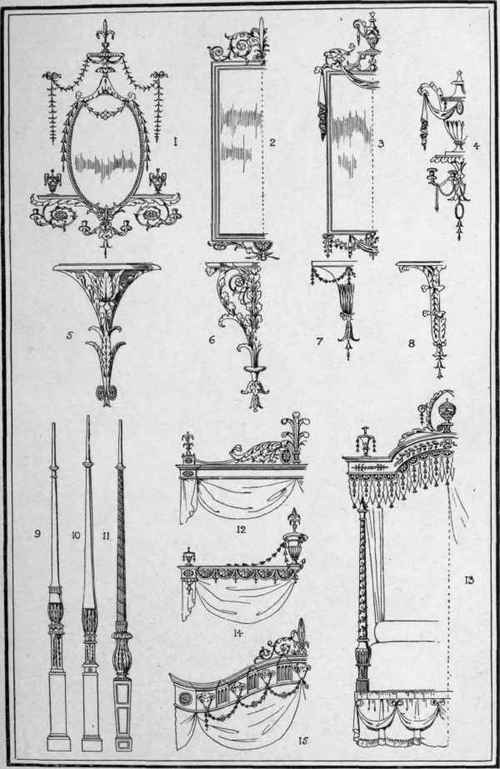
Reference In Text
Page | ||||
Figs, | 1-8 | See | 156 | |
" | 9-11 | " | 155, | 191 |
Page | |||||||
Figs. | 12, | 14, | 15, | See | 156 | ||
" | 13, | " | 155, | 156, | 191 | ||
As will be apparent upon an examination of Plate VIII., the article which Heppelwhite provided to serve the purposes generally associated with the sideboard was most frequently little more than a mere table, of more than ordinarily ornate design, it is true (see Figs. 4, 11, 12, and 13), to place against the wall or in a recess; that is to say, veritably a "side-table" in form as well as in name. In such cases, this table proper was "supported" at each end by a decorative "pedestal" or cupboard (see Fig. 3, Plate VIII.), surmounted by a graceful vase, the various uses of which will be explained presently. One of the two pedestals was nearly always lined with tin, as it was destined to serve the purpose of a plate-warmer, being furnished for that purpose with racks and a heater. The other pedestal was generally set apart for the storage of crockery.
The decorative vases which found a place upon them, says Heppelwhite, "may be used to hold water for the use of the butler, or iced water for drinking, which is enclosed in an inner partition, the ice surrounding it; or may be used as knife-cases, in which case they are made of wood, carved, painted, or inlaid; if used for water they may be made of wood or of copper japanned. The height of the pedestal is the same as the sideboard" (3 feet) "and 16 or 18 inches square; the height of the vase about 2 feet 3 inches."
Figures 1 and 4, Plate VI., represent two of these vase knife-cases; and Figs. 2 and 3 on the same plate two knife-cases of a more common and familiar type. The former, more often than not, were made in satinwood, and the knives were fitted in to the body into baize-covered grooves. When it was desired to remove or replace the knives, the top of the vase was kept-up out of the way by means of a small spring, fitted to the stem in such a manner as to act as secure support. Cases such as those shown in Figs. 2 and 3, Plate VI., were most usually of mahogany, inlaid with satinwood, and sometimes with other veneers of delicate tones of colour. Satinwood itself was sometimes employed for the construction of the main body, as in the vase forms, and afterwards enriched with daintily designed and executed inlay and brush work. Here, once again, we have an article that has been driven out of our homes by modern "improvements"-; but are not our dining-rooms, at least so far as their furnishing is in question, all the poorer by reason of its absence? Which is to be preferred, I would ask - the modern knife-basket or the old "Heppelwhite" vase or case? Can there be two opinions on that point?
Continue to:


My Books

