


Heppelwhite. Part 8
Description
This section is from the book "Style In Furniture", by R. Davis Benn. Also available from Amazon: Style In Furniture.
Heppelwhite. Part 8
In Fig. 2 we have, by way of contrast, one of those handy little corner washstands of a type favoured equally by Heppelwhite and Sheraton (see also Fig. 9, Plate IX., "Sheraton"). Many of these have been preserved to the present day, and for compactness and convenience they are not to be surpassed. And after all, in spite of their extreme simplicity, they are by no means ungraceful.
In Figs. 7 and 8 are two chests of drawers - "dressingdrawers" as they were then termed - a class of article which, says Heppelwhite, "admits of but little variation"; yet the "serpentine" front of the first, the graceful "sweep" of the second, and the shaping of the lower part of the cases of both, impart a distinct charm and individuality to them which at once raises them above the commonplace.
"Heppelwhite." V. Plate 47

Reference In Text
Page | ||||
Fig. | 1. | See | - | |
" | 2. | " | 152 | 194 |
" | 3. | " | 152 | |
Page | |||
Fig. | 4. | See | - |
" | 5. | " | 151 |
" | 6. | " | - |
Page | |||
Fig. | 7. | See | 152 |
" | 8. | " | 152 |
" | 9. | " | 153 |
With Fig. 9 we return to work of a more ornate character. This "commode," as it is styled, is classed in Heppelwhite's book under the heading "Dressing Apparatus," but, in his description of it, the designer states that it is "adapted for the drawing-room," and explains further: "Within are shelves which answer the use of a closet or cupboard. It may have one principal door in front, or one at each end; they are made of various shapes, and being used in the principal rooms require considerable elegance. The panels may be of satinwood, plain or inlaid; the top, and also the border round the front, should be inlaid. The tops of these are frequently inlaid or painted work." It must be obvious, then, that this piece was never intended to play a part in the operations of the toilet, notwithstanding the place it occupies under "Dressing Apparatus."
One of the most sensible and serviceable articles of furniture originated by the cabinet makers of the eighteenth century was, without doubt, the double chest of drawers - the "High Boy," or "Tall Boy," as it was often called. These chests, with their wealth of accommodation for clothes, house linen, and soft goods of every description, always have brought, and always will bring, joy to the heart of the careful housewife; and it is astonishing that they have fallen into disrepute, for they are seldom to be met with nowadays, except in the form of treasured old examples. If any objection is to be urged against their use it is that the upper drawers, by reason of their height from the ground, are somewhat inaccessible; but they may be reserved for the storage of linen and other articles not often required for use, and which, when wanted, might easily be reached by the aid of a pair of steps or a chair. If any doubt as to their desirability in the home be experienced, let the opinion of our women - folk be consulted, and all doubt will be set at rest.
Chippendale was among the first responsible for the perpetuation of the "Tall Boy," and Heppelwhite, following his example, also devoted his attention to its development, as may be seen by reference to Figs. 6 and 8, Plate VI. While providing ample accommodation for the safe storage of household linen, clothes, etc., as already pointed out, they are by no means unattractive pieces of furniture, extremely simple as is their form. They were made of various dimensions, but the height was usually about the same, viz.: - five feet, six inches. Fig. 8, with its fluted pilasters at the angles of the corners, is characterised by greater dignity and sturdiness of appearance than are usually associated with this style, and recalls strongly much of the old "Queen-Anne" woodwork. Mahogany was the wood almost invariably employed in the manufacture of these double chests of drawers, and in the latter part of the century it was often enriched by satinwood "banding" (long thin strips of satinwood inlay).
Figures 5 and 7 show two pedestal cupboards, types which were not quite so commodious, perhaps, as their modern somewhat cumbrous and generally unattractive descendants, but they were certainly lighter in construction and far more graceful. Figs. 9, 10, and 11 illustrate three dainty little inlaid mahogany toilet-glasses, of a kind which usually occupied a place of honour on the top of the "dressing-chest" in the bedroom or dressing-room, and sometimes even in that woman's sanctum sanctorum, the boudoir. Now that the swing looking-glass has become part and parcel of the toilet-table, the need for such delightful little mirrors as those illustrated, with their graceful frames, and delicately inlaid or painted bases, has almost disappeared, consequently the articles themselves, for the most part, also have been banished. True, a few are still made, but they are a mere "drop in the bucket."
Heppelwhite." VI. Plate 48
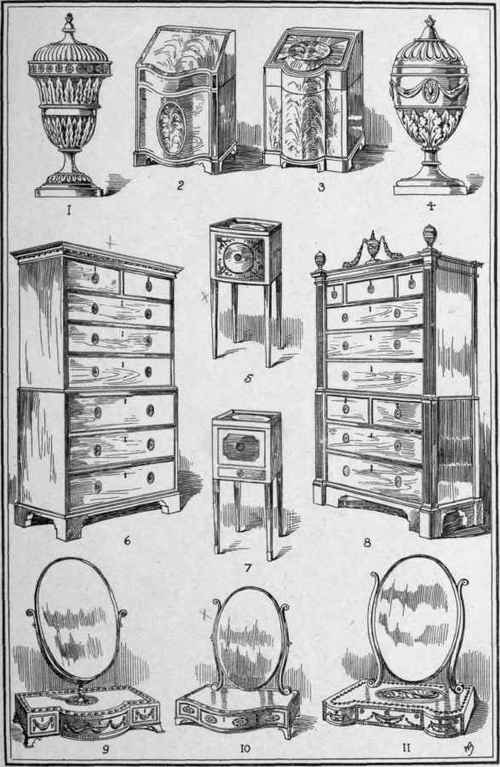
Reference In Text
Page | |||
Figs. | 1-4 | See | 158 |
" | 5-11 | " | 154 |
As a final illustration of bedroom furniture, on Plate VII. is presented a typical example of the "Heppelwhite" "four-poster" bedstead (Fig. 13), together with three characteristic bed-pillars (Figs. 9, 10, and 11). A comparison of these with those designed by Sheraton will furnish demonstration of the fact that, though some similarity exists between the work of the two designers, that of Heppelwhite was far less ornate than that of his contemporary, greater reliance being placed on carefully considered proportion, and the harmonious disposition of the various turned members, than on elaboration of detail. (See bed-pillars, Figs. 5, 6, 7, 8, Plate VII., "Sheraton").
With regard to the draping of his bedsteads, Heppelwhite gives the following advice: "It may be executed of almost any stuff which the loom produces. White dimity, plain or corded, is peculiarly applicable for the furniture, which, with a fringe with a gymp head, produces an effect of elegance and neatness truly agreeable." The designer continues: "The Manchester stuffs have been wrought into bed furniture with good success. Printed cottons and linens are also very suitable, the elegance and variety of patterns of which afford as much scope for taste, elegance, and simplicity as the most lively fancy can wish. In general, the lining to these kinds of furniture is a plain white cotton. To furniture of a dark pattern a green silk lining may be used with good effect." (The word "furniture" as used here by Heppelwhite applies to the hangings. It is an old-fashioned trade term.)
I need hardly point out that there is a considerable difference between the "Chippendale" and the "Heppelwhite" bedstead, the latter being much fighter and more "elegant" in every respect than its forerunner. The top-heavy and over-draped canopy is superseded by a light and graceful structure thoroughly in keeping, both as regards proportion and design, with the rest of the bedstead, and entirely free from that extraordinary medley of French, Chinese, and other nondescript detail which went so far to mar the productions of the preceding period.
Continue to:


My Books

