


Heppelwhite. Part 7
Description
This section is from the book "Style In Furniture", by R. Davis Benn. Also available from Amazon: Style In Furniture.
Heppelwhite. Part 7
Subtle differences, however, in their disposition or arrangement will become apparent if we place side-by-side those belonging to each style respectively, and submit them to a careful and thoroughly comparative examination. To give a broad and general definition, the designs of Heppelwhite's traceries were more angular in character, and consequently less graceful, than those of Sheraton. That this should be the case, is most remarkable, for, as I have already stated, the reverse was the rule in Heppelwhite's chair-backs, and the recollection of that fact is calculated to mislead many when judging his works in which these traceries play a part. But some measure of inconsistency is to be discovered in the work of every genius, and the furniture designer is not exempt from that failing, if indeed a failing it be.
The remaining illustration on Plate IV. (Fig. 2) shows the end of a library, or study, table, on which no particular comment is needed save that we may remark its sturdy and sensible proportions, which were obviously designed for use more than for ornament. Writing-tables of this type were popular from the very first, and their manufacture has never been seriously interrupted since their introduction almost a century-and-a-half ago.
We may now proceed to discover what were Heppelwhite's ideas with respect to the furnishing of the bedroom, and in commencing to deal with these I may say, without further preamble, that they were characterised by far greater simplicity in every way than those which he applied to other rooms of the house. It is well, moreover, that the reader should fully understand that between the fitting-out of the sleeping apartments of a hundred years or more ago, and of those of to-day, there is a vast difference. The complete bedroom suite, as we have become accustomed to it, with separate and distinct toilet-table, washstand, wardrobe, shaving glass, towel-rail, chairs, etc., designed to match one another in every particular, is comparatively a modern innovation, and one altogether unknown in the days of which I am writing. It is quite useless, therefore, to look for it in any of the many design books of that period. Yet it must not be imagined for one moment that this particular chamber was neglected. That certainly was not the case, notwithstanding that its furnishing was, perhaps, somewhat more fragmentary, if I may so describe it, than at the present day. The chief article of importance in the bedroom, next to the bed itself, was the wardrobe, which, in the words of this designer, "is of considerable consequence, as the conveniences experienced in their use make them a necessary piece of furniture." The arrangement of the upper half, or part, of those in common use during the greater portion of the eighteenth century was very different from that with which we are familiar, as they were all invariably fitted with sliding-shelves, or perhaps a better idea will be conveyed if I describe them as very shallow drawers, open at the front, as portrayed in Fig. 5, Plate V. The "hanging cupboard" of our own times appears to have been practically unknown then; consequently, clothes of every description stored within their recesses had to be folded up, and laid flat, instead of being suspended as they now are. Whether the row of hooks or the drawer is the more desirable for the preservation of articles of wearing apparel is, perhaps, a question for our women-folk to decide, as they form the section of the community chiefly interested. If asked for my opinion on the subject, I should feel very greatly disposed to give my vote in favour of the older arrangement. Certain it is that protracted suspension from a hook is enough to ruin the "fit" of many a garment, and all manner of devices - such as patent "coat-hangers," etc., - have been brought out to cope with the difficulty; but none solves the problem more effectually than the old-fashioned drawer or sliding shelf. This, however, is not a question which need be threshed out here.
"Heppelwhite." IV.Plate 46
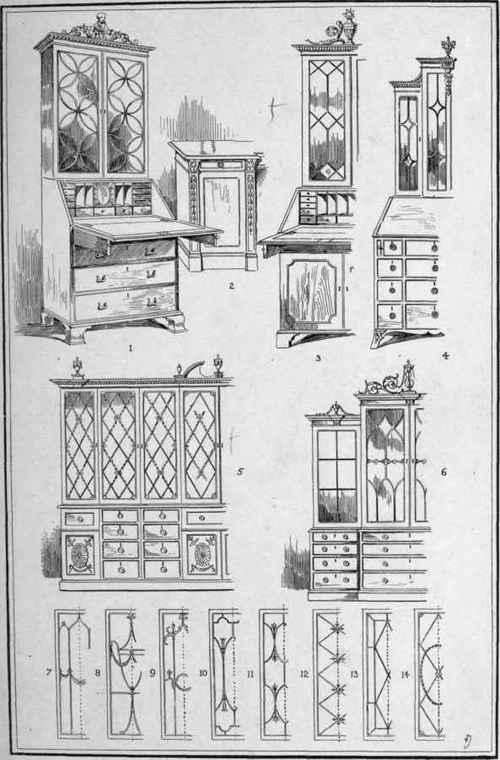
Reference In Text
Page | ||||||
Figs. | 1, | 3. | 4. | 7-14. | See | 148 |
" | 2. | " | 150 | |||
" | 5. | 6. | " | 149 | ||
Figure 3 represents a lady's dressing-table, very similar in arrangement, though not in form, to one that appeared in Sheraton's book (see Fig. 3, Plate VII., in the next chapter), but who was actually responsible for the origination of the idea it is not easy to discover now. The hinged top, which is made in two sections, and encloses the whole of the interior appointments when closed, is so arranged that the two halves can be raised and swung right over, thus doubling the length of the top. This being done, a toilet-glass is revealed, which also is hinged at one end, and is capable of being adjusted to different convenient angles; on each side of this are small boxes for jewellery and accessories requisite to the toilet. The convenience of this piece of furniture, coupled with the small space it occupies, is so great that we cannot but wonder it has not been revived of late years, seeing that economy of space is such an all-important consideration in the planning of our homes. How heartily this little dressing-table would be welcomed in many a so-called "commodious flat"!
Continue to:


My Books

