


Jacobean. Part 8
Description
This section is from the book "Style In Furniture", by R. Davis Benn. Also available from Amazon: Style In Furniture.
Jacobean. Part 8
It is some years now - how many need not be recorded - since a merry little party was settled down in the cosy parlour of a quaint country inn, half farm house and half hostelry, to celebrate a farewell symposium; conviviality was the order of the night. The gathering was in honour of two guests, whose departure was timed for the morrow. On their arrival, some weeks before, they had not met with a very hearty reception at the hands of mine host - a sturdy countryman of the good old-fashioned type, who, on viewing their impedimenta, which consisted of paint-boxes, easels, and other accessories of the palette and brush, eyed them askance as "painter chaps from London." From his point of view they were on a par with "strolling players" or something equally undesirable. A glance at certain credentials from the Lord of the Manor, however, smoothed over these initial difficulties, and there followed days of work amidst delightful scenery, and evenings of good fellowship, with the host beaming and shaking his portly sides at the wit and versatility of his guests; evenings that are even now looked back upon by those who took part in them as having been "right good times." It chanced that one of the artists could sing a rattling good song as well as wield his brush with rare power, and the former accomplishment appealed strongly to our genial Boniface.

Stuart Chair (Now in the possession of Mr. J. Seymour Lucas, R.A.) (See above for reference)
This artist, moreover, had a keen eye for old furniture, and had taken more than a passing fancy to an old Stuart chair that stood in the roomy and comfortable kitchen - the only remaining one of a number, and the particular coign of vantage on which the dog snoozed lazily, and blinked his approval of the evening's harmony. But all attempts to secure that chair had proved vain. Generous offers were made - and refused; equitable exchange was suggested, but the suggestion was always dismissed with a joke; all cajolery proved equally futile. No; the dog had appropriated the chair for years back as his own particular and favourite resting-place; it had become his by right of usage, and was not to go.
The case appeared to be hopeless; but the determination of our ardent young collector was not to be baffled; like Brer Fox, he "lay low" and bided his time. It came at last, and happened on the eventful evening in question. The final libations were mixed, and the host called upon our friend for "Just one more song before we part, lad." But the "lad" was obdurate; possibly he scented an opportunity to gain the desired end. He had gone through his stock more than once; the company knew his songs by heart; he was tired, and "off to bed"; had to be "away early in the morning"; and many other similar excuses were offered.
"Jacobean." XIII. Plate 20
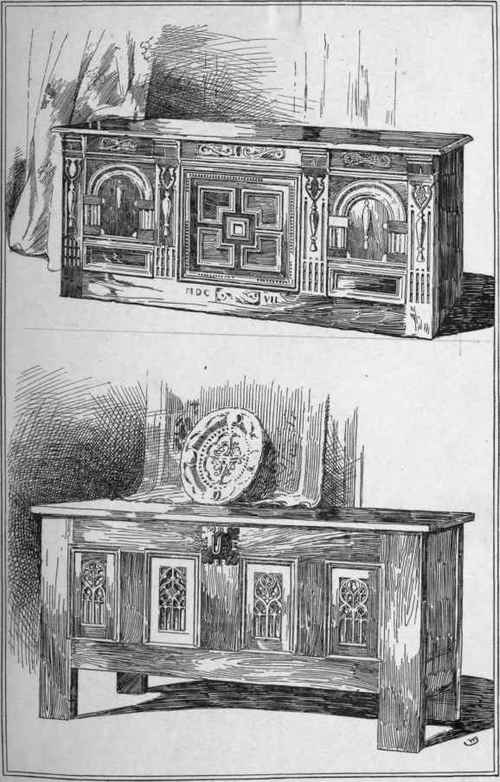
Reference in Text. See pages 66, 67
Persuasion seemed to be of small avail, and all entreaties fell fiat, until, in an unguarded moment, the interests of the dog were forgotten by its owner, and the sacred chair itself was offered as an inducement too strong to be resisted. "Done!" came like a flash, before there was time for retractation; the song was sung, and with an encore. The host got his way, the painter his prize, and on the next day the "find" was carried off to town in triumph.
When I was looking at the very chair a short while ago in the beautiful home at Hampstead where it now finds a resting-place, and where I first marked its lines and listened to the story of its acquisition - of the truth of which there can be no possible doubt - it struck me that few more interesting or picturesquely practical illustrations of the saying, "secured for a song," could be quoted. To complete the story, it only remains for me to add that the young painter was Mr. J. Seymour Lucas, who carried, not a marshal's baton, but an R.A. in his knap-sack; a young painter whom, though not so well known in the days of which we have just been reading, our Royal Academy has since delighted to honour. By so doing it has conferred equal honour upon itself, for his brush has been one of the most powerful among those which have won for modern British painting the laurels which have fallen to its share.
But I must return to the sterner side of our study, and say just a word or two more with regard to the Jacobean chair, before passing on to the discussion of other articles. There is one feature which has not yet been remarked upon, and which, indeed, is generally ignored by most writers who deal with the subject. The feature to which I allude is the height of the seats, which are, in most cases, at a considerably greater distance from the floor than those of the present day. The reason for this is, perhaps, open to discussion; but, when it is remembered that the floors of the rooms in which they originally stood rejoiced in no "Best Brussels," inviting "Axminster," or "Art Squares," but were for the most part of stone, a satisfactory explanation presents itself. The seats, as I have said, were higher than in modern chairs, and the tables, for which these chairs were used, were almost invariably provided with sturdy under-framing, upon which the feet of those sitting at them could rest in comfort and in safety from the "chills" which would arise from contact with the cold stone. That the under-framing was taken advantage of in the way suggested is made perfectly evident by the extent to which it is worn away in the majority of the old tables which survive.
When the occupants of these chairs were not seated at table, it seems beyond question that foot stools were made use of; a large number of those handy little accessories, dating from that time, are still in existence.
However pleasing the "Jacobean" chair may be to the eye - and many of them unquestionably are pleasing - few, if any, of them convey a very strong impression of comfort to the body which aches for repose; on that account, if for no other reason, they would hardly appeal to the modern young couple about to furnish, unless some modification or addition in the direction of comfort were made. Whether the popular impression is right that the race of old was actually made of sterner stuff than their present degenerate descendants, I will not discuss, but, at all events, there seems to have been small call during the earlier part of the seventeenth century for the over-done, puffy, milliner's-shop style of upholstery, with its flounces and furbelows, which constitutes a refuge in many modern homes for tired nature - and dust. Loose cushions were, undoubtedly, employed to palliate the relentlessness of these old seats, and endow them with some measure of comfort, but such additions came as an afterthought, and played no part in the designer's original scheme.
"Jacobean." XIV. Plate 21

Corner From Mr. Robert Sauber's Dining-Room, Showing Jacobean-Chairs, Bread-And-Cheese Cupboard, And Gate-Leg Table - Reference in Text. See pages 66, 67
Continue to:


My Books

