


Sheraton. Part 4
Description
This section is from the book "Style In Furniture", by R. Davis Benn. Also available from Amazon: Style In Furniture.
Sheraton. Part 4
Having in the first place devised what he considered to be a graceful form, which satisfied his hypercritical mind in every particular, and might therefore be depended on to satisfy others less exacting, Sheraton set about to enrich it with such carving, inlay, or painting as he deemed most suitable for the attainment of the object he had in view. The result was almost invariably eminently successful, reflecting the highest credit upon its originator, and exciting the admiration of all possessed of sufficient culture to appreciate such taste and craftsmanship. The consistency with which he adhered to this principle, keeping artistic fitness continually in view, is especially apparent in his chair-backs; but the same rule was brought into force in the designing and construction of the cabinet work which has made his name famous, and the chief characteristics of which we shall take into consideration later.
"Sheraton." II. Plate 53
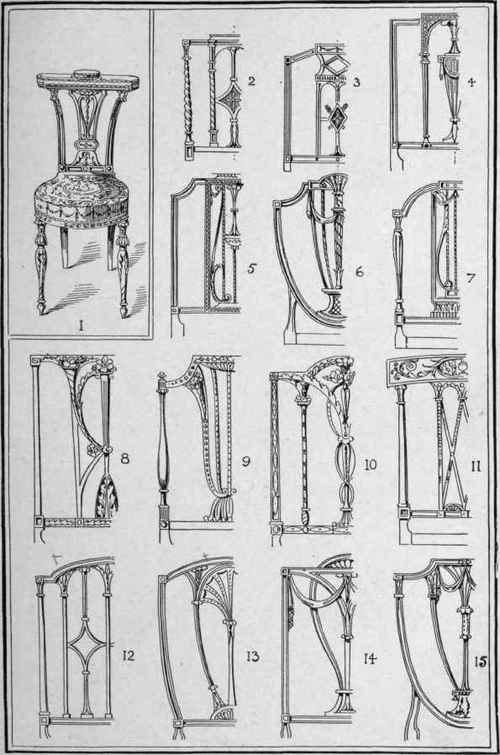
Reference in Text. See pages 141, 170, 171, 173, 262
A glance at Fig. 1, Plate II., and a study of the whole of the decorative detail on Plate III., will aid in giving a still more complete conception of "Sheraton" chair making and upholstery generally. In the first we have a "conversation chair," and with reference to this class Sheraton writes: "These conversation chairs are used in library or drawing-rooms. The parties who converse with each other sit with their legs across the seat, and rest their arms on the top rail, which, for this purpose, is made about 3 1/2 inches wide, stuffed, and covered.
"For the convenience of sitting in the manner just mentioned, the chair is made long between front and back, and very narrow in the back and front in proportion. The height of the chair to the stuffing is 3 feet; at the back 10 inches, spreading out in width to the top rail, which is 20 inches in length. The front is 16 inches, and the height of the seat as common." Here, of course, we have the "Louis-Seize" again; as also in the "triple-back" settee, or "sofa," as it was styled, on Plate III. For the rest, the arms, balusters, and turning shown on the same plate will serve as a capital object lesson in the decorative detail of the style under notice.
Reverting for a moment to the "triple-back " settee, it was the designer's intention that the space between the three main divisions of the back should have "a ground-work covered with silk. . . . Against this ground the two columns and the ornament are supposed to rest."
It has been said, by a competent writer on the subject, that Sheraton "might generally be described as the English designer who adapted to our wants the fancies of the court of Marie Antoinette." A more apt summing-up of a certain, and perhaps the most important, section of his work could not be desired; but taken literally, and by itself, it is calculated to convey but a limited idea of this designer's capabilities.
I will now say a word or two about Sheraton's chairs in which upholstery plays the leading part, as in such examples as those in Figs, 1, 3, and 5, Plate I. In instructions regarding their treatment it is specified that: "These chairs are finished in white-and-gold, or the ornaments may be japanned; but the French finish them in mahogany with gilt mouldings. The figures in the tablets above the front rails are on French printed silk or satin sewed on to the stuffing with borders round them. The seat and back are of the same kind as in the ornamental tablet at the top. The top rail is panelled out, and a small gold bead mitred round, and silk pasted on."
So much for the "Sheraton" chair and sofa. We may now turn our attention to the examination of some of that old master's cabinet work; and in so doing it will be convenient for us to commence with his designs for the furnishing of the dining-room, and see, in the first place, what hand he had in the development of the sideboard in the form in which it was then coming into vogue.
It has been explained, in the preceding chapter, that that article, as we know it to-day, found no place in the design books of the eighteenth-century cabinet maker, and I have ventured to express the opinion that the modern type is not such a very vast improvement when compared with the old, except perhaps in respect to increased accommodation for the accessories of the table. But the sideboard of Sheraton was more commodious than that of Heppelwhite, though very similar in form, as we have seen, and shall see further presently; and it is for us to discover now wherein the difference lay. The former has certain distinguishing features, which may be regarded almost in the light of "hall marks," so to speak.
In the first place, I will recapitulate the fact that Sheraton paid but little attention to the "side-table," which plays so important a part in Heppelwhite's book; and seldom introduced the perfectly straight unbroken front, as Heppelwhite frequently did. In the second place, Sheraton made the corners of his sideboards convex; while Heppelwhite, almost invariably, introduced the concave corner to his designs. By that means, the former considerably enhanced the drawer-space by the difference between the two curves - the concave and the convex. This, as I have said, may be accepted as a practically invariable rule, to which there are few, if any, exceptions.
"Sheraton." III. Plate 54

Reference in Text. Seepages 141, 171, 172, 173-261
As will be seen, too, on Plate IV., Sheraton was hardly pleased with the somewhat bare appearance of the sideboard top, pure and simple, without anything to give a finish to it and lead up to the wall above; he formed the idea, therefore, of adding a superstructure of brass, in many cases somewhat elaborate, from which silk or other curtains could be suspended. This plan was seldom, if ever, adopted by Heppelwhite, who, in the treatment of this piece of furniture, cultivated greater simplicity in every respect, and did not by any means exhibit ingenuity equal to that of Sheraton, a quality which I may state without fear of contradiction he did not possess in any very great degree.
Continue to:


My Books

