


Sheraton. Part 5
Description
This section is from the book "Style In Furniture", by R. Davis Benn. Also available from Amazon: Style In Furniture.
Sheraton. Part 5
As to the form of the superstructure referred to, F'ig. 8, Plate IV., furnishes one example of a type which, says Sheraton, "is used to set large dishes against, and to support a couple of candle or lamp branches in the middle, which, when lighted, give a very brilliant effect to the silver ware. The branches are each of them fixed in one socket, which slides up and down on the same rod to any height, and fixed anywhere by turning a screw. These rods have sometimes returns" (additional rods running at right angles to the back ones) "at each end of the sideboard" (see Fig. 10), "and sometimes they are made straight the whole length of the sideboard" (see Fig. 8), "and have a narrow shelf in the middle" (see Fig. 10 again) "made of fine half-inch mahogany, for the purpose of setting smaller dishes on, and sometimes smaller silver ware."
Proceeding to describe the interior of the sideboard itself, Sheraton says: "The right-hand drawer, as in common, contains the cellarette, which is often made to draw out separate from the rest. It is partitioned, and lined with lead, to hold nine or ten wine bottles" (see Fig. 9).
"The drawer on the left is usually plain, but sometimes divided into two; the back division being lined with baize to hold plates, having a cover hinged to enclose the whole. The front division is lined with lead, so that it may hold water to wash glasses; which may be made to take out or have a plug-hole to let off the dirty water. This left-hand drawer is, however, sometimes made very short to give place to a pot-cupboard behind, which opens by a door at the end of the sideboard. This door is made to hide itself in the end rail as much as possible, both for look and secrecy. For which reason a turn-buckle is not used, but a thumb-spring, which catches at the bottom of the door, and has a communication through the rail, so that by a touch of the finger the door flies open, owing to the existence of a common spring fixed to the rabbet, which the door falls against.
"In spacious dining-rooms the sideboards are often made without drawers of any sort, having simply a rail a little ornamented, and pedestals with vases at each end, which produce a grand effect." Sideboards of this last-named type are described and illustrated in my chapter on "Heppelwhite." Sheraton continues: "There are other sideboards for small dining-rooms, made without either drawers or pedestals; but have generally a wine-cooler to stand under them, hooped with brass, partitioned and lined with lead, for wine bottles, the same as the above-mentioned cellarette drawers."
In reading through the foregoing description we cannot fail to be impressed by the exhaustive thoroughness with which Sheraton went into matters of the most minute detail; and, while striving to produce furniture that would give satisfaction to the eye in every respect, held, at the same time, that considerations of utility were of paramount importance. He recognised that the sideboard had to be looked at, and therefore he rendered it as presentable as possible; but he constantly bore in mind the fact that, after all, its appearance was, strictly speaking, but a minor consideration, so he worked accordingly.
"Sheraton." IV.Plate 55
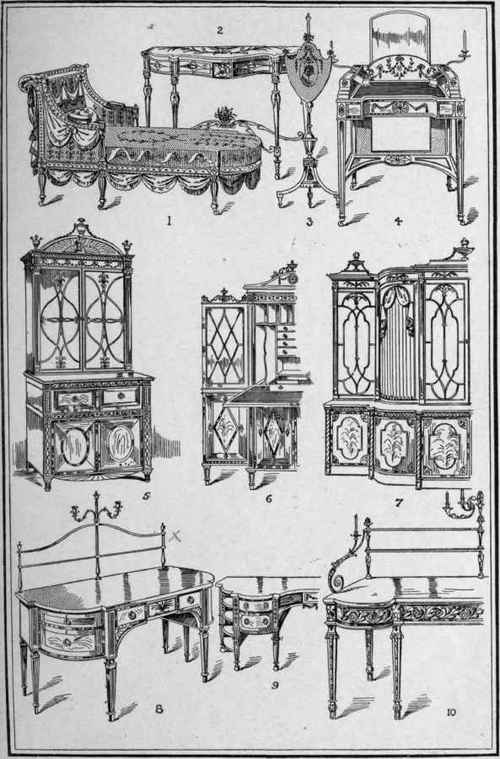
Reference In Text
Page | |||
Fig. | 1. | See | - |
" | 2. | " | - |
" | 3. | " | 189 |
" | 4. | " | 182 |
Page | ||||||
Fig. | 5. | See | 178, | 184, | 186, | 187 |
" | 6. | " | 179, | 184, | 186, | 187 |
" | 7. | " | 179, | 186, | 187 | |
Page | ||||
Fig. | 8. | See | 159. | 175 |
" | 9. | " | 176 | |
II | 10. | " | 175 | |
The reception of the smaller plate, the temporary storage and cooling of wine bottles, baize-lined asylums for the safe keeping of plates, etc., etc., had to be provided for before anything else was thought of; and though, like Heppelwhite, this designer aimed at combining elegance and utility in all his productions, it is impossible, after studying all his works, not to come to the conclusion that he regarded the latter as more indispensable than the former, though neither was by any means, or under any circumstances, neglected.
That he always had the complete effect in view, I need hardly say, and he was particular that it should not be interfered with more than was absolutely necessary even by essential details of construction, as, for example, in arranging the cupboard door "to hide itself in the end as much as possible, both for look and secrecy," and in the substitution of the almost imperceptible thumb-spring for the more apparent and equally effectual turn-buckle. These are small, and, maybe, in the eyes of some people, insignificant points, but in the observation of them reposes the secret of much of Sheraton's greatness. Furthermore, inasmuch as the sideboard often constituted a sort of domestic altar for the display of family plate, it seemed to this designer entitled to have a set illumination of its own, to "bring out" to full advantage the charms of the silver proudly arranged upon it. Hence he provided the brass branches for the reception of candles - as perfect a means of artificial lighting as has yet been found, notwithstanding their disadvantages. These branches were made as decorative as circumstances would permit. And so we might continue to discuss detail after detail, but I imagine that the reader will already have come to the conclusion with regard to these productions that, taking them all in all, anyone who set himself to improve upon genuine "Sheraton," either in regard to general convenience or elegance, would have a hard task. Many have tried, but few have succeeded.
We see, then, that by the time this designer had done with it, the sideboard - as distinct from the older "side-table," with its attendant pedestals and vases, which produced such a "grand effect" - had become firmly established in the British home as an indispensable item in the dining-room, and from that day forward continued to grow in dimensions - though certainly not in grace! - until it assumed proportions altogether and unwarrantably unwieldy.
Continue to:


My Books

