


The Louis-Quinze. Part 3
Description
This section is from the book "Style In Furniture", by R. Davis Benn. Also available from Amazon: Style In Furniture.
The Louis-Quinze. Part 3
Yet withal, in its highest phases, the "Louis-Quinze " is to my mind beautiful, and is endowed with a rare and peculiar fascination possessed by no other style. Appeal to the senses it does, and that most irresistibly; and as the senses have a good deal to say in the temperaments of most mortals, there need be but small wonder that this mode, which was created in their honour, should have flourished "like the green bay tree."
It must be remembered particularly, moreover, that other personalities and forces than those I have named were actively at work. The nature of the dictator whose favour and approval were perforce being courted by those to whose hands the beautification of the royal residences was entrusted, was hardly such as to insist upon the adoption of the strictest code of morality in art or in any other regard. The frivolous Marie-Jeanne Vaubernier, when she was first brought under the notice of Louis the Fifteenth by his valet de chambre, Lebel, and before her title had been conferred upon her, had, although then only in her "teens," gone through varied experiences of a character from which elevation of the mind or tastes could hardly be expected. After the Marchioness du Pompadour, she became all powerful in the kingdom; and her word in everything, from the appointment of a minister to the acquisition of a pet puppy, was supreme. Architects, painters, poets, playwrights, musicians, sculptors, goldsmiths, cabinet makers, upholsterers, decorators, metal workers, and all other disciples of the fine and applied arts, anxious to secure the patronage of the court, submitted their schemes to her, or to officials appointed by her, who would study her preferences in every particular. It was inevitable, therefore, that the art of the period should reflect the tastes of the erstwhile grisette, but then it was the taste of the grisette glorified by the master minds of the age. Truly, in "La Petite Jeanne" diminutive though she was in physical stature, the king encountered a spirit that was neither to be daunted nor thwarted. She intended to have her own way, and had it. In the earliest days of her association with her royal lover, she suddenly came to the conclusion that her little Pavilion at Luciennes ought to be created a Royal Residence. The king laughed at the suggestion, but a Royal Residence it became, and her negro page, Zamore - "something between a monkey and a parrot" - was officially appointed "Governor," with full title, dignities, privileges, and brilliant uniform. There, while urgent affairs of State were awaiting settlement at Versailles, the sovereign would sit, caressed by his fair despot, by the edge of the lake, feeding the royal carp with bread-crumbs, or stuffing the "Governor" with sweetmeats. The presence in office of the Due de Choiseul, prime minister, patron of the arts, and intimate friend of Voltaire, was obnoxious to Jeanne, who protested that he must "go." The king pooh-poohed the suggestion as altogether out of the question. De Choiseul was a great man; had rendered notable service to the State; he was indispensable; the people would be furious. The Countess pouted, and - the prime minister "went." Even the sovereign's influence could not induce any one of the great ladies of the court to act as sponsor at her Presentation to this woman who, in days gone by, had probably helped to make some of their dresses. Presentation, therefore, was of course impossible. Was it? The Countess du Beam, a decayed remnant of the old nobility, who had fallen upon evil times, was unearthed by the determined little body, carried to the capital, and liberally paid to act as sponsor. Jeanne was presented. On the plea of illness the great ladies absented themselves from the function, in order to show their displeasure. "So much the worse," said the king, when informed that they were ill; and the words were uttered in a tone that suggested the unuttered, "for them."
Cannot we picture this imperious little woman, with her "light chestnut hair, skin of white satin, veined with azure; eyes at one moment spirituelle, and at another languishing; a little roseate mouth, with rows of pearls; dimples everywhere, and a figure marked by a certain embonpoint with the pliancy of a snake." Might we not apply the concluding words of that description to many of the furnishing forms by which she loved to surround herself?
"Louis-Quinze." L Plate 71
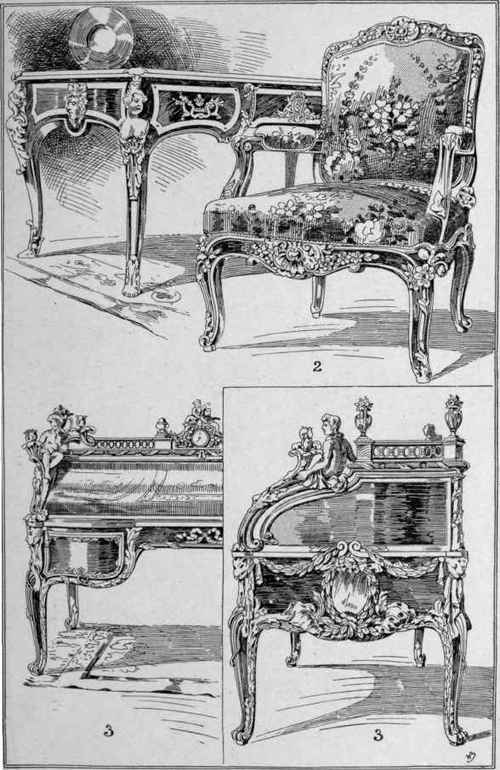
Reference In Text
Page | |||
Fig. | 1 | See | 244 |
" | 2. | " | 245 |
" | 3. | " | 244 |
These reminiscences will serve to remind the reader of the fact that the times were not remarkable for lofty aspirations of earnest endeavour; but in everything the satisfaction of the senses was placed before the cultivation of the intellect, though the intellect was, of course, cultivated in so far as it could be brought to minister to the more carnal appetites. It cannot be urged that the influence of the Comtesse du Barri was in any degree inferior to that of any other of the king's favourites; for his Majesty's choice of companionship throughout was directed by the dictates of his own weak and libidinous disposition. It is remarkable and significant that, whereas the names which stand out most prominently during the preceding reign as those of men of colossal genius are the names of those who were employing their powers for the glorification of the monarchy, under Louis the Fifteenth the giant intellects seem to have been intent upon its demolition. Francois-Marie Arouet de Voltaire had, for instance, more than once full opportunity of judging from personal experience the efficiency of the system adopted in the Bastille for the repression of treason; and saw his works publicly burned by the decree of Parliament. "Jean-Jacques," instead of singing the praises of the Bourbons and writing triumphal marches in their honour, was busily engaged upon his "Contrat Social." Marat was fanning the flames of the revolutionary spirit with all the energy with which nature had endowed his strangely warped intellect, and Joseph-Ignatius Guillotin, M.D., was perfecting his gruesome working drawings, and testing his weights and levers. So I might continue, with reminiscence after reminiscence, but enough has been written to refresh the memory of the reader with regard to the influences at work when the furnishings were produced which we are now considering.
Continue to:


My Books

