


The Louis-Quinze. Part 4
Description
This section is from the book "Style In Furniture", by R. Davis Benn. Also available from Amazon: Style In Furniture.
The Louis-Quinze. Part 4
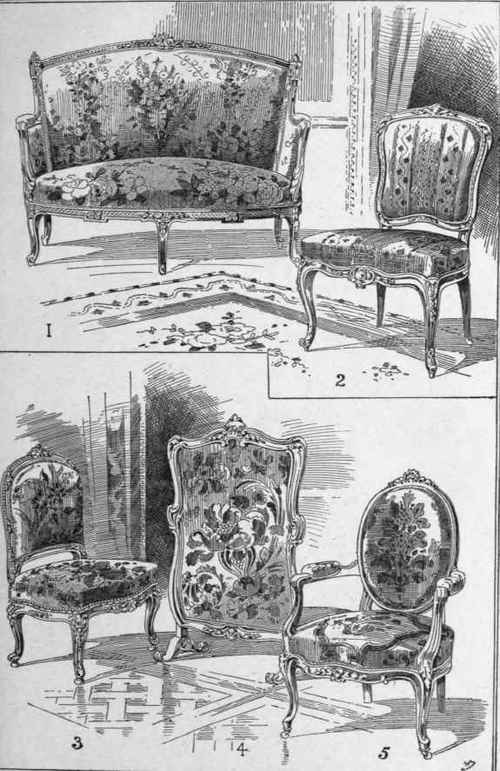
Let us see, then, in what particular directions the character of French furniture became metamorphosed under these prevailing conditions. A glance at the whole of the examples illustrated in this chapter will fully justify my assertion to the effect that the reign of the straight line had terminated for a time and had been supplanted by that of the curvilinear; and an examination of the pieces in detail will bear out many more of my contentions put forward in this and the preceding chapter. The most important example perhaps of all those presented is the writing-table, indicated in Fig. 3, Plate I., which is known and treasured in the Louvre as "Le Bureau du Rot," and was designed and made for Louis the Fifteenth by Boulle's pupil Oeben, in collaboration with his own favourite apprentice Riesener. (Riesener, in after years, married his master's widow, succeeded to the business, and became very wealthy; though he, again, like Boulle, died practically in a state of penury.) The form of this piece, although free in comparison with those of earlier times, exhibits that comparative restraint which characterised the earlier "Louis-Quinze," and the grace which it undeniably possesses is not unmixed with dignity. Regarded from the technical standpoint, as a piece of cabinet work it is as near perfection as possible, while the ormolu mounts are simply superb. As we are considering this "Louis-Quinze" furniture more particularly with a view of ascertaining how far the English designers and craftsmen of the eighteenth century were indebted to it for inspiration, I may point out here that the "cylinder top" was not generally employed in this country in articles of this kind until the time of Heppel-white and Sheraton, and it is not unreasonable to surmise that they borrowed that idea, as they did many others, from this style. In the table, Fig. 1, Plate L, we have a model similar in feeling, but rather more free in character than "Le Bureau du Roi," and closely resembling one illustrated in the preceding chapter. This study furnishes a capital demonstration of the employment of the coquettish female head, a feature already referred to; also of the prominence given to the bust. The whole, indeed, is suggestive of the "certain embonpoint" and "pliancy of the snake." But as time went on, the curves became more and more accentuated, and graceful shaping, whose very subtlety was its great charm, gave way to more pronounced and somewhat vulgar emphasis, and a superabundance of meaningless elaboration - as in the pier-table, Fig. 5, Plate III. (with which may be compared Fig. 4, Plate VIII., and the table on Plate IX., "Chippendale "), and the pier-table, Fig. 4, Plate IV., which, however, is not quite so extravagant an example. Keeping Fig. 5, Plate III., in mind, the reader may well turn to the chapter on "Chippendale," and note the corners of the lower part of the larger press or wardrobe, Plate I.; the legs of the chairs, Plate III.; the chair-legs and screen, Plate IV.; the lower secretaire, Plate V.; the lower arm-chair, Plate IX.; and other pieces dotted about here and there which it is not needful to particularise, for the nearness of the relationship is too apparent to need emphasising. This is particularly noticeable when we examine the chairs shown on the accompanying plates. The legs, in many cases, are almost identical, and as the French models were earlier in the field, there can be no question as to the source from which Chippendale secured his inspiration. All the chairs illustrated here are perfectly typical "Louis-Quinze," though the sofa, or settee, Fig. 1, Plate II., is a late example, almost verging upon the "Louis-Seize." Figs. 1 and 2, Plate III., are more or less modern renderings. The frames of "Louis-Quinze" chairs were almost invariably gilded in every part, or painted in the most delicate tones of white, cream, blue, or green, and touched up with gold; the colouring, where colour was employed, being of so light a shade as to be hardly distinguishable. The coverings were of figured silk, chiefly from Lyons; brocades, choice embroideries, or tapestries from Gobelins, Beauvais, or Au-busson. The designs woven into these latter were usually free and floral in character, as in Fig. 2, Plate I.; Figs. 1, 3, and 5, Plate II.; Figs. 1 and 3, Plate III.; and Figs. 1 and 3, Plate IV.; though the "stripe" was also popular, as in Fig. 2, Plate II., and Fig. 4, Plate III.
Louis-Quinze." II. Plate 72
Reference In Text
Page | ||||
Figs. | 1. | 3-5. | See | 245 |
" | 2. | " | 246 | |
In a previous chapter I have said that Heppelwhite and Sheraton were not influenced to any very great extent by the "Louis-Quinze"; but that they were amenable to its fascination now and again may be gathered by another look at some of the chair and sofa arms employed by them, and by a glance at the arms which predominate in the accompanying examples. The reader may also refresh his memory on the question of the relationship between the three styles - "Louis-Quinze," "Heppelwhite," and "Sheraton" - by again referring to the chapter on "Heppelwhite," and noting the chair-back, Fig. 6, Plate I., Fig. 9, Plate II.; the pier-table, Fig. 10, Plate III.; the stool, Fig. 2, and the sofa, Fig. 7, Plate VIII.; and the dressing-chest on Plate IX. Sheraton was, to all intents and purposes, guiltless in this respect, though by no means in others, as we have already noted, and shall note again.
Continue to:


My Books

