


Chapter I. How A House Is Built
Description
This section is from the book "The Care Of A House", by T. M. Clark. Also available from Amazon: The Care Of A House.
Chapter I. How A House Is Built
Notwithstanding all that is said about the preference of Americans for hotel life, and the multiplication of apartment-houses, flats, family hotels, and other contrivances for leaving a portion of the housekeeping troubles to the janitor, the disposition toward independent home life increases in this country every day. There are few tenants of apartment-houses who do not look forward to the time when they can have a home of their own; and those who possess that blessing, however much they may repine at the anxieties attending it, are seldom contented to give it up permanently. It may be assumed, therefore, that the independent dwelling is likely to continue to be favored by the great majority of American families; and, in view of the complexity of modern houses, it seems as if something might be done to lighten the burden of those who have the care of them by a simple explanation of their construction, and of the principles of operation of their different working portions. Nothing is more trying to the nerves than to have to deal with troubles, the source of which is unknown; and a very moderate knowledge of the general construction of a house, and of the elements of heating and plumbing apparatus, would relieve many a housekeeper from hours of exhausting worry, to say nothing of the saving of money which might often be made through the indication which such knowledge would afford of the source of any of the numerous troubles to which houses are subject, and of the nature of the remedy which should be applied.
Most houses in North America are built of wood, the walls consisting of a frame of studs, or light timbers, set, usually, sixteen inches apart from centre to centre, and covered on the outside with rough boards, which, in their turn, are covered with clapboards, or, sometimes, with shingles. On the inside of the studding laths are nailed, and covered with plaster; and the interior partitions are made with similar studding, covered on both sides with laths and plaster (Fig. 1).
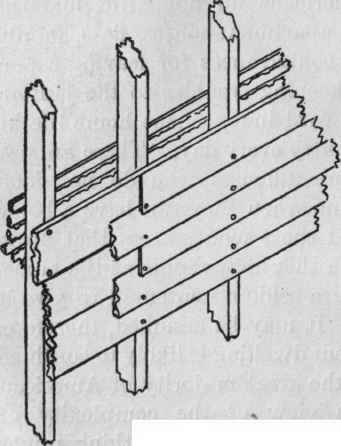
Fig. 1.
The studs of the outside walls stand on a heavy timber, called a sill, which rests on the top of the cellar wall, or, where there is no cellar, on an underpinning of stone or brick, or on stone or brick piers, or on wooden posts; and at the top of the walls is a "plate," or horizontal piece, on which rest the lower ends of the "rafters," or roof timbers. The rafters are usually spaced from twenty to twenty-four inches apart, and are covered with boards, and these with shingles. The studs of the main interior partitions in the first story usually stand on "girders," or heavy timbers, set either level with the beams of the first floor, or just below them, and supported by brick piers in the cellar. The studs of inferior partitions, which carry little or no weight, and of partitions in upper stories, are set on the floors, and openings are framed in both outside and inside studding for doors and windows. The floors are formed with beams, or planks set on edge, usually from eight to ten inches deep, and two or three inches thick, set most commonly sixteen inches apart, from centre to centre, and resting on the sills, girders, and main studding of the house. The floor-boards are nailed on top of the beams, and the under side is usually prepared for plastering by nailing on "furring strips," these being long strips of wood, two inches wide, and seven-eighths of an inch thick, put on twelve inches apart. The laths are nailed to these furring strips, and the plaster is spread on the laths. It is obvious that the floor-beams, laid in parallel lines, and covered with boards above, and with a sheet of plastering underneath, will form a succession of hollow spaces (Fig. 2) of the same depth as the beams, and thirteen or fourteen inches wide; and these spaces are utilized by builders for con-taining hot-air pipes from furnaces, plumbers' pipes, gas-pipes, and electric wires. It is, therefore, often important, in tracing a leak, or on other occasions, to know the direction in which the floor - beams run. This can generally be ascertained by observing the direction of the floor-boards, which usually, although not always, run at right angles to the beams, as shown in Figure 2.' Where there is any doubt on this subject, further evidence may be derived from observation of the ceiling beneath. Most ceilings, particularly over a chandelier, or steam radiator, or register, become slightly discolored by smoke and dust. As plastering is very porous, air, impregnated with these impurities, passes easily through it, and the impurities are filtered out, staining the plaster. As the air cannot penetrate the laths, transmission takes place mostly between them, so that the spaces between the laths are marked on the ceiling by a narrow dark line, the plastering just over the laths remaining white. The furring strips, to which the laths are nailed, appear as broader streaks of white at right angles to those indicating the laths; and, as the furring strips must be nailed at right angles with the beams, the laths will be parallel with the beams, and the direction of the latter will thus be shown. In very cheap houses there are sometimes no furring strips, and the strips are often omitted on basement ceilings. In this case the laths will run at right angles with the beams, instead of being parallel with them; but the two cases can usually be distinguished by measuring the distance between the wider white streaks which indicate furring strips or beams. If the streaks are twelve inches apart from centre to centre, they show, in all probability, furring strips, and the laths run parallel with the beams; if they are sixteen inches or more from centre to centre, they probably indicate beams, and in this case the laths run transversely to them. The direction of the floor-boards will confirm these indications, which are often of great importance.
Continue to:


My Books

