


Materials Of Which Concrete Is Composed
Description
This section is from the book "Practical Concrete Work for the School and Home", by H. Colin Campbell. Also available from Amazon: Practical concrete work for the school and home.
Materials Of Which Concrete Is Composed
Portland Cement
First let us consider the materials of which concrete is composed. There are a number of kinds of cements or cementing materials, but in present-day reference to concrete work, usually portland cement only is considered. Portland cement is a manufactured product and was so named because of a resemblance in color which the first manufactured cement had to a stone quarried near Portland, England.
Portland cement will harden under or in the presence of water-in fact water is necessary to the proper hardening of portland cement, hence of concrete, because the cement is the active ingredient of concrete; that is, the cement is the binder or binding material which unites the sand and pebbles, or broken stone, into what eventually becomes solid stone.
Manufacture Of Portland Cement
The manufacture of portland cement is a scientific process. Briefly, portland cement is made by mixing definite proportions of limy and clayey materials and subjecting them to heat that almost causes them to melt-in other words, converts them into sort of a clinker or slag. After the materials have been kept at a degree of heat for a time sufficient to convert them into this clinker, the clinker is ground until it is reduced to a flourlike powder. This is portland cement.
In describing the fineness of grinding which portland cement must have to meet building construction requirements, it is customary to state the percentage of the powder which must pass through sieves having a certain number of meshes per square inch. Just before the process of manufacturing portland cement is considered complete, there is usually added to it and thoroughly mixed with it, a small quantity of some material (usually gypsum) to regulate the setting or hardening time.
To summarize the details of manufacturing portland cement, we might divide this process into five steps:
(1) Mining and quarrying the raw materials.
(2) Drying and grinding.
(3) Proportioning and mixing.
(4) Burning the mixed materials to a clinker.
(5) Grinding this clinker to an extremely fine powder and adding the proper quantity of some such material as gypsum, to control the setting or hardening of the cement when mixed with water.

Concrete sand boxes for the children to play in. Every home where there are children, and every school playground, should have one or more of these. When the children grow up, the boxes can be used for flower beds.
This summary of the steps of manufacture applies to that process known as the "dry" process. Cement is also manufactured after what are known as "wet" and "semiwet" processes. However, these details of manufacture are of no consequence to the student and will not be discussed.
Portland Cement A Product Of High Quality
Many persons think that when they have been unsuccessful with some attempt at concrete work, the cement was to blame. It is well to remember that portland cement is a manufactured product and that its composition and qualities can be exactly-controlled. If properly stored, portland cement is not susceptible to any great amount of change. Its quality is altered only by allowing it to be exposed to moisture. Moisture will ruin cement if it comes in contact with it before used in a concrete mixture. Portland cement is purposely made so that it will be acted upon by water in a manner to cause it to harden. This action, which takes place between the cement and water, is sort of a chemical one, and is usually described as "hydration." It is a process of crystallization. This is the change which produces the "set" or hardening of cement, or the hardening of concrete due to the set of the cement.

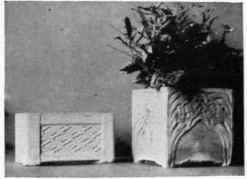
Two widely different types of flower boxes. To the right are simple small ones, while at the left is a large ornamental one used for window or balcony ornament.
Therefore in selecting portland cement to be used for making concrete, one can readily dismiss from his mind all thoughts as to the quality of the cement if he is careful to purchase any of the well-known brands and to purchase from a dealer who has good means for storing the cement so that it is protected from moisture. If when opening the sack and thrusting one's hand into it there are no lumps which cannot be broken by light pressure between the fingers, it is safe to say that the cement is in good condition. Lumps which cannot readily be broken in this way are probably due to the cement having absorbed moisture, which has caused the chemical changes leading to hardening. Such cement has lost most of its binding properties, therefore should not be used. Cement should therefore be stored in a tight, dry shed, never be piled on the ground but on a dry floor far enough above ground so dampness cannot be absorbed.
Continue to:


My Books

