


Walks, Floors And Pavements
Description
This section is from the book "Practical Concrete Work for the School and Home", by H. Colin Campbell. Also available from Amazon: Practical concrete work for the school and home.
Walks, Floors And Pavements
Walks, pavements and floors are similar classes of concrete work. Most of the principles that apply to one apply to the others. Concrete walks and other pavements should be laid on firm, well drained soil. The area where they are to be laid should be free from all vegetable matter. Grass and tree roots should be dug out and the soil firmly compacted by using a heavy tamper or roller. If the soil is one that holds water, that is, that does not drain quickly or readily after rains, then a tile line should be laid parallel with the walk, this drain being connected at intervals to some lower point that will serve as an outlet and lead water away from the soil under and surrounding the walk.

Forms for concrete sidewalk construction. The cinder or gravel subbase should be omitted except where the soil is of a kind that does not drain readily.
Foundation Or Subbase
In rare cases it may be necessary to provide a foundation for a concrete walk, pavement or floor by digging out the old soil and filling in from 8 to 10 inches with clean gravel or cinders. But this fill should not be used if it can be avoided. When necessary, however, such filling should be well compacted and connected with tile drains at suitable intervals so that water will not remain under the concrete. If water were allowed to collect there, its freezing would cause upheaval of the walk due to expansion.
Size Of Slabs
For ordinary sidewalks, slabs should never be larger than 10 feet in any one dimension and preferably have a surface area no greater than 36 square feet. If larger it is best to embed suitable reinforcing in the concrete to prevent cracking of the slabs from frost upheaval. Ordinary walks should be at least 5 inches thick. If they are ever to be used as driveways, then they should be at least 6 inches thick.

Method of setting forms to be used in building a concrete floor such as a hog feeding floor or barnyard pavement. These forms are so staked in position that alternate slabs can be concreted first, then forms removed so that the concrete previously placed serves in part as a form for placing the remaining slabs.
Types Of Construction
Walks, floors and pavements may be of one-course or two-course construction. For most work, one-course construction will be found best. One-course construction means that the same mixture of concrete is placed at one operation to the required thickness of the walk, pavement or floor. Two-course construction means that a mixture leaner in cement, that is, having less cement to each definitely proportioned batch, is used as a base and on top of this a richer top or wearing course is placed. (See Table of Recommended Mixtures.) In two-course work it is very important that the top coat or wearing course be placed immediately after the base concrete is placed, otherwise the two courses will not bond or adhere to each other. For that reason, one-course construction is preferable.
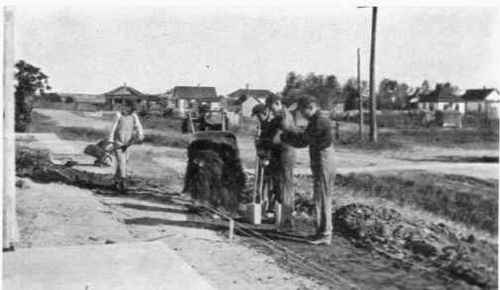
Tamping subbase for sidewalk foundation.

Setting up and staking forms to proper grade and line for a concrete sidewalk.

Tamping concrete for the base of a concrete sidewalk.

Using strikeboard to level concrete of the base for a sidewalk.

Placing and striking off the top or wearing course of a concrete sidewalk.

Smoothing up the surface a little with a steel trowel. Too much troweling will make the surface slippery. A wood float finish is better.
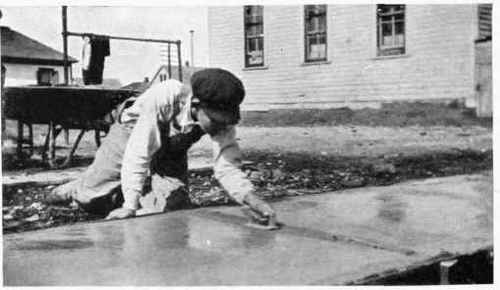
Using a jointer to properly finish the joint between adjoining slabs.

Finishing edge of the walk with an edger.
Finishing Methods
In the past it was common practice to finish concrete walks and pavements to a very smooth surface. This proved objectionable from a number of standpoints, principal among which was the one that such a surface was slippery at times to walk upon; also, the wearing surface was made less durable because excessive troweling with a steel trowel brings considerable cement to the surface. Common practice now is to finish walks, floors and pavements with a wood hand float which, while giving an even surface, gives one that has a slightly gritty texture and thus affords a good foothold.
Continue to:


My Books

