


Concreting Tools And Equipment. Continued
Description
This section is from the book "Practical Concrete Work for the School and Home", by H. Colin Campbell. Also available from Amazon: Practical concrete work for the school and home.
Concreting Tools And Equipment. Continued
Water Barrel, Pails And Hose
A water barrel and pails or a hose are necessary to add the required amount of water to the correctly measured materials.
Wheelbarrow
For transferring concrete from the mixer or mixing platform to the place of final use, a wheelbarrow may be needed. One with a sheet iron body should be used having the front of the body higher than the back, to prevent loss of concrete when the barrow handles are raised in position for wheeling.
Tamper
When placing concrete in the forms, it must be spaded or tamped, depending upon the quantity of water used in the mixture (recommended consistencies for mixtures will be described later). A tamper may be home made by boring a l 1/2-inch hole in the end of an 8 by 8 by 12-inch piece of timber and inserting a handle about 4 feet long in the hole. Metal tampers 6 to 8 inches square may also be used. Several commercial kinds are obtainable.
Spading Tools
A spading tool of some kind is necessary when placing concrete of a certain consistency to properly settle the material in the forms and also to secure a surface finish free from pebble pockets. Such a spading tool may be made by flattening an ordinary garden spade and cutting out portions of the metal so that it is slotted, or by straightening out an old garden hoe. Both tools are used by working them up and down in the concrete close to form faces so as to force back coarse particles and thus cause the sand-cement mortar to come to the form face.
Sometimes a chisel-edged board 4 to 6 inches wide may be used for spading concrete, the upper end being properly shaped to form a convenient handle. In other cases, especially where reinforcing metal is placed in the concrete, smaller spading tools will be needed to work in the smaller space or between sections in which the concrete is placed. Pointed sticks, steel rods, or narrow chisel-edged pieces of wood are used for this purpose.
Strikeboard
A strikeboard is merely a piece of 1 1/2 or 2-inch lumber 4 inches or more wide and long enough to rest across the top of the forms, as in sidewalk construction, so that the top of the concrete can be approximately leveled before final finishing.
Wood Float
A wood float is used to finish the surface of the concrete after struck off, as in building walks, pavements and floors. This is a simple tool and can be made by anyone.
Steel Trowel
A steel hand float or trowel may sometimes be required where a smoother surface is desired than can be obtained by using the wood float. However, care should be taken not to trowel a surface too much with a steel trowel, as such practice brings an excess of cement to the surface and makes it less durable. A steel troweled surface is also likely to be slippery and not provide as secure a foothold as the wood floated surface.
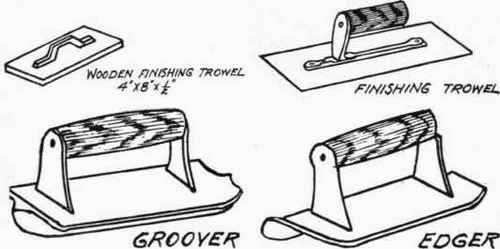
Several common concrete finishing tools.
Groover And Edger
For finishing joints between slabs in walk, floor and similar concrete pavement work, a tool known as a groover is used, while for finishing the edges of the slabs the tool used is known as an edger.
Power Mixer
The foregoing are the principal tools required for the average run of concrete work. When any considerable quantity of concrete is to be mixed, mixing may be done more thoroughly and economically by using a power-operated mixer. Power-operated mixers should be of the batch type, that is, a machine in which all of the materials for a batch of concrete are measured and placed in the drum or cylinder of the machine at once and mixed as a batch instead of as a continuous, uninterrupted operation. In this way all batches of concrete are uniform in proportions and consistency. Many types and sizes of power-operated concrete mixers are on the market. Several manufacturers of concrete mixers make machines that are relatively cheap and at the same time very efficient.

A concrete fountain makes an attractive and permanent fixture for the home grounds. Designs elsewhere in this book show form construction for such ornaments.
Continue to:


My Books

