


Principles Of Reinforcing
Description
This section is from the book "Practical Concrete Work for the School and Home", by H. Colin Campbell. Also available from Amazon: Practical concrete work for the school and home.
Principles Of Reinforcing
Reason For Reinforcing Concrete
When concrete was first employed as a building material its use was confined principally to plain, massive work such as footings and foundations, in just the same way as stone masonry is used. Concrete is very strong when used in mass work where the load is placed immediately upon it, that is, where the load is one of compression; but like most building stones, concrete is relatively weak in tension, that is, in resisting strains or loads that tend to bend it or pull it apart. This fact was known long ago and resulted in attempts being made in the latter fifties or early sixties to give concrete added strength in tension by embedding in it some kind of metal. Placing metal in concrete in this way for the purpose mentioned is called reinforcing the concrete. Reinforced concrete permits more economical use of concrete and at the same time is considerably stronger than plain concrete, that is, concrete without any reinforcing metal in it.
The strength of concrete in compression is about ten times that of its strength in tension. The full tensile strength which concrete possesses is taken advantage of by properly reinforcing it.
Not every kind of metal or material will do for reinforcement in concrete. Usually some kind of steel is specified, that is, one having a certain chemical composition and other properties. The steel, if properly embedded in concrete of correct proportions and consistency, so that everywhere the concrete will bond or adhere perfectly to the metal, takes the pulling and bending strains because the adhesion between the concrete and the steel prevents the steel from slipping. These facts make it possible to use concrete in many ways that would be impracticable were it not reinforced. Therefore we may define reinforced concrete as a combination of concrete and metal (preferably steel of certain quality), the metal being so placed as regards position and quantity that the concrete and the metal both take and resist the strains which they can best withstand.
Practical Illustration Of The Principles Of Reinforcing
It is not practicable in the limited space of this section to go into the technical details of reinforcing concrete, because the subject of concrete design is one that requires considerable knowledge of advanced mathematics and its application to structural design. The descriptions of most of the designs illustrated later in this book include recommendations as to proper reinforcing of the object.
Two or three simple examples will help the reader to understand the principles of reinforced concrete.
An accompanying figure is intended to illustrate a beam made of two pieces connected by a hinge. In the top of the hinged joint is supposed to be a block of rubber; at the bottom is a coiled spring. When a load is placed on top of the beam it will, of course, bend at the hinged joint. One can readily see that supported as it is at the two ends, this bending tends to close the gap at the top where the piece of rubber is inserted and to make the gap at the bottom widen where the coiled spring is inserted-in other words, the rubber will be compressed while the spring will be stretched. At the same time the spring will receive a pulling strain and will have a tendency to resist the bending. Now if instead of being broken and hinged as shown, the beam were made solid, and ii instead of the coiled spring a steel rod were embedded in the concrete, say, 1/2 inch or more from the lower face of the beam, the adhesion between the concrete and the steel would compel the steel to resist the tendency toward bending-in other words, would take up the tensile strain which is exerted by the load, whatever it may be, that is placed upon the beam.
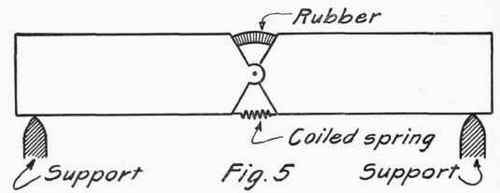
Sketch illustrating the action of a load on a concrete beam supported at each end.
Another example is given in another illustration, which also shows the manner in which bending strains on a concrete beam act and may be resisted. At (a) there are supposed to be illustrated several planks or boards laid one on top of the other and supported at their ends. Any load placed upon them will cause them to bend, and the slipping of one plank past or along the adjoining plank is a horizontal movement. If the planks or boards are bolted together as shown at (b), this slipping cannot occur. In reinforced concrete beams, rods, with what are called stirrups, properly connected to and extending from these rods up in the beam, will take care of the same strains in the concrete as are illustrated at (a) in the planks under load.

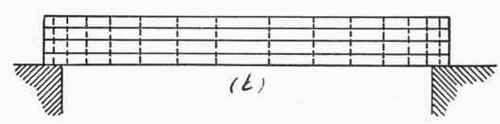
Planks or boards before and after bolted together, showing the effect which reinforcement has in a concrete beam, for instance.
The principal reason why steel is used as reinforcement for concrete is that steel and concrete expand and contract under changes of temperature (as do all materials) in about the same degree or ratio. This is very necessary as it prevents the bond or adhesion between the concrete and the steel from being broken.
Steel is placed in the concrete where it will best resist the tensile strains. By referring to the illustration, in which the hinged beam is shown, it should be easy to see that the best place for the steel would be not at the center of the beam but either along the outside lower face or as near to it as possible. If the steel were left exposed, it would eventually rust, while if the concrete were exposed to severe fire the steel might be injured from such exposure, therefore it is embedded in the concrete as near to the lower outer surface as possible, yet sufficiently deep to be surrounded with enough concrete to protect against corrosion, such as rust, and against exposure to fire.
A beam of concrete or of stone could be made long enough so that without reinforcement and supported at its ends or at one end only, its own weight would cause it to break. If steel is properly placed in the concrete, however, not only may the length of such a beam be increased without danger of breaking but it can be made to support considerable load in addition to its own weight.
Continue to:


My Books

