


Concreting Tools And Equipment
Description
This section is from the book "Practical Concrete Work for the School and Home", by H. Colin Campbell. Also available from Amazon: Practical concrete work for the school and home.
Concreting Tools And Equipment
Tools Commonly Required
Most of the tools required in concrete work are simple and many of them can be home made. The principal ones are the following:
Screen.
Mixing platform.
Square pointed shovels.
Measuring box.
Pails.
Hose.
Tamper.
Spading tool.
Strikeboard.
Wood float.
Steel trowel.
Edger.
Groover.
Wheelbarrow.
Screen
A sand screen should be 2 feet 6 inches or 3 feet wide, and 6 feet long. The frame may be made of 1l/2 or 2-inch lumber, 4 to 6 inches wide. Legs should be so attached to the sides that the screen can be set at the desired angle while throwing material upon it to separate the sand from the pebbles. This angle should be about 45 degrees. A piece of wire cloth or fabric should be nailed to the frame. This may be either 3/8-inch slotted screen wire with cross wires from 4 to 6 inches apart or a woven wire fabric having 4 meshes to the linear inch (16 to the square inch). Material to be screened is thrown in shovelfuls against the upper portion of the screen and in rolling down, the sand and pebbles are separated.
Mixing Platform
A mixing platform may be made by using a piece of sheet steel about 1/8 inch thick with 2 by 4's set on edge and properly fastened to three of the four edges or sides of the steel; or the platform can be made entirely of wood. In this case the floor of the platform should be of not less than 1 1/2-inch lumber, 4 to 6 inches wide, tongued and grooved, and surfaced on the side that is to be uppermost, that is, the side upon which mixing is done. This will make it easy to shovel materials. If tongued and grooved lumber is not obtainable, the edges of the boards should be planed or jointed so that they can be nailed closely together on 3 by 4 or 4 by 4-inch stringers, placed two or more feet apart, to make a firm, unyielding platform upon which to work. Two by 4 strips should be nailed to three sides so that when shoveling materials in mixing, they will not be shoveled off the board.
Measuring Box
The measuring box is necessary to measure exact quantities of sand and pebbles or broken stone.
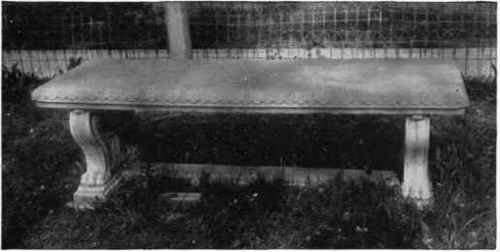
Concrete lawn bench with considerable ornament.
Such a box is a bottomless frame made of 1 or 1 1/2-inch material and should have a capacity not less than 1 cubic foot. If larger, then it should be of 2, 3 or 4 cubic feet capacity and should be marked on the inside so that at certain levels the markings will show volumes of 1, 2, 3, etc., cubic feet. Handles are placed on the sides of the box to make lifting easy after the material required has been measured.
Shovels
For mixing concrete, ordinary square pointed shovels are used. These are familiar objects to everyone and need no description.
Continue to:


My Books

