


Surface Finish Of Concrete. Part 2
Description
This section is from the book "Practical Concrete Work for the School and Home", by H. Colin Campbell. Also available from Amazon: Practical concrete work for the school and home.
Surface Finish Of Concrete. Part 2
Selected Aggregates
By far the most attractive surface finishes that can be given to concrete are those which are in large part prearranged when mixing the concrete. That is, selected aggregates are used instead of common sand, these materials being chosen principally because of their color. For example, instead of using ordinary sand, white sand and marble chips, or granite screenings, crushed feldspar, mica and micaspar, crushed slag, garnet sand and similar colored rock materials are used as aggregates.
Mixtures are prepared and placed in the usual way. When the concrete has hardened so that forms may safely be removed, the surface of the object to be treated is gone over in one of several ways to produce the desired effect.
How Surface Finish Is Secured
With selected aggregates, the surface finish is obtained by washing off the film of cement that coats the particles, thus exposing their surfaces in the surface of the concrete and in that way revealing their color. If the forms are removed within 24 hours after placing the concrete in the mold, it is usually possible to wash off the surface film of cement by merely scrubbing the surface of the object with a stiff bristle brush kept wet with water. If, however, the concrete has become too hard to permit exposing the aggregate surfaces in this manner, then an acid wash is used. This consists usually of 1 part of hydrochloric (commercial muriatic) acid in 3 or 4 parts of water. This wash is applied with brush to the surface and light scrubbing given until the surface film of cement is loosened from the aggregate particles. When this has been done, the surface of the object must be washed immediately and thoroughly with clean water containing no acid so that all trace of acid is removed and its further action prevented. If this were not done, the acid would continue to act on the cement and thus loosen some of the aggregate particles.
Facing Mixtures
Sometimes economy results from using two classes of mixtures for a concrete object that is of considerable volume. That is, if a surface finish by means of colored aggregate is the desired end, then a concrete mixture containing such aggregate is used only for the face of the object and back of this facing mixture an ordinary concrete mixture in which common sand and pebbles or broken stone are the aggregates. When using facing mixtures in this manner, it is necessary that the facing mixture be banked or plastered up the sides and faces of the mold a little in advance of the mixture that is used for the center or backing. It is also necessary that the two mixtures be of the same consistency so that when compacting the concrete in the mold the two mixtures will thoroughly unite.
Combining Several Colored Aggregates
Variations in color and texture of a surface which are to be secured by washing or otherwise exposing the aggregate can be made almost without number by combining two or more selected aggregates. For instance, a mixture of yellow and of white marble chips, or a mixture of gray granite screenings and black crushed slag with a little micaspar or mica, are examples of possible variations. Such mixtures produce a beautiful surface texture when the film of cement is removed by scrubbing, either with water or the acid solution, depending upon the age of the concrete. Often white portland cement is used, and in such cases micaspar, white marble or mixed light-colored aggregates.
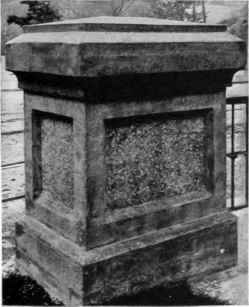
An example of surface finish in the depressed panels, secured by tooling the surface with a bush hammer.
Continue to:


My Books

