


Gas Ranges
Description
This section is from the book "Mechanics Of The Household", by E. S. Keene. Also available from Amazon: Mechanics Of The Household.
Gas Ranges
Gas ranges and all other heaters using gas as a fuel are constructed to utilize the principle of the Bunsen burner.
Fig. 180 illustrates the type of burner used in the Jewel gas range. This represents the form adapted to the top burners for all direct-contact cooking or heating. The burners are of different sizes and arranged as they appear in Fig. 181. This picture shows the top of the range as seen from above, looking directly downward. The gas supply pipe and individual valves for each burner are in position as they appear in front of the range.
In operation, the nozzles of the gas valves stand directly in front of the opening G, in Fig. 180. The stream of gas in passing into the burner induces a flow of air through the opening A. The mixture of gas and air is such as will burn with the characteristic Bunsen flame without smoke.

Fig. 180. - Detroit Jewel one-piece, star-shaped burner.

Fig. 181.
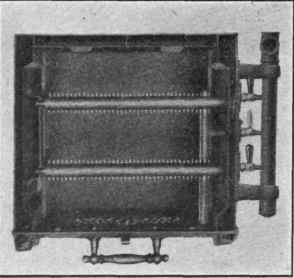
Fig. 182.
Fig. 181. - Showing top burners and valve attachment of a gas stove. Fig. 182. - Section showing arrangement of oven burners and lighter of a gas oven.
The oven burners are different in form but the individual flames are the same as those of the top burners. They extend across the oven as shown in Fig. 182. In this the top of the oven is removed and burners as seen are viewed from above.
The top burners are lighted by direct application of a burning match but the oven burners must be lighted by first igniting a special torch or "pilot lighter." The middle gas valve of Fig. 182 is turned and the torch lighted, then the other valves are opened and the jets are instantly ignited. As soon as they are burning the pilot lighter is extinguished by turning its valve.
The reason for this special lighter is because of the possibility of explosion at the time of lighting. The gas from the jets is mixed with air at the proper proportion to be violently explosive and if by chance the gas should be turned on a sufficient time to fill the oven with this explosive mixture and then lighted, and explosion would be certain, with every possibility of disastrous consequences. All gas ovens should be lighted in a manner similar to that described.
Continue to:


My Books

