


Corner-Shelves Or Cabinets
Description
This section is from the book "Woodworking For Beginners: A Manual for Amateurs", by Charles G. Wheeler. Also available from Amazon: Woodworking For Beginners.
Corner-Shelves Or Cabinets
A simple form of hanging corner-shelves is shown in Fig. 293. This can be of any size, of course, but such articles look clumsy if made very large. Half-inch stock is heavy enough unless the case is quite large, when 3/4" or 7/8" thickness can be used.
Before beginning work read carefully Marking, Rule, Square, Saw, Plane, in Part V., and look up any other references.

Fig. 293.
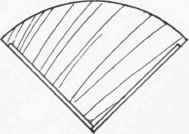
Fig. 294.
One of the sides can be made wider than the other by the thickness of the stock, so as to lap over and secure a tight and strong joint at the back. The top board (with rounding front) can simply be nailed down on the sides (see Nailing and Nail-set), or, to be more workmanlike, a rabbet (Fig. 294) can be cut around the edge of the top on the under side into which to fit the sides, which can be screwed in place (see Rabbet, Boring, Countersink, and Screws). This rabbet should not come quite to the front edge of the top.
The shelves can be screwed in place from the back (see Screws), carefully marking lines with the square, for boring the holes, before putting the case together, and countersinking the holes upon the back.
This case (being fastened by screws) can be taken apart for finishing.
See end of introduction to this chapter for directions about smoothing, putting together, and finishing. See also Scraper, Sandpaper, and Finishing, in Part V.

Fig. 295.
A standing cabinet like Fig. 295 can be made in the same manner as the hanging cabinet just shown, but can, of course, be larger. Stock from 3/4" to 7/8" in thickness can be used. The rail at the top can be made and put on as directed for the desk-rack shown in Figs. 281 and 282.
Continue to:


My Books

