


Gouge
Description
This section is from the book "Woodworking For Beginners: A Manual for Amateurs", by Charles G. Wheeler. Also available from Amazon: Woodworking For Beginners.
Gouge
This tool is similar to the chisel, except for the curvature across the blade. The common gouge has the bevel on the convex or outer side and is known as an "outside" gouge. This is the more useful for ordinary work. The " inside" gouge has the bevel on the inner or concave side. Although very useful for many purposes, it is less important for general work and is harder to sharpen. Gouges are of various degrees of curvature, Fig. 534 showing a "flat" and a "quick" curve. Those of moderate depth and curvature will be more useful for your work than very deep or very flat ones.
In using the common or " outside " gouge, light, short strokes should usually be made, for only the bevel of the tool bears on the wood, which makes this gouge quite hard to control.

Fig. 534.
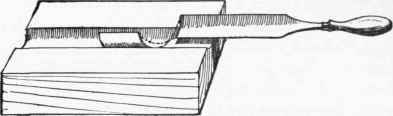
Fig. 535.
You can often apply the principle of the sliding or sideways cut in using the gouge, as with the chisel, to good advantage.
You can roll the gouge around with your hand from side to side so as to make it cut slantingly. This is particularly useful to give a clean cut when gouging across the grain (Fig. 535). In some cases, in working out a moulding, for instance, you can hold the tool at an angle with the work and get a better result than to push it straight forward lengthways
(Fig. 536).
Be careful not to scoop out little hollows below the required depth of the cut, and keep the direction of the grain in mind the same as with the chisel. The little inequalities left by the gouge can be reduced easily by the file, curved scraper, or glass and sandpaper. See Sharpening.
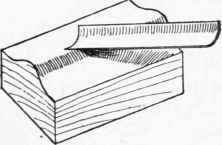
Fig. 536.
Continue to:


My Books

