


"Toe" Nailing
Description
This section is from the book "Woodworking For Beginners: A Manual for Amateurs", by Charles G. Wheeler. Also available from Amazon: Woodworking For Beginners.
"Toe" Nailing
If you wish nails to hold as much as possible, toe them - that is, slant them (Fig. 606). You can see at a glance that the board will be held much tighter than if the nails were driven straight up and down. Of course you cannot always drive nails this way, and there are many cases in which you would gain nothing, but it takes only a moment longer to toe nails, and it is often very useful where you wish to be sure that the work will hold together. There are many cases where you cannot nail any other way, as when you fasten a stud to the top of a sill (Fig. 607), and you can see at once that it is advantageous. Of course this is not a good method for work which you may wish to take apart again.
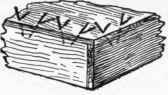
Fig. 606.
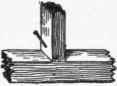
Fig. 607.
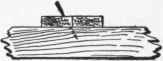
Fig. 608.
Slanting the nails helps to draw one piece tightly up to another, as is often desirable for a tight box or a floor (Fig. 608). You can increase this effect, after you have driven the nail part way in, by drawing the hammer towards you as you strike, or in the direction towards which the nail points, thus bending the upper part of it toward the other piece, which tends to make a tight joint.
Continue to:


My Books

