


Clinching Nails
Description
This section is from the book "Woodworking For Beginners: A Manual for Amateurs", by Charles G. Wheeler. Also available from Amazon: Woodworking For Beginners.
Clinching Nails
The way to clinch nails is simply to drive them through against a heavy hammer,or any solid metal object, held on the other side. As the point comes through it is gradually turned over or hooked around into the wood and when the head is driven home the point will be firmly embedded in the wood. Another way is to simply strike the projecting ends with light, slanting blows. This will gradually bend or curl the point over to one side, and as it bends over you can pound more directly downward until the hooked end of the nail is buried in the wood. Clinching is very useful for many purposes, as in nailing cleats on a shed door. It is usually best to bend the nails over in the direction of the grain, rather than across it.
Whether to clinch or toe the nails must depend on the work. Clinching is better for anything that is to be slammed or subjected to violent treatment, while in many cases toeing is better, and frequently you cannot reach the points of the nails to clinch them.
Blind nailing is resorted to in order to have a clear, smooth surface, as in floors laid with matched-boards. Each board is nailed just above the tongue, with the nails slanting through the solid part of the board (Fig. 609). This holds the board down and tends to force it closer to the adjoining board. The grooved edge of the next board entirely conceals the nailing and leaves an unbroken surface.
Another form of concealed nailing, known as "sliver" nailing, is sometimes practised in inside work (sometimes in putting up "inside finish"). A little shaving is raised with the gouge (an inside gouge is best) or a narrow chisel, where the nail is to go, and curled away sufficiently to drive and set the nail (Fig. 610). Hot glue is then dabbed into the groove, the shaving (which is only raised at one end and not detached from the wood) is pressed back into place, and the spot rubbed with sandpaper drawn around a flat block until the shaving is firmly glued where it belongs. This takes but a moment or two, and when the work is finally smoothed and finished the place cannot be detected, if the operation has been properly done. This is convenient to know in case you have to drive a nail where there is objection to its being seen. See Withdrawing Nails.

Fig. 609.
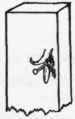
Fig. 610.
Continue to:


My Books

