


242. Wedges
Description
This section is from the book "Bench Work In Wood", by W. F. M. Goss. Also available from Amazon: Bench Work In Wood.
242. Wedges
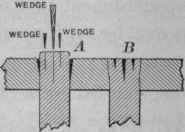
Wedges. The most common use of wedges is illustrated by Fig. 213 in connection with Exercise No. 14, which requires wedges to be dipped in glue and driven between the tenon and the ends of the mortise. Wedges are also driven in saw cuts made in the end of the tenon for the purpose of expanding it, as illustrated by Fig. 296, which shows at A a section of a joint before the wedges are driven, and at B a section of the finished joint. The saw cut should extend somewhat deeper than the point reached by the wedge. If the tenon is broad, or if a considerable increase in breadth is required, more than one wedge must be used. When there are more than two, a large one should be inserted in the center and smaller ones on each side, as shown by Fig. 297, the wedges ready for driving at A and the joint finished at B.
Fig.296
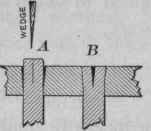
Fig. 297
243. Blind-wedging is sometimes resorted to when the mortise does not extend through the piece. As shown by Fig. 298, the mortise is enlarged at the bottom and the wedges started in; then, as the pieces are driven together, the ends of the wedges strike against the bottom of the mortise and spread the tenon. When driven, the tenon cannot be withdrawn.
Fig. 298

Fig. 299

244. Keys differ from wedges in respect to their sides, which are parallel or nearly so. The key may be a single piece, as shown in the joint, Fig. 197, or, what is better, made as two wedges, Fig. 299. These may be put in place when in the relative position shown by A'B, after which, by driving them upon each other, as indicated by A, B, the joint may be tightened. The parallelism of the outside edges, which are in contact with the joint, is always maintained.
245. Dowels are round wooden pins of small diameter used to strengthen a joint. They should be dipped in glue and driven at a tight fit into holes made for their reception. They may be carried entirely through one piece and into the other, Fig. 277, or inserted as shown by Fig. 274.
Dowels may be made at the bench by the plane, or they may be turned. When planed, they will be improved in section if driven through a round hole in a piece of iron or steel. They are supplied by the trade, of all ordinary diameters, and in lengths of several feet, so that the consumer has but to cut them to lengths suited to his purposes, and point them.
Shoe pegs serve well as small dowels. After being dipped in glue they should be driven in brad-awl holes.
Whenever fastenings are required to be so placed that subsequent operations bring the cutting tools about them, dowels are preferable to brads or nails, since they may be planed off without injury to the tool.
246. Nails are classified according to the process by which they are made, the material used, their form and proportions, and the use for which they are intended. Iron and steel are the most common materials, but when these would be destroyed by corrosion, copper and "galvanized" iron are used. The forms of most importance to the bench-worker may be classed as common and finishing (or casing) nails. Their comparative proportions are illustrated by Figs. 170 and 300, the former representing a common, and the latter a finishing nail. It is evident that the greater strength of the common nail makes its use desirable when there is sufficient material to receive it properly, and when the appearance of the head on the surface is not objectionable. The finishing nail may be used in more delicate material, and makes a smaller scar on the work. Cut nails are so called because, in the process of manufacture, each nail is cut from a plate of metal. The plate has a width equal to the length of the nail, and a thickness equal to its breadth. Generally speaking, all nails of the form shown by Figs. 170 and 300 are cut.
Fig. 300
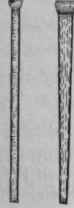
Fig. 170
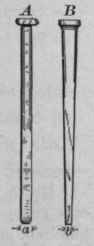
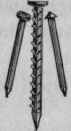
Wire nails, Fig. 301, are now in general use. Their strength and tenacity are unequaled. They are made from drawn wire in sizes varying from that of the smallest brad to that of the largest spike. The terms used to describe cut nails, as to size and form, are also applied to wire nails. The holding power of a wire nail is often inferior to that of a cut nail.
247. The length of nails is indicated by numbers prefixed to the word "penny," as 6-penny, 8-penny, - terms 1 which are now used arbitrarily, though originally they were doubtless significant.
The length of nails of ordinary sizes is given as follows:
Fig. 301
1 It has been suggested that they once indicated the value or price of ,a given number of nails, 6-penny nails being sold at sixpence per hundred, and 8-penny nails for eightpence per hundred. Another explanation is that penny, as here used, is a corruption of pound, 6-penny meaning that a thousand nails weighed six pounds; 8-penny, that a thousand weighed eight pounds; and so on.
A 3-penny nail is one and one-fourth inches long. | ||||
A 4-penny | " | one and one-half | " | " |
A 5-penny | " | one and three-fourths " | " | |
A 6-penny | " | two | " | " |
A 7-penny | " | two and one-fourth | " | " |
An 8-penny | " | two and one-half | " | " |
A 10-penny | " | three | " | " |
A 12-penny | " | three and one-fourth " " | " | |
A 20-penny | " | four | " | " |
248. Brads are small finishing nails, now usually of wire. Their size is expressed in inches and fractions of an inch, and ranges from one-fourth of an inch to two inches.
249. Tacks are useless for fastening pieces of wood to each other, but are indispensable when lighter material, such as cloth or leather, is to be fastened to wood. They vary in form and size with the particular use for which they are intended. Their size is expressed by a number prefixed to the word "ounce." 1 The length of the more common sizes varies as follows:
A 1-ounce tack is three-sixteenths of an inch long. | |||||
A 2-ounce | " | one-fourth | " | " | " |
A 3-ounce | " | three-eighths | " | " | " |
A 4-ounce | " | seven-sixteenths | " | " | " |
A 6-ounce | " | one-half | " | " | " |
An 8-ounce | " | nine-sixteenths | " | " | " |
A 10-ounce | " | five-eighths | " | " | " |
250. Common Screws are either bright or blued, steel or brass, round-headed ox flat-headed.
Bright screws are finished by polishing. When blued, the luster of the polish has been taken off by heat or an acid, and a deep blue finish produced. Blued screws will not rust so easily as bright screws, and in most work they look better -considerations which apply with still greater force to the use of brass as a material instead of steel.
Flat-headed screws, shown by Fig. 124, are the most common. When used on finished surfaces, the heads should be sunk below the general level and the hole above them filled. When this is not convenient, round heads, which in the finished work will appear above the surface, are frequently employed.
1 This expression may have once represented the weight of 1000 tacks; for example, 1000 tacks 3/16" long weighed one ounce, and were therefore called "one-ounce" tacks.
The size of screws is indicated by their length in inches or fractions of an inch, and by the diameter of the wire forming the body; this diameter is expressed by a number which refers to a "standard screw gauge." The sizes of the screw gauge range from No. o, which represents a diameter of a little less than a sixteenth of an inch, to No. 30, which represents a diameter somewhat greater than seven-sixteenths of an inch. The size of a screw two inches long and a quarter of an inch in diameter would be written 2" x No. 15.
251. Glue is chiefly of two kinds, animal and fish. Animal glue is a product obtained from the refuse of tanneries (bone, horn, hoofs, and bits of hide), which is made to give up the glutinous matter it contains by being boiled under pressure. Fish glue is extracted from the spawn and entrails of fish. As prepared for the market, both are generally in the form of cakes, varying in thickness from an eighth of an inch to very thin chips, according to the quality and character of the glue. For bench work these are dissolved in water, and the mixture applied hot. For convenience in dissolving the glue, a glue-pot is used, which is an arrangement of two vessels, one within another, the inner being for glue, the outer for water. Heat is communicated in any convenient way to the water, and the water in turn heats the glue. The use of the vessel of water is to prevent the glue from burning.
Continue to:


My Books

