


Fourth Exercise
Description
This section is from the book "A Laboratory Course In Wood-Turning", by Michael Joseph Golden. Also available from Amazon: A Laboratory Course In Wood-Turning.
Fourth Exercise
Material
Poplar or pine, 3 1/4" x 3 1/4" x 8". Exercise. - To cut compound curves of the form shown in Fig. 52.

Fig. 52.
Turn the wood to a smooth cylinder 3 inches in diameter, and mark it to the dimensions shown in Fig. 53. Both concave and convex curves are to be half - circles in outline. The concave curves are to be cut first, in the divisions marked [a], with the 1/2-inch gouge. The material between the lines is removed by a series of cuts, as shown in Fig. 54. The exact height at which to place the rest cannot be given, as it should be that which will be found most convenient. It ought to be above the centre of the work, as when using the skew chisel.
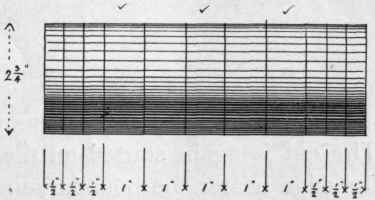
Fig. 53.
Start the cut on the right-hand side of the middle division by placing the gouge in the position shown in Fig. 55, the cutting portion of the edge being square across the work. If the cutting edge is not square across the work when it is pressed into the wood, it will run off to one side or the other, as it may have been started, and so mar the stock. Force the gouge a short distance into the work, as shown in Fig. 54, and then withdraw it and repeat the operation on the left side, as shown in Fig. 56, forcing the gouge farther into the wood, however, as shown in Fig. 57, and gradually turn it over on its back during the cut, as shown in Fig. 58, until it arrives at the position shown in Fig. 59. The cut is again started on the right-hand side, but with the edge nearer the boundary-line for the hollow, and the bevel more nearly a right angle with the axis of the work, as shown in Fig. 60. Finish this cut from the left side as the first one was, and so continue the cutting until the gouge has taken the position shown in Fig. 61, and the cut is of the right depth and shape. The sides are straight for half the depth.

Fig. 54.

Fig. 55.

Fig. 56.

Fig. 57.

Fig 58.
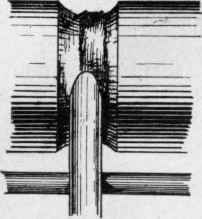
Fig. 59.

Fig. 60.

Fig. 61.
Next cut the convex portion of the curve by placing the gouge in the position shown in Fig. 62, and using it in nearly the same manner that the skew chisel was in the last exercise. The handle is swung around in a nearly similar manner, but must be elevated to a greater extent than the chisel handle was. The whole movement is so nearly similar to that of the skew chisel that more detailed description is not necessary.
The small concave curves near the ends are cut in the same manner that the larger ones are, the 1/4 - inch gouge being used.

Fig. 62.
Continue to:


My Books

