


Sixth Exercise
Description
This section is from the book "A Laboratory Course In Wood-Turning", by Michael Joseph Golden. Also available from Amazon: A Laboratory Course In Wood-Turning.
Sixth Exercise
Material
Hickory or ash, 2" x 2" x 8".
Exercise
To make a chisel-handle of the form and dimensions shown in Fig. 69.
It is sometimes necessary to turn a number of pieces to be precisely alike of such things as handles, ' balusters, and similar articles. To avoid the necessity for frequent adjustment of the measuring tools a "templet" of the form shown in Fig. 70 is made. The templet may consist of a 3 piece of sheet-iron, or of wood and iron, as shown in the sketch, or be entirely of wood. The principal dimensions for length are notched on one edge, and the caliper sizes to correspond are cut out of the other, as shown in Fig. 70.
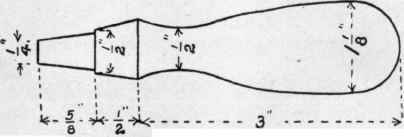
Fig. 69.

Fig. 70.
To Make The Handle
First turn the stock to the diameter represented by the largest opening in the templet, and then hold the notched edge of the templet against it, and mark lines around it to correspond to the notches on the edge of the templet, as shown in Fig. 71. Next, with the parting-tool, cut grooves into the wood where the marks were made, using the notches cut from the edge of the templet, instead of the calipers, to determine the diameter of the work, as shown in Fig. 70, using the opening that corresponds to the notch whose mark is being cut. After the grooves have been cut, the work will have the form shown in Fig. 72. Next, using the skew chisel and gouge, finish the work to the desired form, referring frequently to the pattern, to be sure the wood is assuming the correct outline.
After the wood has been cut to the desired form, it may have a coat of oil given to it, and then be polished by rubbing it with a rag while it is revolving, or a coat of varnish may be given to it.

Fig. 71.

Fig. 72.
Good results may be gotten in this and the succeeding exercises by using a shellac varnish made by dissolving amber shellac in alcohol and applying a thin coat with a brush. The wood ought then to be put away for an hour to dry and harden, when it will be found that the varnish has caused small particles of the wood to project from the surface. These may be removed with a piece of fine sandpaper, care being taken that the sandpaper is applied with only enough pressure to remove the hard particles and not to scratch the surface. The surface is then wiped clean of dust and another coat of the varnish applied, and this is continued until the desired effect is obtained.
When the varnishing and polishing are complete, trim off the ends by which the piece was held in the lathe;
Balusters and other similar pieces may be turned in this way, a way used when there are many pieces to be turned that are to be alike.
Continue to:


My Books

