


Extra Tools
Description
This section is from the "Educational Woodworking For Home And School" book, by Joseph C.Park . Also see Amazon: Educational Woodworking For Home And School.
Extra Tools
73. Cabinet Scraper
The cabinet scraper is an oblong piece of polished saw steel and is used in scraping hard woods. Cabinet scrapers are made in assorted sizes. The 3" times 5" size is a good size for bench work. They are sharpened with a file in such a way that a fine wire edge is turned, and it is this wire edge that really does the cutting or scraping. As soon as this is worn off the scraper should be filed again. With the improved block planes which we now have there is little use for cabinet scrapers.
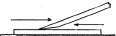
Fig. 112. Showing position of chisel on oilstone.

Fig. 113. Cabinet scraper.
74. Oiler
The oiler is used about the bench to hold oil that is used frequently on the oilstone and for other purposes. A copperized can like the one shown in Fig. 114 is a good can for use about a bench. Oilers are made in assorted sizes and in different shapes and styles.
75. Bench Brush
This is a brush used in dusting the tools and bench. It should be used very carefully at the close of each exercise. Remember that the bench and tools are to be left clean when you finish your work each day.

Fig. 114. Oiler.

Fig. 115. Bench brush.
76. Handles
Frequently handles are broken and should be replaced by new ones. An assorted stock of these handles should be kept on hand, or where practicable they should be made by the students.
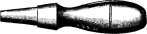
Fig. 116. Socket chisel handle.

Fig. 117. Turning handle.

Fig. 118. Carving tool handle.

Fig. 119. Tanged chisel handle.

Fig. 120. File handle.

Fig. 121. Adz-eye hammer handle.
77. Steel Letters And Figures
These are used in lettering and numbering finished work, or they may be used for other purposes. Each letter is held in position and then struck with a hammer, making an indentation in the wood. A more perfect letter can be made on end wood than on parallel fibers. They are made in assorted sizes from 1/32 of an inch to 1/2'.
78. Trimmer
A trimmer is a tool used in trimming end wood either squarely across the fibers, or at an angle. They are made so the cut can be adjusted at any angle from 30 to 150 degrees. There are many styles and makes of trimmers on the market at the present time.

Fig. 122 a. Wood trimmer.
One of the best made is the Fox, shown in Fig. 122 a. It is built upon the mechanical principle of a shearing cut, the knife shearing against the point of a gauge which is made to swing about a pivot in the arc of a circle. The gauge and knife are the most vital parts of the trimmer and should be kept in perfect order. Make thin cuts and keep the knife sharp.

Fig. 122 b. Wood trimmers.
Continue to:


My Books

