


Lesson IV Finishing the Third Side
Description
This section is from the "Elementary Woodwork" book, by Frank Henry Selden. Also available from Amazon: Elementary Woodwork for Use in Manual Training Classes.
Lesson IV Finishing the Third Side
Take the piece used in Lesson 3 (Use Of The Gauge) and plane the third side or second edge, planing down to the 11/2 inch gauge line, making the piece 11/2 inches wide. It will be noticed that when you have planed sufficiently to remove the rough edge caused by the gauge spur that the piece is a very little less than 11/2 inches wide. This is caused by planing to the inside edge of the line. If you wish to have the piece full width you must set the gauge enough wider to allow for planing the line off.
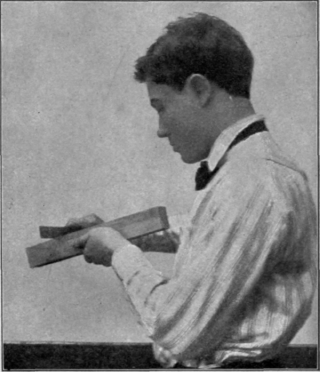
Fig. 17. Measuring.
See that the edge is square by using the try -square as on the first edge (Fig. 12). If the edge is planed to the line, it should be straight, yet it is best to examine it very carefully near the ends and at the middle by using the rule as shown in Fig. 17. In measuring with the rule the fingers grasp the rule; the end of the thumb rests against the piece of wood, and the rule is moved until one of the inch graduations is at one edge of the piece. Do not place the end of the rule even with one edge of the piece. Always hold the rule on edge, so that the graduations will come in contact with the surface being measured. You may not be pressing hard enough on the toe of the plane in starting, or on the heel in finishing, the stroke, as directed in Lesson 1 (To True The First Surface Of A Piece Of Wood). Only by planing the piece straight to the extreme ends will you get the proper control of the plane. No mark should be placed on this side.
If you do not get the edge perfectly square and straight by the time you have reached the line, do not continue planing by guess, but draw another gauge line very near to the edge and try again to plane to a line. Perhaps your plane is set too heavy, or perhaps the iron has shifted so that it is cutting too much on one side. Examine your tools and the edge thoroughly before trying the second time; and then, by cutting a very thin shaving and testing the edge after each stroke of the plane, you should be able to get the edge exactly correct. If you fail the second time, draw another line and try again and again until you do succeed in getting the edge exactly correct. Each time work more slowly and with more care. Keep a constant watch of the condition of the plane, for it is quite impossible to make the edge true if the plane is not properly set or is dull. Review often the directions for adjusting and sharpening the plane given in Part III.
Continue to:


My Books

