


Scraper
Description
This section is from the "Elementary Woodwork" book, by Frank Henry Selden. Also available from Amazon: Elementary Woodwork for Use in Manual Training Classes.
Scraper
For cleaning off thick bits of finish and for smoothing cross grained pieces a scraper is required. One may be made from a piece of an old of broken saw blade". Various sizes and shapes may be purchased. They may be rectangular in outline or of any other shape required to fit the work. For the present work a small rectangular scraper is sufficient.

Fig. 185. Scraper Bur.
The cutting or scraping is done by a very fine edge or bur which is nearly at a right angle to the surface of the scraper. This is shown very much enlarged in Fig. 185. To produce this bur the edge of the scraper is first draw filed as shown in Fig. 186.
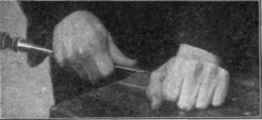
Fig. 186. Drawfiling a Scraper
The draw filing is to make the edge square and straight except that each end is rounded a little. For some work the edge is curved the entire length. After draw filing, lay the scraper flat on the bench and rub the edge several times the entire length with the chisel, as shown in Fig. 187. The chisel is held nearly, but not quite, flat on the scraper. This smooths the edge and forces a bit of metal out as indicated in Fig. 188.
Next change the chisel as shown in Fig. 189 and draw it towards you, using all the force you can. This will turn the bur as shown in Fig. 185. You can turn a bur on but one edge or on each side of all the edges, and if you are careful in using the scraper you will not cut your fingers on the edges. A little soapy water on the chisel will cause it to work better and avoid tearing off the bur. Always hold the scraper firmly and as near perpendicular to the surface as the bur will cut.
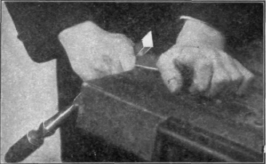
Fig. 187. Laying the Bur.
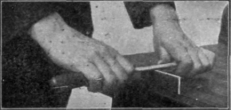
Fig. 189. Raising a Bur.

Fig. 188. Bur Flat.
Remember that when properly sharpened and used the scraper will cut off shavings, and therefore do not use it when it is so dull that it removes only dust.
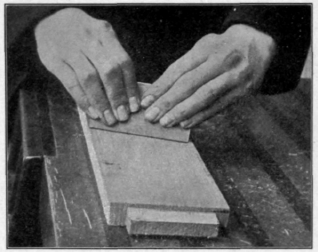
Fig. 191. Pulling a Scraper.
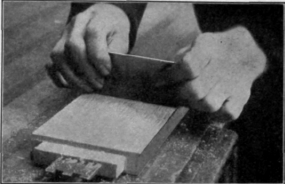
Fig. 190. Pushing a Scraper.
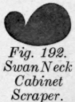
Fig. 192. Swan Neck Cabinet Scraper
The scraper is usually held in one hand for scraping thick places on finish as shown in Fig. 49. For finishing rough places on wood it is held by both hands, as shown in Figs. 190 and 191. Whether the scraper should be pushed from you or pulled towards you depends upon the nature of the work and the strength of your hands. Do not use any handle or holder while scraping ordinary small work. Be careful to hold the scraper so that it will cut at the center of the piece and not round the surface. Change the position or direction of the stroke sufficiently often to avoid following the defects in the surface. Be careful not to scrape out the soft places and leave the hard grain above the remainder of the surface. For working in hollows a scraper like the one shown in Fig. 192 may be used.
It is nearly always best to go over a surface with the smooth plane before using the scraper. Only on a very cross grained surface should one try to finish with the scraper directly from the planing machine. Some machines plane so smooth that the surface appears to be perfectly smooth except to the experienced eye, yet unless the hand plane is used the scraper will not be likely to remove the roughness so that it will not show through the finish.
Continue to:


My Books

