


Tools. Part 6
Description
This section is from the book "Elements Of Woodwork", by Charles A. King. Also available from Amazon: Elements Of Woodwork.
Tools. Part 6
In fitting the cap iron to the top of the cutter, a very fine, sharp file should be used. The filing must all be done upon the under side of the cap iron, at the places where it rests upon the face or top of the cutter; or, if preferred, the cap may be very carefully bent, but unless there is considerable fitting necessary, and unless thejoint is perfected by the use of a file, this method is not recommended.
If sufficient care and skill are exercised, a plane may be sharpened and adjusted so finely that a veneer of .01" or less in thickness of bird's-eye maple, burl walnut, ash, or similar wood may be smoothed. It is not wise, however, to spend the time necessary to keep a plane sharpened and adjusted to do this sort of work, as a scraper and sandpaper, or the latter alone, is the most economical way to smooth woods of such nature.
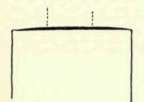
Fig. 53. - Shape of Edge of Plane Iron.
(D.) To remedy clogging of the mouth, remove the con ditions which cause it; simply digging out the shavings is useless. An improperly fitted cap iron is one of the principal causes of trouble; the cutter may be ground so thin that when it is forced against a knot or hard place, the iron chatters, which allows the shavings an entrance under the cap iron. In this lies the only real advan tage of a wooden plane over the modern iron plane, as in the former the iron is much thicker and stiffer. The cap iron may be so thick that it causes the shavings to curl too much, or the frog may be set too far to the front, which will make the mouth too small. This latter may be remedied by moving the frog back, but in a wooden plane, the mouth and the throat would have to be cut larger in order to allow the shavings to clear them selves properly.

Fig. 54. - Jack Plane.
41. The jack plane (Fig. 54) generally is 15" long, and its ordinary use is for the purpose of roughing out a piece of wood for jointing or smoothing. If it is properly sharpened, it may be used as a smoothing plane, or as a jointer upon small work, as it is capable of doing as good work as any plane.
The jack plane generally is ground more rounding, and the cap set farther back than in the other planes, espe cially if it is to be used upon rough work.
42. The jointer. - (A.) This tool is from 20" to 26" long, and is used to straighten edges and surfaces, or to fit them together. The shape of the edge of the cutter of this plane should be but slightly elliptical, less so than the jack plane or the smoother, unless the two latter are fitted for doing very fine work.
(B.) In using a jointer for squaring or jointing an edge, it should be carried to one side or the other of its face as may be necessary to take advantage of the elliptically shaped edge of the cutter, by cutting a shaving thicker on one edge than on the other, thus making the edge of the board square with the face side.
To make a perfectly square edge, the cut should be made in the center of both the iron and the width of the face of the plane. The plane should be held as shown in Fig. 55, the fingers under the face of the plane, the tops of the finger-nails touching the board lightly, guid ing the plane, and keeping the bit cutting in one place upon its edge.
43. The smoothing plane (A.) is of the same type and mechanism as those described above, though it is but 9 or 10" long; if satisfactory work is expected from it, it must be kept in good order, with the cap iron perfectly fitted. For general work, it is not necessary to spend the time to insure that the plane should be continually in readiness to work upon hard, tough, cross-grained wood, as a plane to do the latter kind of work well is unnecessary upon softer or straight-grained wood. For ordinary work, the cap iron should be set from 1/32" to 1/16" from the edge of the bit, but for the finest work, the closer to the edge it will fit and allow a shaving to be taken, the finer the work that may be done. No wood used upon ordinary work is so cross-grained or knurly that it cannot be smoothed economically, if a properly sharpened and ad justed plane is used.

Fig. 55. - Method of Guiding a Jointer.
(B.) A smoothing plane should cut a shaving as nearly the entire width of the bit as possible, therefore a very flat, elliptically shaped edge must be maintained. In using a plane or any kind of cutting tool, the di rection of the grain of the wood should be carefully studied, and every advantage taken of it to facili tate the work.
44. The block plane (knuckle joint cap, Fig. 56) (A.) is constructed upon a somewhat different principle than the planes above described, as the adjusting nut (a) under the cutter at the rear end of the plane is raised or lowered to withdraw or advance the bit, and thus govern the cut of the tool. The size of the mouth is controlled by a movable section of the face at b. This plane has no cap iron, as the use for which it is intended makes it unnecessary. The block plane is used across the end of the wood, at right angles with the general direction of the grain. The iron, or cutter, is so placed in the stock of the plane that its cutting angle is as nearly in line with the cut as possible, with the beveled side of the iron uppermost. By this method of construction, the iron is given more stiffness to resist the chatter, or vibration, caused by planing end wood.
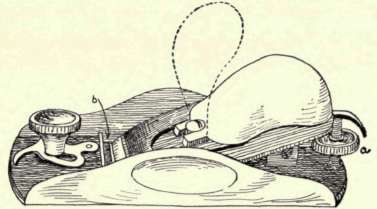
Fig. 56. - Knuckle Joint Block Plane.
Continue to:


My Books

