


Exercise 19. - Gluing
Description
This section is from the book "Exercises In Wood-Working", by Ivin Sickels. Also available from Amazon: Exercises in Wood Working.
Exercise 19. - Gluing
Material. - Two blocks of wood.
Glue prepared for use. Work. - To face the blocks and unite them with glue.
To prepare glue: Fill the inner vessel of the glue-pot about one third full of dried glue; cover with cold water and set aside for several hours; after which keep the outer vessel about one half full of water, and boil with the inner vessel in place. Add enough hot water to the melted glue until the drip from the brush begins to form drops.
Plane the surfaces of the blocks perfectly flat. Test them by holding together as in Fig. 1, and note if the surfaces come together at the edges, and particularly at opposite corners, as a and c. Mark the edges of the block, so that you will know which way they go together. The surfaces may be roughened with the scratch-plane, and must not be oily. Adjust the hand-screws a little wider apart than the thickness of the united blocks.
Heat the blocks and apply the hot glue to both surfaces, then rub them together, forcing out the excess of glue. Rest the lower jaw of the hand-screw on the bench, and place the blocks well into the screws, as shown in Fig. 2; tighten the screw a until a slight pressure is exerted on c, c, Fig. 2; then turn the screw b until the jaws close down at d, d, Fig. 3. Examine carefully to see that the joint is evenly closed, adjusting the pieces with the hammer, if not in place. Remove the excess of glue with a wet sponge, or with the chisel when partially set, after which stand the pieces aside for several hours.
In gluing together the edges of boards, or the parts of a door, clamps must be used, as shown in Fig. 4.
Fig. 5 represents a block built up by uniting several pieces; the pieces b, b may be doweled as well as glued, the pieces a, a simply glued. Where glue alone is used, some attention should be paid to the direction and character of the grain. If possible, the grain should be parallel and alike in size. A coarse grain, a, will not unite well with a fine grain, b, Fig. 6, especially if the pieces are not perfectly seasoned. Fig. 7 illustrates a way in which large pieces are built up in pattern-work.
Ex. 19.

Fig. 1

Fig. 2

Fig. 3
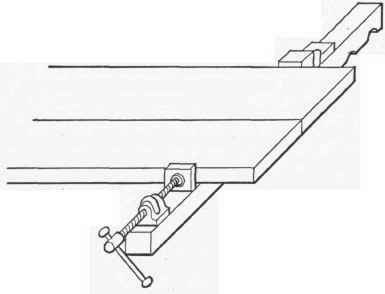
Fig. 4

Fig. 5

Fig. 6

Fig. 7
Continue to:


My Books

