


Exercise 18. - Uniting With Dowels
Description
This section is from the book "Exercises In Wood-Working", by Ivin Sickels. Also available from Amazon: Exercises in Wood Working.
Exercise 18. - Uniting With Dowels
Material. - Two blocks of wood, about 3" wide, 2" thick, and 4" to 5" long. Work. - To mark for the positions of the dowels, and join the pieces.
Plane the surfaces of the blocks until perfectly flat, test them by bringing the surfaces in contact, and note whether they touch all around. The dowel-joint is a weak one, and, unless the surfaces are flat and brought in close contact, the dowels will be of no service in holding the pieces together.
Select positions for the dowels on the pieces to be united, so that other joints or cuts will not interfere with them. Fix a point (a, Fig. 1) on each piece, at corresponding distances from the edges, for one dowel. With this first point for a center, mark the arcs b, b with the compasses, and mark on them corresponding points for the second dowel. From the points a, a describe the arcs c, c; and from b, b the arcs d, d, crossing c, c to give the places for the third dowels. With a 3/8" auger or dowel-bit bore a hole about 1" deep at each point. Saw three dowels from a dowel-rod, about 2" long, and slightly chamfer their ends with the chisel or rasp. Drive them into one piece. Measure the depths of the holes in the other piece, see that the dowels are not too long, and then force the pieces together.
An ordinary way of getting the marks for the dowels is to place small shot in position on one piece and press the other piece on them.
Fig. 2 shows a method of marking with try-square and gauge for dowels; Fig. 3, the dowels in position and the pieces ready for gluing.
When dowel-rods can not be obtained, the dowels may be made with a dowel-plate. Fig. 4, a, is a dowel-plate, of iron or steel, and having a number of holes of different sizes in it, through which rough pieces of wood, b, are forced with the hammer.
Fig. 5 shows the diagonal positions of dowels in uniting thick pieces. Fig. 6 illustrates the use of dowels in holding the parts of a core-box in position. Fig. 7 illustrates the use of dowels in uniting the parts of a hand-rail; a is a square nut, b a nut (shown enlarged at c) with projections, so that it may be turned with a punch.
Ex. 18.

Fig. 1

Fig. 2
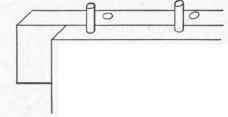
Fig. 3
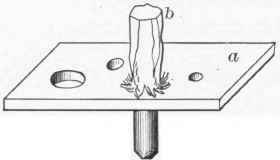
Fig. 4

Fig. 5

Fig. 6
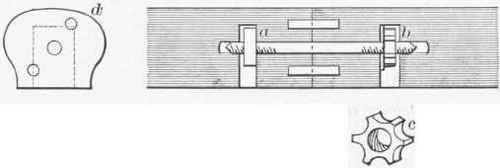
Fig. 7
Continue to:


My Books

