


Exercise 4. - Use Of The Hammer
Description
This section is from the book "Exercises In Wood-Working", by Ivin Sickels. Also available from Amazon: Exercises in Wood Working.
Exercise 4. - Use Of The Hammer
Material. - Sawed block of pine, 4" square and 16" long. Work. - To strike blows on the block, in order to learn the right manner of holding the hammer.
Grasp the handle of the hammer firmly, whether for a light or a heavy blow, and hold it so that its striking face is parallel with the surface of the wood (Fig. 1). Strike two or three light blows at one end of the block, and examine the impressions, which should be like those of a, Fig. 2; but if like b, Fig. 2, the hammer must be held better. Strike two or three again, and examine the prints of the hammer. Now strike several heavy blows, and note the result. It is a common fault among students to draw the handle down, as in a, Fig. 3, in striking a hard blow, and in correcting this fault to give the opposite result (b, Fig. 3). If the print shows that the hammer falls as at c, Fig. 3, then it is not held sufficiently tight in the hand.
For light blows a wrist motion is used, for ordinary blows a movement from the elbow, and for heavy blows a shoulder or combined movement of all the parts of the arm is necessary.
Cut nails are wedge-shaped, and if driven the wrong way will spread the fibers and cause the wood to split; but if driven the right way, break and compress the fibers without splitting the wood: a and b, Fig. 4, show the cut nail in its proper position, c and d, Fig. 4, the wrong position. Pick up a cut nail near the smaller end, the thumb and finger will instantly determine the wedge from the parallel sides and place the nail properly on the wood. Some men pick up the nail near the larger end, but allow the third finger to determine its shape. Wire nails do not need examination before striking, but must be struck a direct blow, or they will bend.
Fig. 5 illustrates a peculiar drawn blow of the hammer. Starting at d, it follows the direction of the broken line in its course; the effect of which is to bend the nail in such a manner that it forces the board a close up to c, as shown at f. This blow is practiced in nailing floors and clinching wrought nails. If the point a, Fig. 6, be struck light, drawn blows, it will curl, as shown at b. And if the blows are now drawn less, but made harder, the point will sink into the wood as at d, leaving a small and clean depression.
Ex. 4.
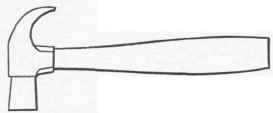
Fig. 1
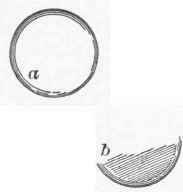
Fig. 2
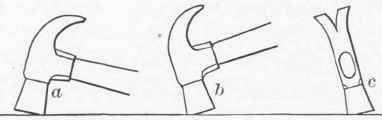
Fig. 3
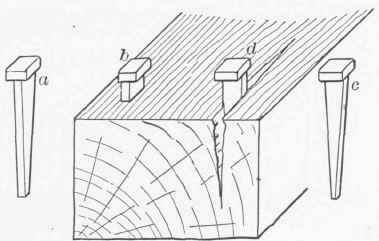
Fig. 4
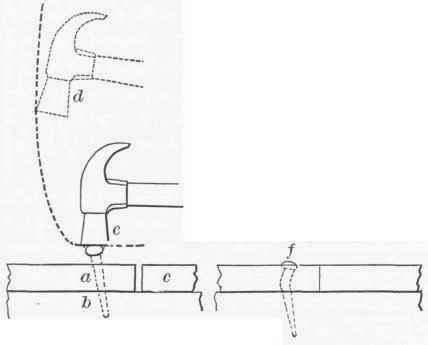
Fig. 5
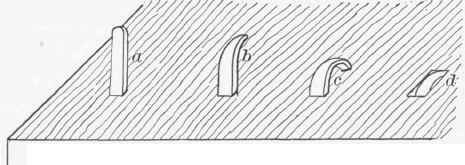
Fig. 6
Continue to:


My Books

