


Estimating. Part 6
Description
This section is from the book "Inside Finishing", by Charles A. King. Also available from Amazon: Inside Finishing (1912).
Estimating. Part 6
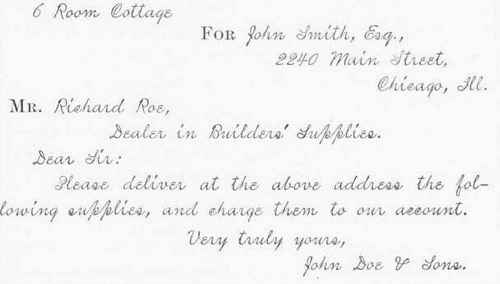
Chicago, ILL.
Date, jan. 1, 1912 BILL OF MATERIAL FOR
Framing 6 2" X 6" X 12' sills.
14 2" X 6" X 14' sills.
9 2" X 8" X 16' girders.
24 2" X 8" X 12' floor joists.
68 2" X 4" X 14' studs, plates, etc.
Finish
9 window frames, 14" X 30" X 1 3/8" 4 lt. 17 window frames, 14" X 28" X 1 3/8" 4 It.
9 door frames, 2' 8" X 6' 8" X 1 3/4". 1 3/8" X 1/2" rabbet. 90 ft. 4" crown molding. 90 ft. 3 1/2" X 7/8" facia. 2000 ft. 4 1/2" matched siding.
9 #2 doors, 2' 8" X 6' 8" X 1 3/8".
Hardware 100 lb. 8d com. nails.
100 lb. 20d spikes.
50 lb. 8d finish nails.
6 mortise locks.
36 6-lb. sash weights.
Never use ditto marks (") to repeat figures, as they very often cause errors. Stock bills should always be made out in duplicate, by means of carbon paper, one copy to go to the dealer, and one to be retained by the builder, as one may be lost, and mistakes may be checked.
73. The contractor. - Whenever unsuccessful, the young contractor should endeavor to discover, if possible, in what way his successful competitor was able to do the work more cheaply than he could. Did the successful competitor's figures differ in regard to material or labor? Was the material used the same that he would have furnished? If the builder who is doing the work is a successful man, a young contractor may learn much in regard to the faults of his own estimate.
A feeling of antagonism exists among a certain class of builders toward an architect, and many do not hesitate to cause him all the annoyance possible. This is a very shortsighted policy, as an architect's advice to his client is usually of great weight, and the contract is not always awarded to the lowest bidder. If an architect has had unsatisfactory dealings with a builder, he will, like most people, avoid him as much as possible in the future.
Architects, as a rule, are suspicious of builders, and naturally so, as the antagonistic builder is found everywhere, and until confidence is established, the architect is apt to be very searching and particular in his examinations and requirements. The more friends among the architects a builder can gain by his honesty and ability, and the more he can inspire their confidence, the better work, the more work, and the better prices he can command.
The young contractor should be very careful in regard to the legal aspects of a contract, as there are many ways in which an unscrupulous man might take advantage of technicalities, and the young builder should make a study of forms of contracts and the conditions which govern them, and which they govern.
Blank contracts covering all of the conditions usually observed in a building contract may be secured from a stationer who deals in legal forms.
Every city of importance has building regulations suited to its own local conditions, and these should be carefully followed, or much expense and annoyance may be caused.
A building permit is usually required in most cities, and it is generally the builder's place to secure it.
A treatment of the legal aspects of the work of a contractor is not within the province of this book, therefore mention only is made of its importance.
Suggestive Exercises
58. What should the contractor always insist on having when estimating a house?
59. What should the contractor know of the location of the house and the subsoil?
60. Describe the approximation method of estimating. Describe a safe method of estimating. Are the prices of labor and material the same in all localities? What should the contractor endeavor to attain in estimating the cost of a building? What is necessary in order to estimate methodically? How are the different items treated? How is the total of each division of items treated to find the cost? What is the range of percentages added, and for what?
61. What is included in the estimate of the excavation of a building? What conditions govern the distance to which the excavated earth is to be carried? What is a day's work for two men excavating with a wheelbarrow? With a horse, cart, and driver? What is the proportion of the cost of filling and grading to the cost of the excavation?
62. What is the safest way for a carpenter to find the cost of the masonwork of a building? How should these estimates be made a part of the bid for an entire job? Name at least twelve items which should be considered in estimating masonry. What is generally the unit of measurement for stonework? Recite the table of quantities. How is a wall usually measured to estimate the quantity of stone in it? What is the usual rule in regard to the measurement of small openings? Of large openings? What is the proportion of stone in a wall to rough stone? What is a day's work for a man and a helper in laying rubble? Ashlar? How much lime and sand should be used for each? What is a day's work for a stonecutter upon granite or bluestone?
63. How is a brick wall usually measured? What is the method of measuring a brick wall for the slow burning type of building? How many bricks are there in a square foot of wall surface? In a two-brick wall? In a three-brick wall? How many bricks are there in a cubic yard of solid brickwork? What is the allowance for breakage and waste? How much lime is used to lay 1000 common bricks? 1000 face bricks? What is a fair day's work for a bricklayer upon ordinary work? Upon face brick? Make a stock bill of the masonry work of a small house with the estimate, working from a plan.
64. Mention twenty-five items to be considered in estimating the frame of a house. What is the common method of finding the number of studs needed? Is this accurate? Why is it most used? Explain a more exact method, and compare the two. How many nails should be used in setting 1000' of studding? What is a fair day's work for two men in studding a house? How are the corner posts usually estimated? How are they ordered? How is the number of floor joists, rafters, etc., found? How is the number of jack rafters found? How many nails will be used in setting 1000' of the above? What is a fair day's work in setting the above?
Continue to:


My Books

