


Floor Laying, Inside Finish. Part 6
Description
This section is from the book "Inside Finishing", by Charles A. King. Also available from Amazon: Inside Finishing (1912).
Floor Laying, Inside Finish. Part 6
Fig. 18. - Vertical Section of Paneled Dado and Setting.
17. Rake dado may be made as easily as any other, if the work is done properly, the difficult parts being to get the clamps on so that they will not slip, and to prevent the muntins (2, Fig. 19) from slipping as the pressure is applied by the clamps.
As the top of the top rail and the bottom of the bottom rail of a piece of panel work usually are covered at least one inch by the finish, they may be notched to receive the clamps as shown at a, b.
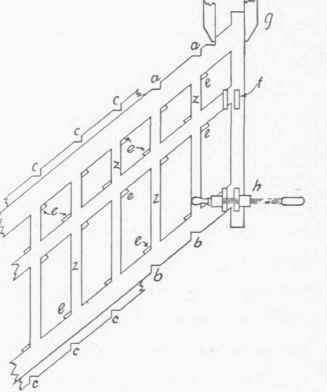
Fig. 19. - Setting up Rake Dado.
Another and better method is shown at c, Fig. 19, in which a piece 1 1/2" wide is screwed to the outsides of the top and bottom rails to prevent their slipping, and the notches cut as indicated. These pieces may be used indefinitely upon similar work. To prevent the muntins from slipping when the pressure of the clamps is applied, a small piece of soft wood (e) may be cut upon the end at the angle at which the muntin intersects with the rails, and glued by a rub joint at the place where the long corner of the muntin will rest against it.
The panel work must be tried together to be sure that each piece will go to its place with the least pressure; pounding should be dispensed with as much as possible, as the small pieces (e) will be knocked off easily.
If there is trouble in getting the stiles on, they may be easily brought to their places by the glue blocks (/) being fastened on both sides of the rails and stiles, and hand screws applied. Hand screws (h) will draw the stiles up to a joint. The face of the stile should be fair with the face of the rail. This should be done at each joint of the rails and stiles; it is customary to put on the glue blocks (/) at the same time that the blocks (e) are applied. It is generally better to use cold glue for work of this sort.
Some workmen prefer to cut the ends of the rails, and make the joints against the stiles after the panel work has been glued up and the glue hardened, because it is sometimes difficult to keep the ends of the rails exactly in line. The top rail may be brought to the stile by applying a hand screw, as at g. The middle and bottom rails may be brought up to a joint by extending clamps across the face of the panel work from the outside of the stile over a muntin; this method should be applied carefully, as the muntins may be pulled away from the rail, or the edges bruised. The former method is considered the better.
18. Soffits. - (A.) For a curved soffit, or the jamb of an arched opening, there are several methods of obtaining a piece of the desired sweep. One method known as "kerfing" consists of making, with a clean cutting saw, a series of cuts or kerfs across the face of the soffit, and nearly through to the back. These cuts should not be made in a hit or miss manner, but at regular intervals, so that, when the soffit is bent to fit the arch, the sides of each saw cut will come together on the face. The distance between these cuts may be found by the method indicated in Fig. 20, in which ab and gd both equal the inside radius of the soffit.
The piece of wood from which the soffit is to be made should be of clear, straight-grained stock, and held upon a straight surface with a hand screw, as at c. The saw cut g should be made square with the edges of the piece, at the distance from the end of dotted lines d, which equals ab; the end should then be lifted up until the saw cut g is brought together. The distance h should be carefully measured with a pair of compasses and spaced from g a distance each way equal to the radius of the semicircle ef. All cuts should be made with the same saw with which the cut g was made, and to the same depth. In applying this method, it is necessary that the distance between the centers of the saw cuts shall equal exactly the distance h, so that when the soffit is in place the pressure necessary to bring it to the correct curve will force the sides of the cuts closely together, and conceal them as much as possible.

Fig. 20. - A Scarfed Circular Soffit.
One objection to this method is that unless the face of the soffit is smoothed off with a crooked-faced smoother, after it is in place, the curve will appear to be a series of short faces between the cuts and, if the work is to be finished in the natural wood or stained, the cuts will show; if the wood is painted, a very satisfactory job may be made.
This work often is done by bringing the ends together and fastening them at the right place, after filling the saw cuts with glue. After the glue is set, the face may be smoothed off upon the bench.
Another modification of the same method is to make saw cuts in the back at equal intervals, and, after bending the soffit around a form to the correct curve, to fill the saw cuts with feathers of wood glued in, as shown at kl, Fig. 20.
After dressing the back off to the desired thickness, the piece may be handled as any straight piece, as it will hold its shape, though it will have but little strength.
(B.) A circular soffit may be made also of any kind of soft, flexible wood by preparing thin pieces which are to be bent to the desired form, the face piece being of the same kind of wood as the finish it is to match. These pieces should be bent to the required curve by means of pieces fastened to the floor to the correct sweep, about twelve inches apart, as at a, Fig. 21, or over a form, as in Fig. 20. The pieces to be glued together are forced to the pieces upon the floor by means of hand screws, and held there until the glue has set.
There is a tendency for pieces glued in this way to straighten themselves. This may be counteracted by making the sweep a little smaller than desired, so that this tendency will bring it to about the proper sweep. As different kinds and thicknesses of wood act differently, no rule can be given which will apply generally, but a little experience will give the workman judgment. Usually, one twelfth or one fifteenth of the radius of the sweep will be a safe spring allowance. This is the method commonly used in cabinet shops upon the best class of work, as the piece may be handled with little danger of breaking it; if many are to be made, a form of the correct shape should be used, as that is the most economical way.
Continue to:


My Books

