


Floor Laying, Inside Finish. Part 7
Description
This section is from the book "Inside Finishing", by Charles A. King. Also available from Amazon: Inside Finishing (1912).
Floor Laying, Inside Finish. Part 7
19. A splayed soffit for a circling top window may be made by the method described in Fig. 22. Points a, c, b show the face of the soffit, and d, e, f, the drop of the splay, or the size of the soffit at the window frame. At g may be seen the section of the reveal or jamb, its angle with the face of the casing, or line of the wall, being shown at g, h. It will be observed that g, g, z forms one half of a cone, and with h, h forms one half of the frustum of a cone. Thus we have the simple development of the frustum of a cone, one half of which will be the splayed soffit. With z as center, and zg, as radius, describe the arc xy, and with the radius zh describe the arc vw, which will give the sweep of both edges of the soffit. Trisecting the arc bc, as at k, and spacing one of these three divisions six times upon the development of the frustum of the cone, working from the center e, we have the approximate length of the soffit, which should be cut longer to allow for fitting the vertical reveal casings. This splayed soffit may be bent by either of the methods described in Topic 18, the saw scarfs radiating from the apex of the cone (z), or the center of the developed soffit.
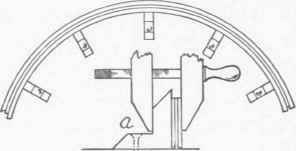
Fig. 21. - A Built Circular Soffit.
20. Circular panel work. - In making circular panel work, the rails should be made and bent as shown in Fig.
21, the face piece (a, Fig. 23) being of the finish wood desired. The piece 6, which forms the bottom of the groove into which the panel fits, should equal the desired width of the groove; the back piece (c) should be of the right thickness to make the rail match the straight panel work which it joins, or the stiles which are fitted upon the end.
The rails may be built to any desired section, or for any method of construction used in panel work.
In circular panel work, the panels are usually plain and built up of several layers of veneer. If a raised panel is desired, the panels are sometimes planed to the right curve and if a very quick sweep is wanted that may have to be done, but it is difficult to do it properly. This is a very laborious and expensive method, and the results rarely justify it; instead, it is quite the usual practice to warp the panels to the right curve after they have been molded or raised. This is done by wetting the side, which is to be convex, with moist sawdust, and exposing the other side to dry heat.
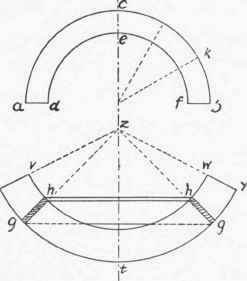
Fig. 22. - A Splayed Soffit.
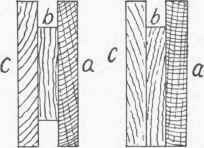
Fig. 23. - The Rails for Curved Panel Work.
The panels should be watched carefully, and tried frequently with a pattern of exactly the desired curve, and when the panel has warped to fit the pattern, the wet sawdust should be brushed off, and the panel set where the air will reach both sides of it evenly, until it has dried thoroughly. As the panels are apt to straighten somewhat in drying, it is best to allow them to warp a little more than the pattern demands.
21. Closets. - (A.) Ample closets should be provided for various purposes, as nothing adds more to the livable-ness of a house, or appeals more to the heart of the housewife. In every kitchen there should be closets for groceries, dishes, etc. In many houses a dust and vermin proof closet is specified for holding the family linen. This closet should be fitted with shelves and drawers, the details of which generally are provided by the architect, or by the owner.
(B.) A moth proof closet should be built of a good grade of sound, well-seasoned lumber, and made proof against dust, moths, and vermin. The doors should be made tight by the use of weather strips; naphthaline or moth wax should be used plentifully to insure against damage by insect pests. A red cedar chest or closet, while new, is satisfactory, but the wood loses its aroma in a few years, after which, unless the surface is planed, it is no more moth proof than any other wood, though it may still resist the ravages of boring insects and of mice.
(C.) China closets are built usually in the dining room. They should have glass doors, and be at least 12" deep in the clear inside. Clothes closets may be of almost any size, but they should not be less than 48" high. They should be provided with hooks; if there is a shelf, the capacity of the closet may be increased by screwing into its under side hooks which are especially useful as places to hang garments which are on forms.
(D.) The pantry should have shelves not less than 10" wide above the principal shelf, which may be from 18" to 30" wide, and 30" from the floor, to be used for a working table. Covers should be arranged in the wide shelf for the flour and sugar barrels, which should be in a closet underneath. Bins for meal, etc., are often wanted by the owner, who usually decides how the shelving is to be arranged. In the best houses, the pantry shelves are inclosed by doors, but this is not often done upon ordinary work.
(E.) A large trunk closet, or one for general storage, is a great convenience. In most houses planned by architects, these closets and their details are carefully worked out, and the carpenter who fits up these and other little conveniences in a new house is sure to be appreciated.
22. A drawer case for bedding, linen, or clothing is frequently needed, and should be placed where it is easily accessible from the bedrooms. It is a good plan to place it in a closet, so that when the door is closed the case will be out of sight. In some places the case of drawers may be placed across the end of a closet or alcove, so that there will be no need of finishing the ends. Such a case is shown in Fig. 24.
In making the drawer case as illustrated, the joints of the partition frames (a) should be made by being tongued and grooved, or doweled at the corners and glued. The standards (b) which support the partitions should be grooved at c, at the proper distances to fit the drawers which slide between them.
Continue to:


My Books

