


Appendix III. Useful Tables
Description
This section is from the book "Carpentry", by Ira Samuel Griffith. Also available from Amazon: Carpentry.
Appendix III. Useful Tables
Fractional Equivalents For Decimal Values

Where rafter lengths are determined by multiplying unit lengths by the run, the answer will almost invariably result in a decimal. Such decimal values may be readily translated into fractional forms by means of the accompanying table.
Example: A roof of ⅓ pitch has a common rafter run of 14'; find the length of common rafter.
Answer: 14x14.42"=201.88" or 16.82'. By the table, .82 = 53/64. A carpenter, however, would not care for such accuracy; the nearest 1/16" or even ⅓" would be sufficient.
Wood And Machine Screw Sizes
The difference between consecutive sizes is .01316".

Frequently the carpenter wishes to know the diameter of hole necessary to receive the shank of a screw of a certain gage. Should a screw gage be accessible, he may readily determine this. Should no gage be at hand, he may determine the size of hole by consult-ing the accompanying table of Wood and Machine Screw Sizes..
Example: What size bit must be selected to bore a hole for a No. 10 screw. By the table, a No. 10 screw is .18944" in diameter. By the table of Fractional Equivalents for Decimal Values it will be seen that a 3/16" bit must be used. The test for gage of screw is always made over the shank just below the head.
Length And Number Of Wire Nails To The Pound

Nails are sold in quantity by the keg, 100 lbs. of nails, exclusive of the keg. Twenty, 30,40,50 and 60d are" base." Other sizes have certain fixed additions per keg to this base price. For example, the price list adopted by manufacturers in 1896 allows an addition per keg of $.70 for 2d common, $.45 for 3d common, etc.
Wire nails are also bought and sold by weight, the size of wire according to the standard wire gage and the length in inches being taken into consideration in specifying the size and in fixing the price per pound.
Common wire nails are thick and have large flat heads. They are used in rough work where strength is desired. Finishing nails are used for fine work such as inside woodwork and cabinet work. Casing nails are somewhat thicker and stronger than finishing nails; they have smaller heads.
Wire Brads
Size, inches.................. | ½ | ½ | ⅝ | ¾ | ¾ | ¾ | ⅞ | ⅞ | 1 |
Wire Gage, nos............... | 20 | 18 | 19 | 19 | 18 | 16 | 18 | 17 | 18 |
Approx. no. brads to lb........ | 7500 | 7200 | 4267 | 3556 | 2758 | 2600 | 2364 | 1781 | 2069 |
Size, inches.................. | 1 | 1 | 1¼ | 1¼ | 1½ | 1½ | 1½ | 1¾ | 1¾ |
Wire Gage, nos............... | 17 | 16 | 17 | 16 | 16 | 15 | 14 | 15 | 14 |
Approx. no. brads to lb....... | 1558 | 1143 | 1246 | 913 | 761 | 584 | 500 | 500 | 406 |
Size, inches.................. | 2 | 2 | 2½ | 2½ | 3 | 3 | 3 | ... | ... |
Wire Gage, nos............... | 14 | 13 | 13 | 12 | 14 | 12 | 11 | ... | ... |
Approx. no. brads to lb....... | 350 | 268 | 214 | 164 | 150 | 137 | 105 | ... | ... |
Board Measure Table
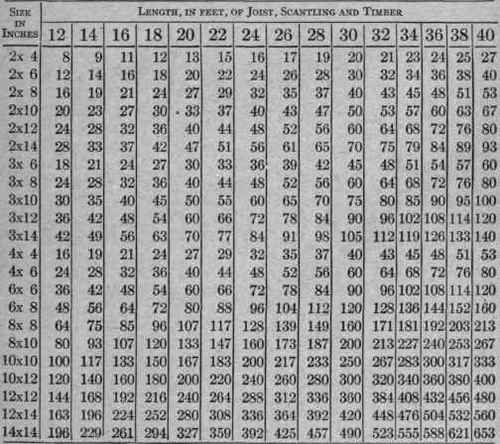
Strength Of Materials Yellow Pine Posts
Load in Tons | ||||||
Length IN FT. | Size in inches | |||||
4x4 | 5x5 | 6x6 | 7x7 | 8x8 | 9x9 | |
8 | 4 | 5 | 6 | 7 | 8 | 9 |
10 | 3 | 4 | 5 | 6 | 7 | 8 |
12 | 2 | 3 | 4 | 5 | 6 | 7 |
14......................... | 1 | 2 | 3 | 4 | 5 | 6 |
16......................... | ... | 1 | 2 | 3 | 4 | 5 |
18......................... | 1 | 2 | 3 | 4 | ||
Hard Pine Beams And Girders
Load in Tons | |||||
Length IN FT. | Size in inches | ||||
2x6 | 3x6 | 4x6 | 6x6 | 8x8 | |
6................................ | 1 | 1½ | 2 | 3 | 5½ |
8................................. | ¾ | 1 | 1½ | 2½ | 5 |
10................................ | ¾ | 1 | 2 | 4½ | |
12................................ | ½ | 1 | 1½ | 3 | |
14................................ | . . | ½ | 1 | 2½ | |
16................................ | • • a | ½ | 2 | ||
18................................ | 1 | ||||
STEEL I BEAMS | |||
Load in Tons | |||
Length in ft. | Size in inches | ||
6 | 8 | 12 | |
10.... | 7 | 14 | 18 |
12.... | 6 | 12 | 16 |
14.... | 5 | 10 | 14 |
16.... | 4 | 8 | 12 |
18.... | 2 | 6 | 10 |
20.... | 4 | 8 | |
22.... | 2 | 6 | |
24.... | .. | 4 | |
BRICK PIERS | |||||||
Load in Tons | |||||||
Height IN FT. | Size in inches | ||||||
6x6 | 6x8 | 8x8 | 8x12 | 12x12 | 12x16 | 16x16 | |
6......................... | 2 | 3 | 4 | 5 | 6 | 7 | 9 |
8......................... | 1½ | 2½ | 3½ | 4½ | 5½ | 6 | 8 |
10......................... | 1 | 2 | 3 | 5 | 5½ | 6 | 7 |
Stresses For Structural Timbers
Working Unit Stresses Used In Dry Locations | ||||
Bending | Compression | |||
Species of Timber | Stress in extreme fibre Lbs. sq. in. | Horizontal shear stress Lbs. sq. in. | Parallel to grain "Short Columns" Lbs. sq. in. | Perpendicular to grain Lbs. sq. in. |
*Fir, Douglas - | ||||
Dense grade............ | 1,600 | 100 | 1,200 | 350 |
Sound grade......... | 1,300 | 85 | 900 | 300 |
Hemlock, eastern......... | 1,000 | 70 | 700 | 300 |
Hemlock, western........... | 1,300 | 75 | 900 | 300 |
Oak....................... | 1,400 | 125 | 900 | 400 |
Pine, eastern white.......... | 900 | 80 | 700 | 250 |
Pine, Norway............... | 1,100 | 85 | 800 | 300 |
*Pine, southern yellow Dense grade.............. | 1,600 | 125 | 1,209 | 350 |
Sound grade......... | 1,300 | 85 | 900 | 300 |
Spruce..................... | 900 | 70 | 600 | 200 |
Tamarack.............. | 1,200 | 95 | 900 | 350 |
* Note: The safe working stresses given in this table are for timbers with defects limited according to the sections on defects in the rules of the Southern Pine Association for Select Structural Material. "Dense" southern yellow pine and "dense" Douglas fir should also conform to the other requirements of this rule. "Sound" southern yellow pine and "sound" Douglas fir require no additional qualifications, whereas the other species should, in addition to being graded for defects, have all pieces of exceptionally low density for the species excluded. •
This table gives working unit stresses for structural timbers used in dry locations, and is compiled in the main from material furnished by the Forest Products Laboratory, Madison, Wis.
Table Of Brick Wall Contents In Number Of Bricks
Seven Bricks to Each Sq. Ft. of Wall Surface | ||||||
No. OF SQ FT. OF WALL | Thickness | |||||
4" | 8" | 12' | 16" | 20" | 24" | |
1.................... | 7 | 15 | 23 | 30 | 38 | 45 |
2.................... | 15 | 30 | 45 | 60 | 75 | 90 |
3.................... | 23 | 45 | 68 | 90 | 113 | 135 |
4.................... | 30 | 60 | 90 | 120 | 150 | 180 |
5.................... | 38 | 75 | 113 | 150 | 188 | 225 |
6.................... | 45 | 90 | 135 | 180 | 225 | 270 |
7.................... | 53 | 105 | 158 | 210 | 263 | 315 |
8.................... | 60 | 120 | 180 | 240 | 300 | 360 |
9.................... | 68 | 135 | 203 | 270 | 338 | 405 |
10.................... | 75 | 150 | 225 | 300 | 375 | 450 |
20.................... | 150 | 300 | 450 | 600 | 750 | 900 |
30.................... | 225 | 450 | 675 | 900 | 1,125 | 1,350 |
40.................... | 300 | 600 | 900 | 1,200 | 1,500 | 1,800 |
50.................... | 375 | 750 | 1,125 | 1,500 | 1,875 | 2,250 |
60.................... | 450 | 900 | 1,350 | 1,800 | 2,250 | 2,700 |
70.................... | 525 | 1,050 | 1,575 | 2,100 | 2,625 | 3,150 |
80.................... | 600 | 1,200 | 1,800 | 2,400 | 3,000 | 3,600 |
90.................... | 675 | 1,350 | 2,025 | 2,700 | 3,375 | 4,050 |
100.................... | 750 | 1,500 | 2,250 | 3,000 | 3,750 | 4,500 |
Example - Determine the number of bricks in a wall 12"X18'X60'. Solution - The wall contains a surface area of 1,080 sq. ft. By the table
100 sq. ft. contains 2,250 bricks, then 1,000 sq. ft. will contain 22,500 bricks.
80 sq. ft. will contain, by the table, 1,800 bricks, making a total of 24,300 bricks.
Continue to:


My Books

