


Compressive Or Crushing Strength. Continued
Description
This section is from the book "The Mechanical Properties Of Wood", by Samuel J. Record. Also available from Amazon: The Mechanical Properties Of Wood.
Compressive Or Crushing Strength. Continued
The first is typical of any dry thin-walled cells, as is usually the case in seasoned white pine and spruce, and in the early wood of hard pines, hemlock, and other species with decided contrast between the two portions of the growth ring. As a rule buckling of a tracheid begins at the bordered pits which form places of least resistance in the walls. In hardwoods such as oak, chestnut, ash, etc., buckling occurs only in the thinnest-walled elements, such as the vessels, and not in the true fibres.
According to Jaccard6 the folding of the cells is accompanied by characteristic alterations of their walls which seem to split them into extremely thin layers. When greatly magnified, these layers appear in longitudinal sections as delicate threads without any definite arrangements, while on cross section they appear as numerous concentric strata. This may be explained on the ground that the growth of a fibre is by successive layers which, under the influence of compression, are sheared apart. This is particularly the case with thick-walled cells such as are found in late wood.
[Footnote 6: Jaccard, P.: Étude anatomique des bois comprimés. Mit. d. Schw. Centralanstalt f.d. forst. Versuchswesen. X. Band, 1. Heft. Zurich, 1910, p. 66.]
| TABLE VI | |||
|---|---|---|---|
| RESULTS OF ENDWISE COMPRESSION TESTS ON SMALL CLEAR PIECES OF 40 WOODS IN GREEN CONDITION | |||
| (Forest Service Cir. 213) | |||
| COMMON NAME OF SPECIES | Fibre stress at elastic limit | Crushing strength | Modulus of elasticity |
| Lbs. per sq. inch | Lbs. per sq. inch | Lbs. per sq. inch | |
| Hardwoods | |||
| Ash, white | 3,510 | 4,220 | 1,531,000 |
| Basswood | 780 | 1,820 | 1,016,000 |
| Beech | 2,770 | 3,480 | 1,412,000 |
| Birch, yellow | 2,570 | 3,400 | 1,915,000 |
| Elm, slippery | 3,410 | 3,990 | 1,453,000 |
| Hackberry | 2,730 | 3,310 | 1,068,000 |
| Hickory, big shellbark | 3,570 | 4,520 | 1,658,000 |
| bitternut | 4,330 | 4,570 | 1,616,000 |
| mockernut | 3,990 | 4,320 | 1,359,000 |
| nutmeg | 3,620 | 3,980 | 1,411,000 |
| pignut | 3,520 | 4,820 | 1,980,000 |
| shagbark | 3,730 | 4,600 | 1,943,000 |
| water | 3,240 | 4,660 | 1,926,000 |
| Locust, honey | 4,300 | 4,970 | 1,536,000 |
| Maple, sugar | 3,040 | 3,670 | 1,463,000 |
| Oak, post | 2,780 | 3,330 | 1,062,000 |
| red | 2,290 | 3,210 | 1,295,000 |
| swamp white | 3,470 | 4,360 | 1,489,000 |
| white | 2,400 | 3,520 | 946,000 |
| yellow | 2,870 | 3,700 | 1,465,000 |
| Osage orange | 3,980 | 5,810 | 1,331,000 |
| Sycamore | 2,320 | 2,790 | 1,073,000 |
| Tupelo | 2,280 | 3,550 | 1,280,000 |
| Conifers | |||
| Arborvitæ | 1,420 | 1,990 | 754,000 |
| Cedar, incense | 2,710 | 3,030 | 868,000 |
| Cypress, bald | 3,560 | 3,960 | 1,738,000 |
| Fir, alpine | 1,660 | 2,060 | 882,000 |
| amabilis | 2,763 | 3,040 | 1,579,000 |
| Douglas | 2,390 | 2,920 | 1,440,000 |
| white | 2,610 | 2,800 | 1,332,000 |
| Hemlock | 2,110 | 2,750 | 1,054,000 |
| Pine, lodgepole | 2,290 | 2,530 | 1,219,000 |
| longleaf | 3,420 | 4,280 | 1,890,000 |
| red | 2,470 | 3,080 | 1,646,000 |
| sugar | 2,340 | 2,600 | 1,029,000 |
| western yellow | 2,100 | 2,420 | 1,271,000 |
| white | 2,370 | 2,720 | 1,318,000 |
| Redwood | 3,420 | 3,820 | 1,175,000 |
| Spruce, Engelmann | 1,880 | 2,170 | 1,021,000 |
| Tamarack | 3,010 | 3,480 | 1,596,000 |
The second case, where the fibres bend with more or less regular curves instead of buckling, is characteristic of any green or wet wood, and in dry woods where the fibres are thick-walled. In woods in which the fibre walls show all gradations of thickness - in other words, where the transition from the thin-walled cells of the early wood to the thick-walled cells of the late wood is gradual - the two kinds of failure, namely, buckling and bending, grade into each other. In woods with very decided contrast between early and late wood the two forms are usually distinct. Except in the case of complete failure the cavity of the deformed cells remains open, and in hardwoods this is true not only of the wood fibres but also of the tube-like vessels. In many cases longitudinal splits occur which isolate bundles of elements by greater or less intervals. The splitting occurs by a tearing of the fibres or rays and not by the separation of the rays from the adjacent elements.
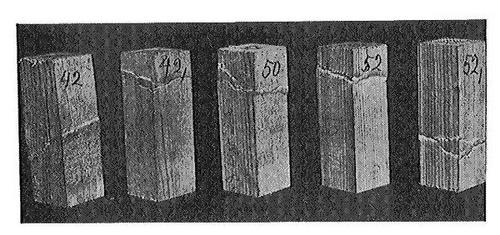
Figure 8
Failures of short columns of green spruce.

Figure 9
Failures of short columns of dry chestnut.
Moisture in wood decreases the stiffness of the fibre walls and enlarges the region of failure. The curve which the fibre walls make in the region of failure is more gradual and also more irregular than in dry wood, and the fibres are more likely to be separated.
In examining the lines of rupture in compression parallel to the grain it appears that there does not exist any specific type, that is, one that is characteristic of all woods. Test blocks taken from different parts of the same log may show very decided differences in the manner of failure, while blocks that are much alike in the size, number, and distribution of the elements of unequal resistance may behave very similarly. The direction of rupture is, according to Jaccard, not influenced by the distribution of the medullary rays.7 These are curved with the bundles of fibres to which they are attached. In any case the failure starts at the weakest points and follows the lines of least resistance. The plane of failure, as visible on radial surfaces, is horizontal, and on the tangential surface it is diagonal.
[Footnote 7: This does not correspond exactly with the conclusions of A. Thil, who says ("Constitution anatomique du bois," pp. 140-141): "The sides of the medullary rays sometimes produce planes of least resistance varying in size with the height of the rays. The medullary rays assume a direction more or less parallel to the lumen of the cells on which they border; the latter curve to the right or left to make room for the ray and then close again beyond it. If the force acts parallel to the axis of growth, the tracheids are more likely to be displaced if the marginal cells of the medullary rays are provided with weak walls that are readily compressed. This explains why on the radial surface of the test blocks the plane of rupture passes in a direction nearly following a medullary ray, whereas on the tangential surface the direction of the plane of rupture is oblique - but with an obliquity varying with the species and determined by the pitch of the spirals along which the medullary rays are distributed in the stem." See Jaccard, op. cit., pp. 57 et seq.]
Continue to:


My Books

