


Simple Works In Wood. Part 10
Description
This section is from the book "Our Workshop", by Anonymous. Also available from Amazon: Our Workshop.
Simple Works In Wood. Part 10
The bevil, however, can be employed for any angle by simply altering the position of the blade, which is attached to the stock by a pin that affords the requisite freedom. This tool is very useful for "trying" the truth of the mitre at the extremities of the pieces of a light frame, etc, as the kerf in the sawing-block may not be quite exact, and subsequent correction of the mitre by the plane is then necessary. The stock of the bevil must be applied to the surface of the work, and the blade to the edge or side which is to be bevilled.
The brad-awl, shown in two views (fig. 53), is the simplest of the boring tools for wood. It consists of a cylindrical steel wire with a chisel edge, which is formed by grinding a chamfer on two opposite sides. The awl is fixed in a small handle made of beech, box, or other hard wood. This tool answers very well for making holes in soft woods, but as it displaces rather than removes the fibre, it is apt to split hard material. The wire-worker's awl (fig. 54) is better qualified for boring hard wood, being square, and sharpened on the four corners or angles, which cut the fibre as the tool revolves. It gradually tapers also towards the extremity, which terminates in a sharp point, formed by grinding a slight chamfer for a short distance on each of the sides.
Large holes can only be made by removing the material, and much ingenuity has been displayed in the formation of "bits" which, by allowing the chips to escape while boring, save the time which would otherwise be lost in frequently withdrawing and clearing them. The simplest of these contrivances is the shell, also called the gouge-bit or quill-bit (fig. 55). In shape it much resembles an ordinary gouge, and it is sharpened at the end in a similar manner. The sharp extremity shears the fibre of the wood round the margin of the hole, and the material entering the semi-cylindrical shell is removed almost as a solid piece. Holes of several inches in depth can be bored with this kind of bit, and it will work very easily if lubricated with a little tallow. When boring a deep hole, the tool is apt to go astray; it is therefore advisable to change the position of the work occasionally, to prevent the accumulation of error in one direction. If the work be turned a quarter round after every twenty revolutions of the bit, the latter will not depart far from its intended course.

Fig. 53.

Fig. 54.

Fig. 55.
A larger variety of the quill-bit is met with in the shell-auger (fig. 56). The body or shell still resembles a gouge, but the cutting extremity is differently formed. A plan of the cutter is shown above. It consists of a small transverse blade, which pares away the wood, and allows it to escape into the shell.
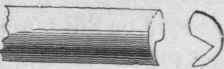
Fig. 56.
The common gimlet (fig. 42), is a diminution of the shell-bit, with only this difference, that the former terminates in a screw instead of a sharp edge. The screw is conical in shape, gradually decreasing from the full diameter of the shell to a sharp point. The tool is drawn into the wood by the screw, and the cutting is performed by the sharp angular corner at the extremity of the fluted part. When the shell or fluted part has penetrated about an inch into the wood the instrument must be unwound to liberate the screw, and then withdrawn and emptied. The gimlet is more apt to split the wood than the gouge-bit, and should not be used near the margin of work, especially if the material be hard or brittle.
The twisted gimlet (fig. 44), to which reference has before been made, may be employed with less risk of splitting the work. The stem is conical, or larger at the upper than at the lower extremity, which is formed into a screw precisely similar to that of the fluted gimlet. Instead of a longitudinal groove or flute, a spiral groove is made in the stem for the escape of the material.

Fig. 5/.
The cutting is done by the sharp extremity of the stem at the termination of the spiral groove. The centre-bit shown in two views in fig. 57 is a very useful tool, much employed for boring holes which are required to be round, smooth, and parallel, but not very deep. The point, p, is stuck into the wood where the centre of the intended hole should exist, and after the point has penetrated a short distance, the nicker, n, which is sharp and knife-like, marks out the circumference of the hole. The pressure applied by the operator causes the centre-point and nicker to sink into the wood as the bit revolves, and the cutter, c, pares away the material within the circle described by the nicker. The efficient action of this instrument depends on the proper relative proportions and sharpness of the centre nicker and cutter. The centre must be a little longer than the nicker, to enable the tool to-obtain a steady footing before it is required to-withstand even the slight strain brought upon it by the nicker. The nicker must in its turn be in advance of the cutter, so that it may divide the fibre round the margin of the intended hole, previously to the removal of the wood by the cutter, which latter should have a little less radius than the nicker, as it must not touch the circumference of the hole. The nicker leads or prepares the way for the cutter throughout the entire depth of the hole, and also leaves its circumference tolerably smooth. The length of the centre from its point to the edge of the cutter is available for keeping the bit in its true position. The bit represented in fig. 58 is unprovided with a nicker, but is furnished with two cutters, one on each side of the centre-point. If the tool be sharpened down the sides, which must also be exactly parallel, it will bore hard wood very satisfactorily in all directions of the grain.
When the bits become blunt, they can be sharpened by rubbing the cutting parts with a small slip of oilstone, which may be purchased at any tool-shop. As the grindstone cannot be employed, the bits should not be too long neglected, otherwise it will take some time to restore them to an efficient condition. If the steel be not very hard, a fine file or a bit of gritstone may be used prior to the oilstone, if the bit has become very blunt.

Fig. 58.
The centre and small gouge-bits have motion imparted to them by the brace (fig. 59), which is simply a crank made of either iron or wood. A metal socket or pad is provided at the lower end, into which the shanks of the bits are inserted. The hole in the pad is square, and slightly taper, and a spring catch is added to retain the bit while it is being withdrawn from the wood. The upper extremity of the brace is fitted with a swivel-cap or head, which the carpenter places against his chest when using the tool horizontally, but he holds it in his left hand when employing the instrument vertically.

Fig. 59.
The large shell-bits require much power to move them, and are therefore fitted at one end with a transverse handle, somewhat similar to that of an ordinary gimlet. Sometimes a ring or eye is formed at the extremity of the shank, and a handle is driven tightly into it.
As the amateur is not likely to require boring tools of large size, it is unnecessary to consider the formation of twisted augurs, etc, which are only combinations of the twisted gimlet and the centre-bit.
When using a centre-bit to bore a hole quite through a piece of work, the tool must not be allowed to pierce the opposite side, as it will leave the margin of the hole torn and uneven. Directly the centre-point appears, the bit must be withdrawn, and the work turned over. The centre-point can then be placed in the small hole it has made, and the large hole be satisfactorily finished. Very little pressure must be used, or the thin plate of wood will be forced in, and leave the edge more ragged than if the hole had been completed from one side.
Continue to:


My Books

