


Chapter VI. Grooving Planes, Etc
Description
This section is from the book "Our Workshop", by Anonymous. Also available from Amazon: Our Workshop.
Chapter VI. Grooving Planes, Etc
THERE are many joinery works which cannot be conveniently united by nails and screws, and even glue in some situations would be of little service. The strength and neatness of many works depend on the judicious employment of tongued and grooved attachments, rebates, mouldings, etc, which are formed by suitable planes, totally distinct from those used for surfacing. The surfacing-planes, however, must in all cases be first employed to impart the requisite truth to the work, previously to applying the grooving-planes, etc.
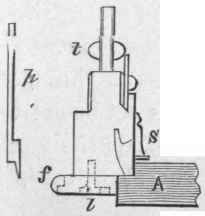
Fig. 60.

Fig. 61.
Fig. 60 is a back, and fig. 61 a side view of the aide fillister, which is employed for planing a rebate around the edges of a panel, a portion of which is seen at A. The fillister is required to work, not only with, but also across the grain. We have seen that soft wood, like pine, cannot be smoothly planed across the grain, and that the plane must be held obliquely to enable the cutting edge of the iron to attack the fibre as favourably as possible. It must be evident that the fillister, and planes of a similar class, which are always constrained to move parallel with the edge of the work, cannot be used obliquely when cutting across the grain. To surmount this difficulty, the iron is fixed obliquely in the stock, instead of straight across, as in the sur-facing-planes.
The depth and width of the rebate are regulated by moveable pieces attached to the stock, which are capable of great nicety of adjustment. The width is determined by the amount the loose strip or fence, f, f, figs. 60 or 61, is set back from the side of the stock which is towards the work, and the depth by the height the stop, s, s, is raised from the sole.
To make this quite clear, we will suppose that the rebate is one inch wide and one inch deep. The screws, l, l, which secure the fence to the sole, must be slackened, and the fence set back one inch from the side of the stock. The distance must be measured by the rule at both ends of the plane, care being taken to set the edge of the fence quite parallel to the side; the screws are then tightened. The depth is more readily adjusted, it being only necessary to raise the stop, s, s, one inch above the sole, by turning the thumb-screw, t, t, in the proper direction. Both measures are now fixed, and the iron will continue to cut until the stop, s, s, by coming in contact with the surface of the work, prevents any further encroachment. The fence, f, f, by rubbing along the edge of the work, not only determines the width of the rebate, but also keeps its shoulder parallel to the edge. It must be understood that the fence is placed against the margin of the panel from the first, and continues in contact with it until the rebate is finished.
The oblique iron, like the cutter in an ordinary surfacing-plane, is sharp only on the lower edge which works the rebate in the direction of its depth. The shoulder or perpendicular edge would therefore be left rough, if another addition were not made to the fillister. A small supplementary cutter or scoring point, p, p, is fixed in advance of the oblique iron, and, by dividing the fibres, makes the perpendicular edge or shoulder clean and square. The action of this little tooth or blade, seen separately on the lefthand side of fig. 60, is somewhat similar to that of the "nicker" of the centre-bit. Most of the planes for working across the grain are furnished with oblique irons and scoring-points.
The skew rebate, also called the rabbet-plane, is frequently used instead of the fillister, but owing to the absence of the fence and stop, it is more difficult to manage satisfactorily. This tool is shown in elevation in fig. 62; fig. 63 is an end view, and fig. 64 is a plan of the sole. The iron (fig. 65), like that on the fillister, is fixed obliquely or askew in the stock. No scoringpoint is provided, but the iron is made to act in a two-fold manner, by sharpening the right-hand edge, r, so that it may work the perpendicular side of the rebate. A hole, h, fig. 62, passes through the side of the stock to allow the shavings to escape.

Fig. 62.

Fig. 63.

Fig. 64.

Fig. 65.
Square rabbet-planes, in which the irons are set straight across the stock, are also in very general use. The iron is sharp only on the lower edge, and is employed in the lengthway of the grain. Neither the skew nor the square rabbet-plane can be used with certainty to commence a rebate, owing to the absence of a fence to determine its width or the distance from the margin of the work. A practised joiner may execute the work by the aid of a deep gauge-line, indicating the width of the rebate, and placing his fore-finger under the sole and against the margin of the board, to act as a fence. If, after gauging a deep line, the wood be roughly removed by a firmer chisel, in order to leave a shoulder to guide the plane, the difficulty will be much diminished. A narrow strip of wood is sometimes temporarily tacked on to the sole of the plane to serve as a fence, exposing only as much of the iron as the width of the intended rebate. If the perpendicular side of the rebate be left rough, the plane must be turned over to enable the iron to work it.
The plough (fig. 66) may be used either as a rebate or a grooving-plane, but it is more especially qualified for the latter. In some respects the plough is similar to the fillister, being furnished with a fence and a stop. The fence, f, is not immediately attached to the stock, but is built on two transverse stems, s, s, which penetrate the sides of the stock, and afford the fence a much greater horizontal range than it could otherwise possess. The position of the fence being determined, the stems are locked by thin wedges, which are knocked in gently, so that they may again be easily liberated. The iron is not fixed obliquely in the stock, but square across, as in the surfacing-planes. The width of the groove is the same as that of the iron, consequently the plough must be furnished with several cutters. An iron plate, p, p, is secured to the stock, in order to retain the cutter in the perpendicular position, which it effects by fitting into a narrow angular groove made in the back of the latter; the plate is cut away in front of the blade to allow the shavings to escape. As the plough is almost invariably employed in the lengthway of the grain, the scoring-point is not required.
Continue to:


My Books

