


Simple Works In Wood. Part 7
Description
This section is from the book "Our Workshop", by Anonymous. Also available from Amazon: Our Workshop.
Simple Works In Wood. Part 7
Occasionally the pincers (fig. 38) must be used to extract a nail which has become hopelessly crippled. If the nail be very fast, as it often is in hard wood, one of the bows of the pincers must be allowed to rest on the surface of the work, in order that it may act as the fulcrum of a lever when the handles, which must be grasped in the right hand, are powerfully depressed. A double claw is provided at the end of one of the handles for "prizing up" nails which have been home. The claws are sharp enough to penetrate the wood around and under the head of the nail, the neck of which can then pass between them. By depressing the opposite end of the pincers the nail will be raised sufficiently to enable us to draw it out.
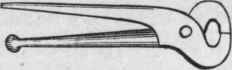
Fig. 38.
If the work require a finishing touch from the plane, the heads of the nails must be punched below the surface. This is almost equally necessary if the wood is to be painted, and the cavities left by the displaced heads must be filled with putty to hide them. The punch consists of a cylindrical piece of steel about three inches long, tapering from the middle of its length to one extremity. The point must be quite blunt, otherwise it will not drive the nail down satisfactorily. Two opposite sides of the taper end of the punch must be flat for brads, and somewhat similar in shape to the nail itself. The point of the punch must be hardened to enable it to retain its shape. If the end be heated to a dull red, and then be thrust into a lump of tallow or candle-grease, it will become sufficiently hard.
The wood screw, also sometimes called the screwnail, is a strong and ready means of uniting numerous works in wood. The screw possesses a great advantage over the nail in situations where considerable strength is required, as it powerfully resists any tendency to draw it out of the wood like a common nail. There are many instances in joinery and cabinet making, in which a nail would be useless, owing to the fragile character of the work and the trifling thickness of the material, which could not afford sufficient hold for a nail. It is in these delicate articles that the screw proves of so much value. The screw, unlike the nail, needs no application of the hammer, which is another advantage peculiar to the former. The jar occasioned by driving a nail would be fatal to some of the lighter classes of works, supposing nail-hold could be found in them.
Probably Mr. Nettleford's patent screw represented at A, fig. 39, is the best at present manufactured. The upper side of the "thread" which is flat and considerably inclined, offers great resistance to the screw being drawn out of the wood like a common nail. The thread may be compared to a cone, the base of which stands upwards. The conical or sloping sides of the thread enable the screw to penetrate the wood with great facility. The stem or shank of the screw is also made taper, being smaller at the extremity than at the commencement of the thread. At B is shown the mould or impression made by the screw in wood; and at C is seen the irregular and imperfect counterpart of the thread of a common wood-screw. Nettleford's patent screw may not be sold by the tradesman with whom some of our readers may be obliged to deal; however, the best specimens of the ordinary screws will answer sufficiently well for many purposes.

Fig. 39.
When choosing either iron or brass wood-screws select those with moderately deep threads, approaching as nearly as possible the shape of A, fig. 39. The end or point of the screw must also be smaller than the blank part just below the head. Those having a projecting bur at the extremity of the thread should be rejected, as the bur is apt to tear away the wood as the screw advances, leaving little or perhaps nothing by which it can hold. The nick, or diametrical saw-cut made in the head for the screw-driver, must be of uniform depth, and not, as it frequently happens, highest at the centre. The depth of the nick is also of some importance, for if too deep the head is liable to be broken by the screw-driver, which latter, however, will have insufficient hold if the nick be too shallow. The depth of the nick may with advantage be about half the thickness of the head, and it should be of the same width throughout.
The end of the screw-driver should be formed as shown in the two views, fig. 40. The sloping sides, or chamfers, must not meet at the extremity, or a sharp edge will result, which would injure the sides of the nick if the screw-driver slipped out. The chamfers must be ground to an angle of about ten or fifteen degrees, or the tool will be unable to retain its hold in the nick, and by frequently slipping out it will not only disfigure the head of the screw, but also lessen our power to move it. For very large wood-screws, and for screws for metal work, the extremity of the driver should be somewhat differently formed, as seen in fig. 41. The sloping sides, or chamfers, are unfavourable in their action when much resistance has to be overcome, as the pressure on the inclined surface is apt to force the tool out of the nick. In fig. 41 the sides of the driver are filled parallel for a short distance, to enable it to fit the nick for its entire depth. The parallel part must not be deeper than necessary, or it will be liable to break; and for the same reason a sharp angle or corner should be avoided where the straight part meets the chamfer. The end must be made of steel, and hardened, so that a smooth file will just scratch it. There is less difficulty in driving a screw straight than a nail, as the former will generally follow the direction of the hole made to receive it, while the latter is influenced in a great measure by the blows of the hammer.

Continue to:


My Books

