


Bowls
Description
This section is from the book "Art And Education In Wood-Turning", by William W. Klenke. Also available from Amazon: Art And Education In Wood-Turning.
Bowls
Bowls and solid trays, Plate XIII, come under the heading of face-plate work, and regardless of design, are all worked out in much the same manner. However to make the following description a little easier to follow, we will take one of the nut bowls as our example.
The rough stock should be 1 3/8"X 4 3/4"X4 3/4", dressed on one face, (a) Cut out a 4 3/4" circle on the band-saw. If no band-saw is available, simply cut off the corners with a handsaw, (b) glue the dressed surface to a piece of whitewood of about the same diameter, with a piece of note paper between. The object of the paper is to separate the fibers of the waste wood from the wood to be turned, so that a few light taps with a chisel and mallet will separate the two pieces when the work has been completed.

Plate XIII.
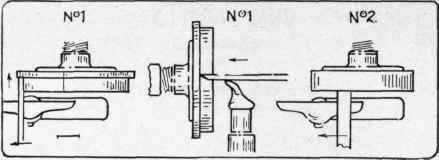
Fig. 41.
After the glue has set (use nothing but the best grade of hot glue on all problems); (c) screw the faceplate in place, (d) Start the lathe on slow speed, with the tee-rest parallel with the face of the work and a little below the center line. By means of the 1/8" mortising chisel, held horiziontally and standing on its edge, (e) cut in the direction indicated in No. 1, Fig. 41. Do not cut the entire thickness, otherwise the wood on the opposite face will split off. Merely cut off enough wood to center the work, (f) Turn the tee-rest parallel with the edge, and with a gouge clean off the remaining wood.
Having turned the wood to the largest possible diameter, (g) face off the surface with a 1" flat scraper, No. 2, Fig. 41, working from the center out, and to a thickness of 1 1/4" (measuring from the glued joint).
(h) Trace on a scrap piece of paper, the inside outline of one-half of the bowl, as indicated in Fig. 42. (i) Transfer this to a piece of cardboard and cut with a sharp knife. This pattern is known as a templet, by the aid of which it is possible to obtain the correct shape of the inside of the bowl.

Fig. 42.

Plate XIV.

Plate XV.

Plate XVI.
With a 1/8" chisel, (j) cut a diameter of about 1" and 1 1/16" deep (scant measurement): measure the depth as indicated, Fig. 43. (k) Hollow out the inside with a round-nose scraper to conform with the templet. (1) Now sandpaper thoroly. (m) Shape the outside with flat, skew, and round-nosed scrapers, keeping a uniform thickness, Fig. 44. The thickness of the outside must be calipered with the fingers. Having performed all necessary turning, (n) sandpaper the work thoroly and polish. (See Finishing, page 33.) To separate the bowl from the waste wood, place a 1" flat scraper in the glued joint (with the bevel against the waste wood), and tap gently with a mallet. Clean off the bottom and glue on a piece of felt. Since glue will not adhere to oily surfaces, and there is a great possibility of grease working its way on the bottom from polishing and handling, it is better to use shellac. Put on one coat and allow it to dry. A second coat is then applied, using rather thick shellac, and when "tacky," put the felt in place. Trim off the edge of the felt with a sharp knife when the shellac is dry.

Fig. 43. Measuring the Depth of a Bowl.

Fig. 44
Continue to:


My Books

