


The Darning Ball
Description
This section is from the book "Art And Education In Wood-Turning", by William W. Klenke. Also available from Amazon: Art And Education In Wood-Turning.
The Darning Ball
Our first complete problem, combining all the cuts of the three preceding exercises, is represented by the darning ball, Plate II.
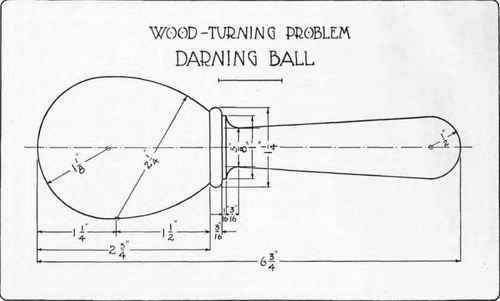
Plate II.
In working out this problem, we not only make use of the various cuts just mastered, but we also introduce the use of sandpaper and polish.
The stock for the darning ball is maple, 2 3/8"x2 3/8"x9". Maple is used because it is a light-colored, tight-grained, hard wood, all of which requirements are essential in the making of a good darning ball.
Fig. 24 illustrates the blocking-out of the wood so as to properly locate lengths and diameters at important points.
Having blocked out the work, turn the left-hand end of the ball, then the right-hand end, thus clearing away enough wood so that the small bead and cove can be turned, Fig. 25. Next the tapering part of the handle is shaped, and finally the rounded end.
It must be remembered, however, that this problem is to be sandpapered, oiled, and polished, therefore it is not advisable to weaken the ends beyond 3/8" diameter; until all polishing has been completed.

Fig. 24.
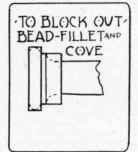
Fig. 25.
The ends are to be cut clean with a knife, filed, and thoroly sandpapered, removing every scratch or mar. It may be necessary, while sandpapering, to take off some of the polish, but this can easily be refmished by hand.
Continue to:


My Books

