


A Home-Made Seismograph
Description
This section is from the book "Handy Man's Workshop And Laboratory", by A. Russell Bond. Also available from Amazon: Handy Man's Workshop And Laboratory.
A Home-Made Seismograph
The Scientific American has occasionally told its readers something of the seismograph, and of the mysterious tremors and pulsations of the earth's crust that it reveals. But probably very few have ever seen one, or had the opportunity to "feel the earth's pulse" for themselves. Yet a really serviceable seismograph can be constructed by anyone with a mechanical head, with very few tools and a very small outlay. The following is substantially a description of the seismograph constructed by the writer at Euphrates College. Harpoot. Turkey. It involved an outlay for materials of less than three dollars. This instrument has been in operation for the past sixteen months, and has during that time recorded over one hundred and sixty earthquakes. Its construction is shown in the accompanying engraving.
The Steady Mass
The fundamental part of the instrument is a horizontal pendulum, whose function it is to remain at rest during an earthquake. The mass is a sheet-iron drum, A, full of gravel, weighing about eighty pounds. This is fixed securely to the end of a one-inch iron pipe, E, whose other end rests, by a frictionless bearing C, against a solid wall. The drum is also hung from the wall by a similar bearing at C". The bearings are made as follows: The half-inch machine bolts. B and B'. turn in nuts which are very firmly imbedded in the wall. In a slight depression in the head of B a quarter-inch bicycle ball, C, is set, with wax. Against this ball rests a polished, hardened steel plate, D. slightly concave, which is tacked to the hardwood plug driven into the end of the pipe E. The upper bearing ball. C, is set in a depression in the bent bar F (1 1/2 by 3/8-inch iron) which is firmly clamped to the wall by the bolt B'. The concave steel plate is is cemented to the iron stirrup G. The other end of the stirrup is formed into a hook, over which passes the suspending wire. W, whose ends are fastened to the ends of the rod H H',. which passes through the drum . A.
Adjustment Of The Steady Mass
By tapping the bar F to one side or the other, the bearing C' is brought exactly over C . so that the pendulum swings out perpendicular to the wall. The bolt B is then turned in or out, to regulate the period of the swing. The pendulum, when disturbed, should swing back and forth once in forty or fifty seconds. Turning the bolt B inward shortens the period, turning it outward lengthens it. If B is too far out, the pendulum will not swing back and forth, but will swing clear over to either side. As it is impossible by moving the plate F to adjust the pendulum very exactly, a weight, Z, of two or three ounces, is hung by a long thread against the strut E a few inches from the bearing. The support from which this weight is hung can be adjusted, so as to bring more or less pressure on the strut as needed.
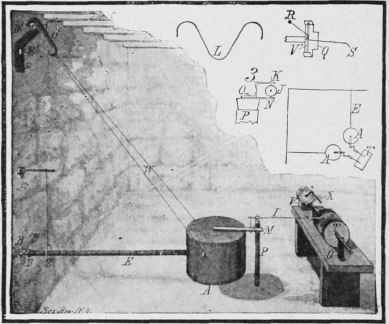
Fig. 193 - A home-made seismograph.
Multiplying Lever And Recording Pen
To the steady mass is connected the short arm of the multiplying lever I. The short arm consists of a bit of brass wire. No. 12, three inches long. It is inserted into the cork f which serves to join together the two arms of the lever and their pivot. A'. At one inch distance from the pivot the brass wire is flattened slightly on top, and a conical depression is made in it. In this depression rests one point of a link, L, of fine piano wire, shaped as shown in the detail view. The other end of the link rests in a similar depression in the brass bar .M. which lies on the pendulum drum. This link com-municates any motion of the drum to the short arm of the lever I. The long arm of the lever is a stout straw, fourteen inches long. The short arm should nearly balance the long one; if necessary, a drop of solder may be added at the end of the wire. At the end of the long arm is a crosspiece, Q, of aluminium foil, whose two ends are bent up to form a support for the needle V' whose pointed ends rest in depressions in the foil. A piece of No. 24 aluminium wire is given two turns about the needle V' and cemented to it. One end of the wire, an inch long, is ground to a conical point, .S', and bent downward so that the point rests on the drum T. The other end is bent up and to one side, and cut off half an inch long. A drop of wax, R, makes this short arm nearly balance the point. Thus when the point is down, it rests on the drum very lightly, and when swung- up. the short arm does not touch the drum. The pivot, K, is a common sewing needle, rather fine, whose point rests in a conical depression at .V. while the upper end passes through a fine hole in the sheet-brass yoke, K 0 N. The latter is fastened with a screw to the top of the post p, which is an iron pipe, firmly planted in the ground, with a hardwood plug driven into its upper end.
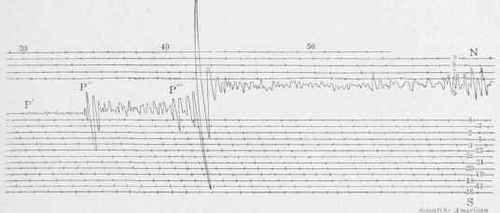
Fig. 194 - A diagram or the Boklhara earthquake recorded by the homemade instrument at Harpoot, 1850 miles away..
Recording Drum And Clock
The recording drum is a cylindrical tin can closed at both ends, with a quarter-inch shaft fastened in its exact axis. The drum must he perfectly balanced on its axis by adding wax or solder to one side or the other. The shaft rests on uprights, U, of thick strap iron, which are fastened to the table 011 which the recorder is mounted. A screw thread of about thirty turns is formed on one end of the shaft with a soft brass wire, wound spirally and soldered at each end. This thread engages the upright, U, and drives the drum slowly forward as it. rotates. The clock is an ordinary one-dollar lever clock. It is firmly fastened on the block. V, on the table, so that its axis is exactly in line with that of the drum T. The L-shaped iron wire .V is soldered along the minute hand, and also to its bushing and pivot, so that it will rotate rigidly with the minute hand. The long arm of the L is parallel with the axis of the drum, and is engaged by a fork soldered to the end of the shaft. Thus the drum rotates with the clock, but moves gradually along its axis, On the drum is wrapped a sheet of white glazed paper, held in place by an open ring of spring wire slipped over each end of the drum. The paper is blackened by revolving the drum over a large, smoky flame, such as a kerosene torch.
Continue to:


My Books

