


Rotagons
Description
This section is from the book "Handy Man's Workshop And Laboratory", by A. Russell Bond. Also available from Amazon: Handy Man's Workshop And Laboratory.
Rotagons
There is a class of geometrical figures possessing peculiarities which possibly have not been investigated or published before. For the sake of a title, and owing to the relation these figures bear both to circle and polygon, let us arbitrarily name them "rotagons." A rotagon is a plane figure whose perimeter is composed of an odd number of circular arcs such that each point where two arcs meet is the center from which the opposite are may be described.
Referring to Fig. 190, the figures A, B, C, and D show four out of an infinite number of forms which the rotagon may take. It may be observed that these figures have the same width in all directions, that the sum of the arcs equals a semi-circle, that the sum of the points of the inscribed star is therefore 180 degrees, or in other words, the dotted line and arcs represent the overlapping sectors of a semi-circle, and that these dotted lines may be conceived as link work whose limit of motion is reached in the figure A. When inscribed in a square or rhomb, rotagons may be conceived as turning around while remaining at all times in contact with the four sides. When regular in form, they may turn in any regular polygon the number of whose sides is one more or one less than the number of arcs, and they will maintain contact with all of the sides. It follows that the same motion is possible within any combination of three or more sides of the polygon, which, if produced, will close.
The motion is complex and the complete orbit of any given point consists of a number of elements (glissettes) which may be either elliptical, circular, or straight. These orbits, by reason of their composite nature, are of curious and even fantastic forms. Some idea of their endless variety may be gained from the accompanying diagrams, which were developed graphically by means of cardboard models. As the figure A turns in a square (see Fig. 190), the points I, 2, 3, 4, describe the paths shown in section E. Sections F, G, and H contain the orbits of the same points as the figure turns in rhombs, whose minor angles are respectively 75, 60, and 45 degrees. Sections K, L, M, and N show the corresponding curves for points 1, 2, 3, 4, in the figure B. When A revolves once in a square, its center of gravity at point 1 makes three revolutions in an opposite direction in an orbit composed of four elliptical arcs. Regular rotagons produce symmetrical orbits, but irregular figures such as C and D produce unsymmetrical orbits. That such complex and intricate motions are possible in a single moving part under such simple conditions of operation, seems almost incredible until one has made the experiment. There is a singular grace and beauty in some of the curves, which suggest possible adaptation in the field of decorative design.
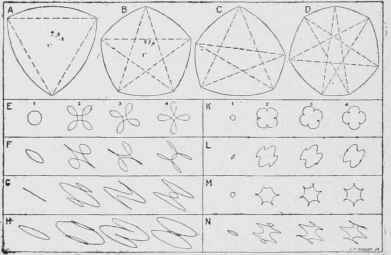
Fig. 190 - Figures produced by rotagons of various forms.
Fig. 191 shows more fully the motion of the triangular rotagon. Twenty points are taken in the figure DAE, the point O being at the center and points 1, 2, 3, etc., being on the three axes A, B, and C. Each point and its corresponding orbit is indicated by the axis letter and the number of the point on that axis. The orbits marked 90 degrees are described by these points when the rotagon moves in a square, and the other orbits are developed by turning the figure in rhombs, whose minor angles are 75, 60, and 45 degrees, as indicated.
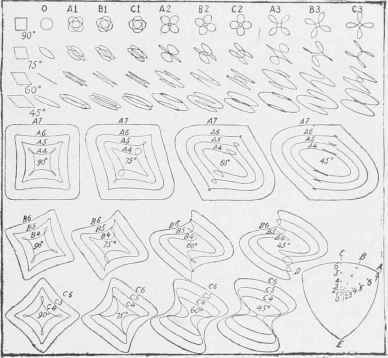
Fig. 191 - Motions of a triangular rotagon in a square and rhombs of various angles.
In Fig. 192 the model f is shown ready for operation. The weighted pencil b is inserted in one of the boles in the cardboard and the model is turned around by hand and at the same time kept in contact with the guides aa, which may be set at any angle. As the motion is determined by two contact points, the other two sides are unnecessary. The model used is about six inches in diameter, and from the orbits drawn by the pencil, freehand ink tracings were made in order to facilitate reproduction in the accompanying cuts. This accounts for some roughness in the curves, which does not exist in the pencil drawings. Five-sided and seven-sided models (c and d) are shown in the illustration, and also a piece of wood c resting on "three-cornered roller ' When set in motion c travels in a straight line, exactly as if supported on cylinders, while the motion of the supports is alternately circular and cycloidal. The same motion would follow with any other form of the rotagon. To most persons it will come as a surprise to realize that a cylinder is not the only form of roller which will impart straight-line motion to a supported body.
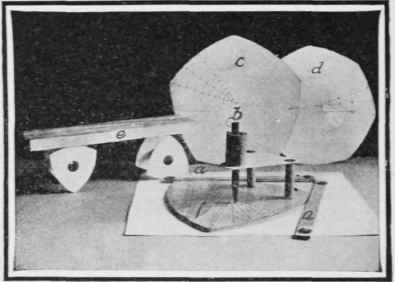
Fig. 192 - Rotagon apparatus for producing geometrical figures.
The rotagon may possess little interest for the mathematician and may be without value in the realm of mechanics, but its properties are so unique and the infinite variety of its fixed motions is so startling that it becomes worthy of investigation, even if regarded onlly as a scientific toy.
Continue to:


My Books

