


An Inexpensive Ice Yacht
Description
This section is from the book "Handy Man's Workshop And Laboratory", by A. Russell Bond. Also available from Amazon: Handy Man's Workshop And Laboratory.
An Inexpensive Ice Yacht
The following description of a junior ice yacht is not taken from a published article, or a design suggesting how to make a good boat, but is a description of one which has been already made, and proven a marked success. While there were many boats alongside, made of all manner of designs and material, from the first-class boats designed by experts to the yachts made by the farmer boys, from fence rails and ice skates, with a table cloth or bed sheet tor sails, this particular one outclassed them all, for sped at any rate.
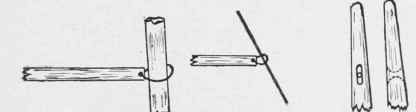
The mast and gaff rings and detail of the mast head.
The material can be easily procured, in most cases from the lumber pile in the back yard or wood shed. But in any case it should cost but a few dollars complete.
The general view of the yacht is shown in Fig. 340, with the various parts lettered to correspond with the details on Fig. 341, and the plan of boat shown in Fig. 342.
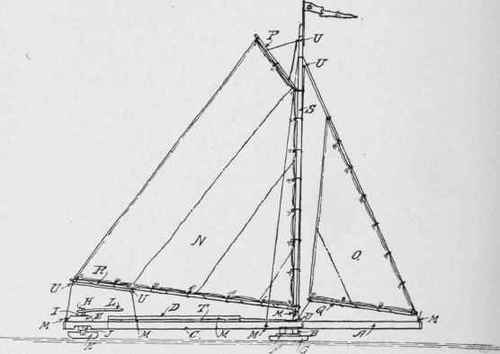
Fig. 340 - General view of the ice yacht.
The backbone A is made from 3 by 4-inch pine, notched where shown, for the cross arm or runner plank B and the rudder K. The cross arm B is made from 2 by 8-inch timber. Two parallel saw cuts are ripped up the ends, 3 inches apart and 2 feet in length, one foot of which is cut away as shown. The other foot is to give pliability to the boat, should the side runners strike any object when racing. The 2 by 1/4-inch recess at either end is to fit over the piece marked F, which bears on the upper side of the runners G. Holes for 1/4 -inch bolts are bored and drilled through each, as indicated. Find the middle of the cross arm, and secure it to the backbone with spikes. A notch for the mast, one inch deep, is cut in the backbone with a chisel, and a 3/4-inch hole is bored in the end for the rudder.
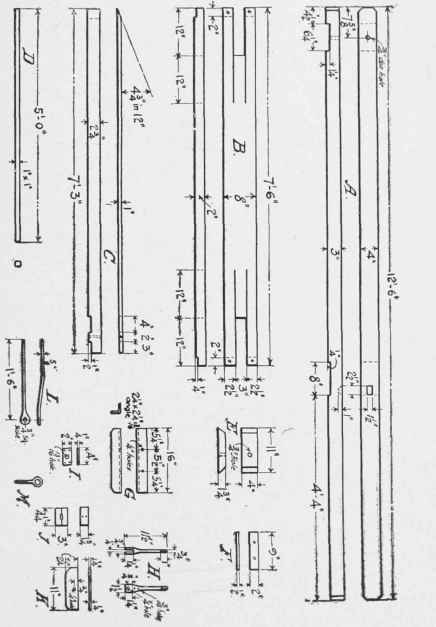
Fig. 341 - Details of the yacht frame.
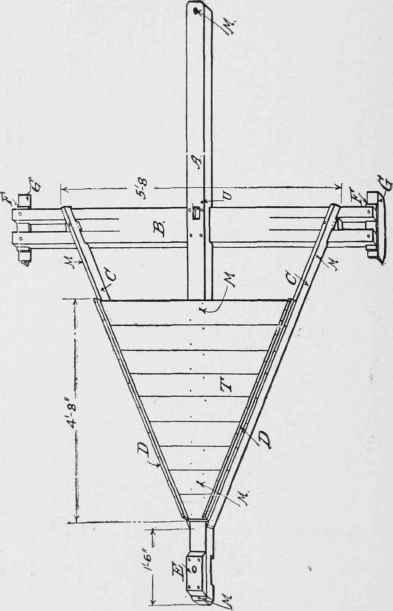
Fig. 342 - Plan view of the frame.
The side frames C are made from hardwood chamfered at one end 4 3/4 inches in one foot. Care must be taken to make them right and left, or else cut the notches at the other end. the last thing-. These notches must be carefully cut. to escape the free ends of the cross arm when they spring. Referring to Fig. 342, their location will be seen. Secure the chamfered ends 18 inches from the end of the backbone, spreading them 5 feet 8 inches apart, on the cross arm B, and nailing them to the 3-inch tongues with a single nail driven from the top, and with small toe nailing. Holes should be bored for the former. The flooring T can be made from almost any kind of boards nailed to the sides C, and finished off with railing strips D, 1 inch square.
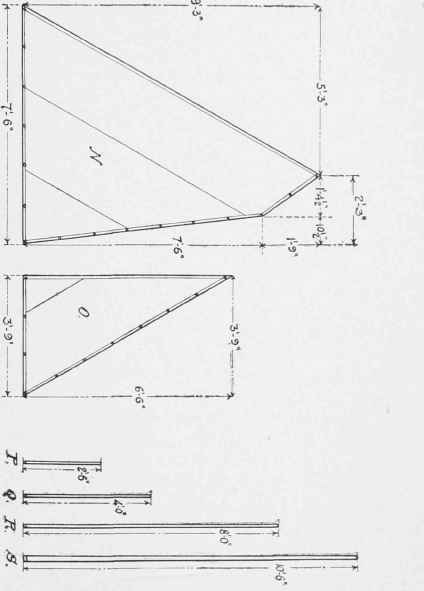
Fig. 343 - Dimensions of the sails and spars.
The side runners G are made from 2 1/2 by 2 1/4 by 3 16-inch angles, though a piece of steel or iron, bent into shape, or even an old pair of skates will do. The heel and toe should be rounded off at the corners, the bearing edges being sharpened to a 45-degree V point.
The rudder blade K is made from a piece of steel 2 1/4 by 3/16 or 1/4 inch thick, served in the same way as the side runners. A 1/4-inch hole is drilled as shown, for the jaw of the rudder stem H. The stem H had better be made by a blacksmith, from 3/4-inch round iron, flattened and split at the lower end to take the runner K. Two small holes are drilled a little above the jaw, for 3/16-inch bolts, to connect the wooden block /, which is in two parts, and nailed together when in position, as clearly shown assembled in Fig. 340. A block of wood E, 1 3/4 by 4 by 11 inches long, tapered at the ends, is secured in position over the rudder stem, and the small plate I screwed down before the tiller L is put on.
The tiller is made from a 5/8-inch round iron, flattened at the end, and provided with a square hole, to fit the end of the rudder stem H. The other end can be wrapped with string or cloth to make it comfortable for the hands. Eight screw-eyes M, shown in Figs. 340 and 342 can be used to fasten the free ends of the ropes.
Fig. 343 shows the spars and plan of sails. The latter can be laid out on the floor of a room, using the corner to get the right angle necessary. The jib O is a right-angled triangle, having complementary angles of 30 and 60 degrees, but it will be well to lay out the sail by using the sides, 3 feet 9 inches and 6 feet 6. The mainsail N is laid out in the same manner, by using the corner of the room to obtain the right angle, and stepping back from the wall 10 1/2 inches and 2 feet 3 inches, to obtain the intersecting points. Allowance must be made for turning over, and eyelets can be worked in. about 12 inches apart. The sails can be made from ordinary sail cloth, linen, or. as in this case, of linen floor covering; care being taken to get the seams as shown, or the sail will not hang well.
The gaff P and the jib-boom Q can be made from dowel sticks or light curtain poles. A rope can be used in place of the jib-boom if desired. The main-boom R can be a pine stick, about 1 1/2 inches in diameter by 8 feet in length. Make the mast from spruce or yellow pine, 2 1/2 inches diameter at the heel, tapered at the top to about 1 7/8 inches. The heel is to be shaped to fit the 2 1/2 by 1 1/2-inch mortise in the backbone A. With a pair of wire nippers and pliers, the mast hoops and sail rings can be made from copper wire. Holes should be bored in the ends of the booms and gaff for a ring, as illustrated.
Five small sheaves or blocks, with screw attachment, are connected at various points, marked U in Figs. 340 and 342, for the sheets and halyards, the free ends of which can be fastened to screw-eyes. Holes can be bored through the masthead for these ropes, as shown in the sketch, instead of using blocks, although the latter will give more satisfaction.
The shrouds and stay for the mast are fastened to the latter, about 1 foot from the top. and drawn through the screw-eyes when the mast is set up. The mainsail and jib are drawn up by ropes passing over sheaves or blocks U, and fastened to cleats, or else screw-eyes, on both sides of the lower end of the mast. About 65 feet of rope will be necessary all told, which should be of the finest quality for the mast shrouds and jib-stay. The pennant can be attached either to the head of the mast or at the end of the gaff P.
When sailing on smooth ice, the runners should be set to a sharp edge, but when the ice is soft, the edges need to be dulled a little. The mainsail need seldom be swung out of line too much, and great care should be taken when sailing before the wind. It will be well to take a few lessons before venturing out on too large a sheet of ice.
While it is a nice thing to be able to sail an ice yacht, it is a useful, and often necessary, accomplishment to know how to stop one. The boat should be thrown up into the wind, i. e. turned around to face the direction of wind, and the rudder turned at right angles to the side runners G. When turning around to go in an opposite direction, a firmer hold should be taken, to avoid accident; it being no unusual sight to see a novice flung out of the cockpit at a tangent, and skimmed across the ice on all fours.
Continue to:


My Books

