


Chapter IX. Model Toy Flying Machines. A Simple Monoplane
Description
This section is from the book "Handy Man's Workshop And Laboratory", by A. Russell Bond. Also available from Amazon: Handy Man's Workshop And Laboratory.
Chapter IX. Model Toy Flying Machines. A Simple Monoplane
As it now has been proven beyond doubt that the flying machine is no longer a thing of the imagination, but has come to stay as a fixture for future Wrights, Bleriots and Curtisses to improve upon and make it a thing of commercial use, so now is the time in think of the flying machine as a source of instruction to the young folks as a toy or model.
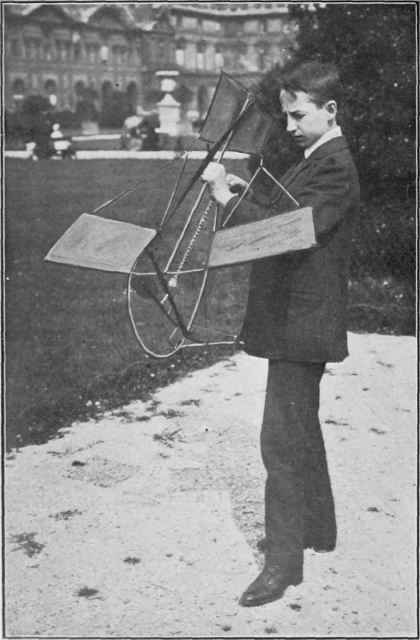
A monoplane flying machine ready for flight. (See page 438).
We already have numerous small models on the market which will fly after a good deal of experimenting, coaxing and alterations, but as a source of pleasure are absolutely out of reason with the young folks.
Small machines can be made by anyone familiar with the principle of flight, and having made several small aeroplanes, two of which were very successful, I will endeavor to explain how I made them, so that anyone interested can make a small aeroplane that will fly.
There are several successful types of aeroplanes, but for models or toys two have proved most satisfactory, the monoplane and the biplane. Although 1 made one triplane, which was fairly successful, I still think the monoplane or biplane more satisfactory. Which of the two is the better must be left to the option of the intending maker. As in the real flyers, both have their advocates, and both types are successful in flying. We have the re-cenl flight across the English Channel of Bleriot and the endurance trials of Latham for the monoplane, and the very successful demonstrations of the Wright brothers for the biplane, but, as a question of construction for the young beginner, I think the monoplane is the simpler and more easily made.
Personally, my first small real flyer was a monoplane: it was a very simple flyer and took but a few hours to make. To be sure, I bad to do a good deal of experimenting so as to make it fly in a given course, regardless of the direction of the wind. I had always been very fond of kite flying, and it was only the thought of being ridiculed that kept me away from kites. Now, here was a chance to try something new. I came to the conclusion that 1 could make a monoplane to use as a kite without much trouble.
I first procured a piece of straight-grained whitewood, 12 inches long and 1/4 inch square, smoothed it down until it was straight and true. To this stick I nailed two small blocks 1 inches long, 1 inch wide and 1/4 inch thick, to form the body of my aeroplane. (See Fig. 359.) Then I took some round 1/8-inch rattan, and after soaking it a short time in hot water to make it more pliable, I bent it to the shape of the main plane. The ends of the rattan, where they meet in the center, were fastened together by a small piece of very thin tin 1 1/2 inches long and 1/2 inch wide, rolled it into a sort of tube. The tube was slipped over the ends of the rattan and two pins were driven through the tin and rattan, fastening it to the body of the aeroplane.
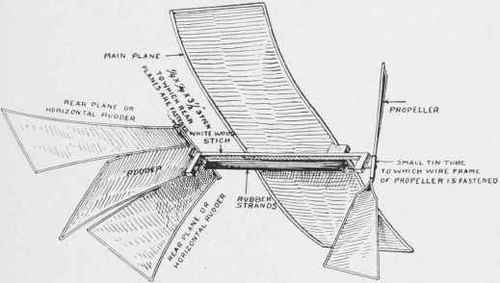
Fig. 359 - Details of the monoplane flying machine.
Over this rattan frame I spread white silk, cut very carefully to the proper size, allowing 3/16 inch for turning; it over the rattan, and sewed the silk on with a fine hemstitch. The rattan was very soft and still very damp, which would leave the silk in a wrinkled and drawn condition. To overcome this I squared my corners as nearly as the rattan would allow me and fastened the plane to a flat hoard with broad thumb tacks, leaving it to dry thoroughly. When it was perfectly dry, the few remaining wrinkles were ironed out and the plane was perfect.
Next, I secured some stiff wire, such as is used by milliners, bent it to the shape of the two horizontal and vertical rudders, and covered it with silk, allowing 1/8 lap. The silk was glued on with thin diluted fish glue. The vertical rudder was stiffened by covering it with a coat of diluted glue on both sides, then the whole was set aside to dry. The rudders were fastened at the rear of the areoplane, the two horizontal rudders to serve as rear planes and at the same time to control the up and down motion, and the vertical rudder to guide the motion left or right.
The aeroplane was now complete, and it took but a few trials to ascertain the proper place to fasten the string to make it soar like a kite. It would go up in the air without any difficulty, and remain steady, no matter how hard the wind blew. It made a very pretty effect when up in the air, giving no trouble, such as aw ordinary kite would, and when one gave a steady downward pull, as in winding up the cord, it would circle around, the circles growing smaller and smaller as the aeroplane came down to the ground.
To convert it into a power-driven machine, I bought some rubber strands, 1/16 inch square and about I yard long. A small hook was screwed into the block at the end of the body and a small hole through the block at the front.
The latter was faced with a piece of tin. A piece of wire forming a loop hook at one end was passed through the front block and formed the propeller shaft. The propeller was made like the rudder, of silk stitched over a wire frame. It was a two-bladed affair and was given three coats of glue, making it very stiff. The rubber strands were now fastened together at the ends and looped over the two hooks. The rubber was then twisted by turning the propeller in the opposite direction to that in which the propeller should turn to make the aeroplane go forward: then when the propeller was released, the rubber strands untwisted, making the propeller revolve in the right direction to force the aeroplane forward through the air.
The aeroplane was now a finished flyer, and for the first trial I twisted the rubber strands about 50 turns, released the propeller, and watched it fly away from me. Needless to say it almost smashed itself against the house, but after a few trials the proper adjustment for the rear planes and rudder was found, the toy flew easily from 100 to 150 feet in any direction, and at a height of about eight feet or more. By bending the rear planes up and down the elevation of the aeroplane could be varied, and the vertical rudder was used to make it go to the left or right.

Fig. 360 - A model monoplane flying machine.
If everything is made as described, and the main plane exactly centered on the body, the forward end slightly raised by a small block 1 inch long, and tapering from 1/2 inch high at the front end to 3/16 inch at the rear, fastened at a point near the front end of the body, there will be no need of a balancing weight to make the machine stay right side up.
Continue to:


My Books

