


How To Make Paper Flower Pots
Description
This section is from the book "Handy Man's Workshop And Laboratory", by A. Russell Bond. Also available from Amazon: Handy Man's Workshop And Laboratory.
How To Make Paper Flower Pots
All gardeners and florists, and especially the amateurs, find that the common burned-clay flower pots are at once heavy and fragile, and that much room is required when they are to be stored away. As substitutes many gardeners have used strawberry boxes and paper oyster pails, and have found them handier, especially for growing tomato or melon plants in hot beds and cold frames. Such things do well, but any gardener can make paper pots that will serve the purpose still belter. Common building paper, that can be purchased for a dollar a roll, is excellent. For three-inch pots cut it into pieces that are nine inches square; for four-inch pots, twelve inches square, and for five-inch pots, fifteen inches square. Each piece of paper is now to be folded, first along the solid lines (Fig. 306), dividing it into nine equal squares. The corner squares made are then pinched up into dog's ears and the whole piece is erected into the shape of a box with the dog's ears overlapping on opposite sides of the box. The ears are secured in place by means of ordinary clips and the box is done. A hole punched in the bottom will afford drainage. When ready for transplanting the clips are removed from the box which is then opened and the mass of earth and roots lifted out with no injury whatever to the plant.

Fig. 306 - How the paper is folded.
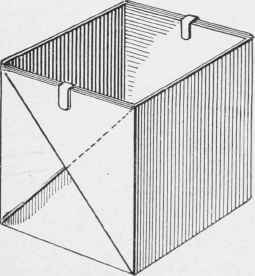
Fig. 307 - A paper flower pot.
Continue to:


My Books

