


How To Make A Cigar-Box Automobile
Description
This section is from the book "The Boy's Book Of Mechanical Models", by William Bushnell Stout. Also available from Amazon: The Boy's Book Of Mechanical Models.
How To Make A Cigar-Box Automobile
IT'S surprising how quick people were to take up the automobile as soon as somebody really got down to work at it. It was a long time ago, though, years before the use of railroads, that people first thought of it.
Way back at the beginning of the steam engine, when machinery was just coming into use, several men worked at a scheme for attaching a steam engine to a coach - all traveling was by coach in those days, you know - and they made some pretty good machines too. A man named Hancock, and some other companies too, had a line of steam coaches running from London out to the suburbs. They were big affairs and weighed tons, but they worked and went eight and even ten miles an hour. They had regular boilers and burned coal or wood and made a quantity of smoke and dirt. In the Kensington museum in London I saw some of the drawings of these huge machines made at the time, and they are funny to us now, though they were fine for then.
Things were just getting into shape, and companies were starting to develop the machine to make it really worth something, when parliament cut off its own head and killed this industry by passing a law putting such a big toll tax on the steam coaches that the industry was completely put out of business, and Hancock's and Gurney's steam carriages were good only for scrap iron and chicken coops. I saw too in that museum a little copy of Murdoch's model that he made to try out a scheme he had for driving a carriage on the road. He made only a small model about ten inches high and took it into the country just outside his village one night to try. It went so fast that he couldn't keep up, and the village parson, who happened to be in the way, was scared almost out of his senses.
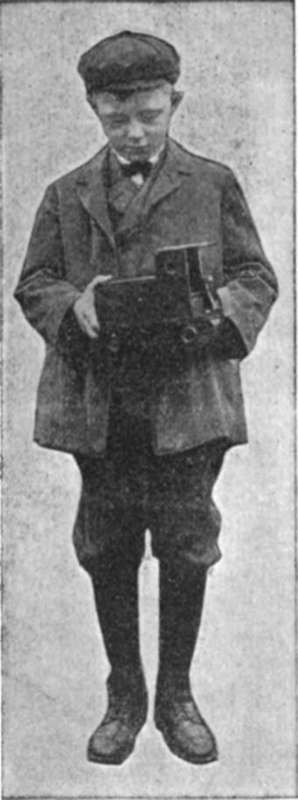
The little machine, spitting fire and smoke and steam, came hissing out of the darkness straight at him, and he - as you can imagine - took to his heels. When he stopped, back in the village, he told, breathless, how he had been chased by the devil.
After this toll law put a stop to making engines to run on roads, all the time was spent on locomotives, and there wasn't much done toward real autos until just a few years ago. None of us grown-ups have to think back very far to remember the first automobile we ever saw. Why, it is only since about '89 that any one has made automobiles in the United States, and my! what a fuss they had trying to find a name for them.
The first machines were for passengers only, but you know how many things the automobiles are used for now. The only thing we have anywhere near like those old ones is the road locomotive, as it is called, - something like the threshing-machine engines you see dragging their loads around the country, only stronger.
From these down to the little fire-spitting motorcycle there are all grades and kinds of autos,-the great sight-seeing car, driven, by gasoline or electricity, or both, and seating as many as fifty or a hundred people; enormous trucks carrying loads of many tons' weight; the large limousines and heavy touring cars which we see so often, - it seems as though there was no end to the attachments that may be added.
The racing cars are smaller in size than the automobiles that we see around town, but they are more powerful than any of the others. Then come the runabouts, and that nowadays may mean a high-powered machine as well as one of low power. In this class too come the delivery wagons, which are sometimes the same only with different bodies, and from this down there is only the little cycle car and the motorcycle, unless you count the toy machines sold in the shops and worked by the rider like a tricycle. The latest of these toys winds up with a spring and starts and stops with a foot pedal which, is operated by the boy rider.

Chassis And Driving Machinery
In Figure I is a toy model made of a cigar box. The frame is the size of the side of a cigar box and may be made of the same kind of wood, the pieces E and F being about a half or three quarters of an inch wide.
The shafts or axles a, running crosswise, may be of wood or wire passing through holes in the frame piece F with little twists of wire b between the wheels and frame to keep the wheels from rubbing.
The little back axle wheel A, if the axle is of wood, may be a piece of spool wedged on tightly. The wheel D, Figure 2 - the friction wheel - is of half-inch wood, but round of course, and fastened to a wire axle twisted around as you see in the drawings, running double through the center of the wheel D, after which one end is turned up as at I and fastened with a staple I to hold the wheel securely and firmly in position.


This construction may be clearly seen in Figure 2.
On the face of the wheel D is a piece of sand-paper, or rubber sheet d, to increase the friction between it and the small wheel A on the axle.
The wire shaft at the back of the wheel runs through a hole in the center of E, the back of the frame.
A crosspiece X, fastened in the position you see in Figure I and through which the twisted part of axle w passes, forms a second bearing in a hole or vertical slot.
At the front of the frame is the wire crank C with its hook, between which and the wire shaft w at the rear the rubber bands R are fastened, and you can see too how the brad n is fixed to keep the crank from turning backward.
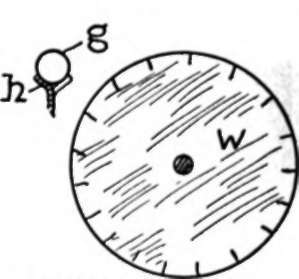
If you want to make rubber-tired wheels and can use a soldering iron to solder on wire axles, you can make your wheels of tin, like Figure 6, cutting little slots all around the edge and then bending the flaps so formed first one way and then the other, as at b, after which you can slip on a rubber teething ring g for the tire, or a bunch of rubber binders, the wheel having been, or' course, cut out to the proper size.

Fastening Body to chassis
Fig.4.
The wire axle will be soldered through the hole in the center.
In Figure 3 is a runabout body cut from a cigar box set on edge,-with keyhole or fret saw. It won't take the whole height of the box, and after you have sawed out the shape the seat and the top of the hood are made out of the pieces left. The seat should be a little longer than the box part B is wide.
Figure 4 shows you how to fasten the body to the "chassis" by a strip of tin t, and this needs no explanation, for you easily can see how it is done.
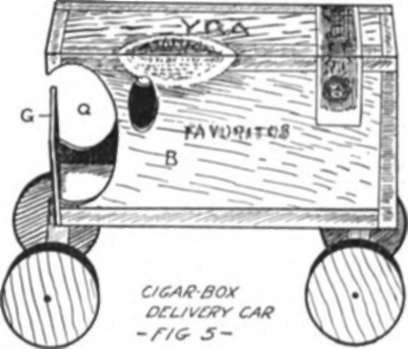
In Figure 5 is shown the delivery wagon.
Rubber tired wheels
Fig.6.
The cigar box is made into a delivery wagon by cutting out the oval windows and the curves at the front of the box, leaving on the part G for a dashboard. The wheels are of quarter-inch wood with flat rubber bands stretched around the rims for tires.

Figure 7 shows another type of delivery body which is easy to copy from the drawing. The wheels are of cardboard with cork hubs.

Figure 8 shows the hardest kind of body, a limousine, and this one is set right down onto the chassis without any tin between. It is the hardest one to cut out with the windows and all, but when done makes the prettiest model. The only extra attachments are the pieces supporting the roof in front. The lines on this body are merely for looks and do not indicate a real door or divisions.
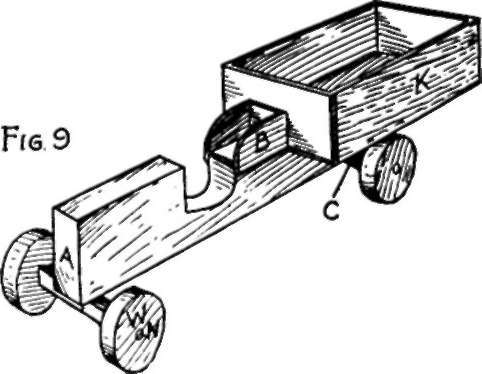
The drawing Figure 9 is of a real London Lorry, or truck. You can see from the drawings how the toy truck is made, and in Figure 10 are given the patterns for making the toy. You can trace off the patterns onto inch wood and cut them out with a keyhole saw or knife.
The body A is of inch wood cut as shown, and has a hinge behind at H.
To the back part a cigar box K is fastened to the hinge H so it can tip, only the greater part of the box must be forward of the hinge.

The axles C are of wood, squared off to fit the notches N at the ends of A.
They are fastened crosswise as shown, and the wheels, which are also of inch wood, - or can be carpet-sweeper wheels, - are pivoted at the ends by a nail or screw.

The seat sides are fastened at S and are patterned at B. The size of the hind wheels is given at W. The front wheels can be a trifle smaller.
The small sketch Figure II shows a side view of the completed auto lorry and shows also how a roof awning can be added if desired.
Continue to:


My Books

